Description
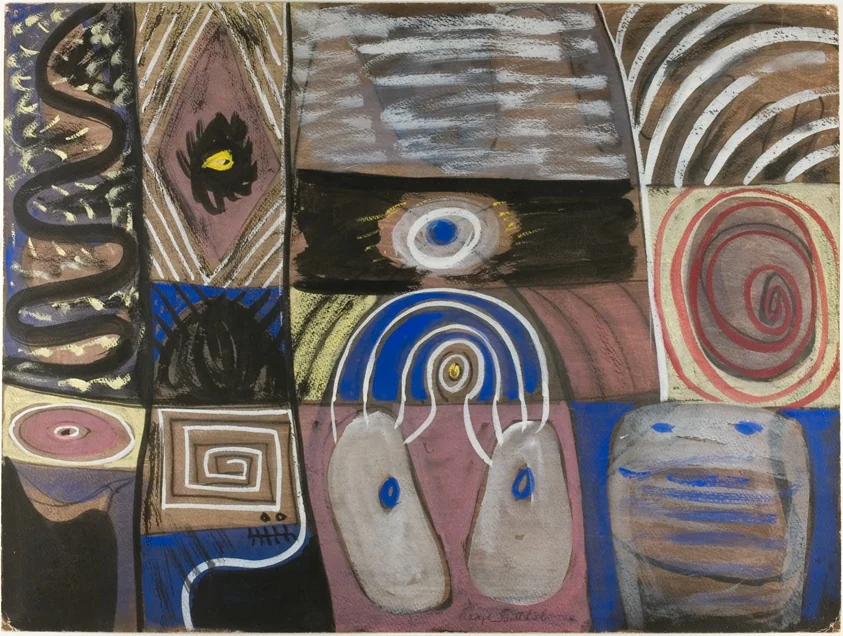
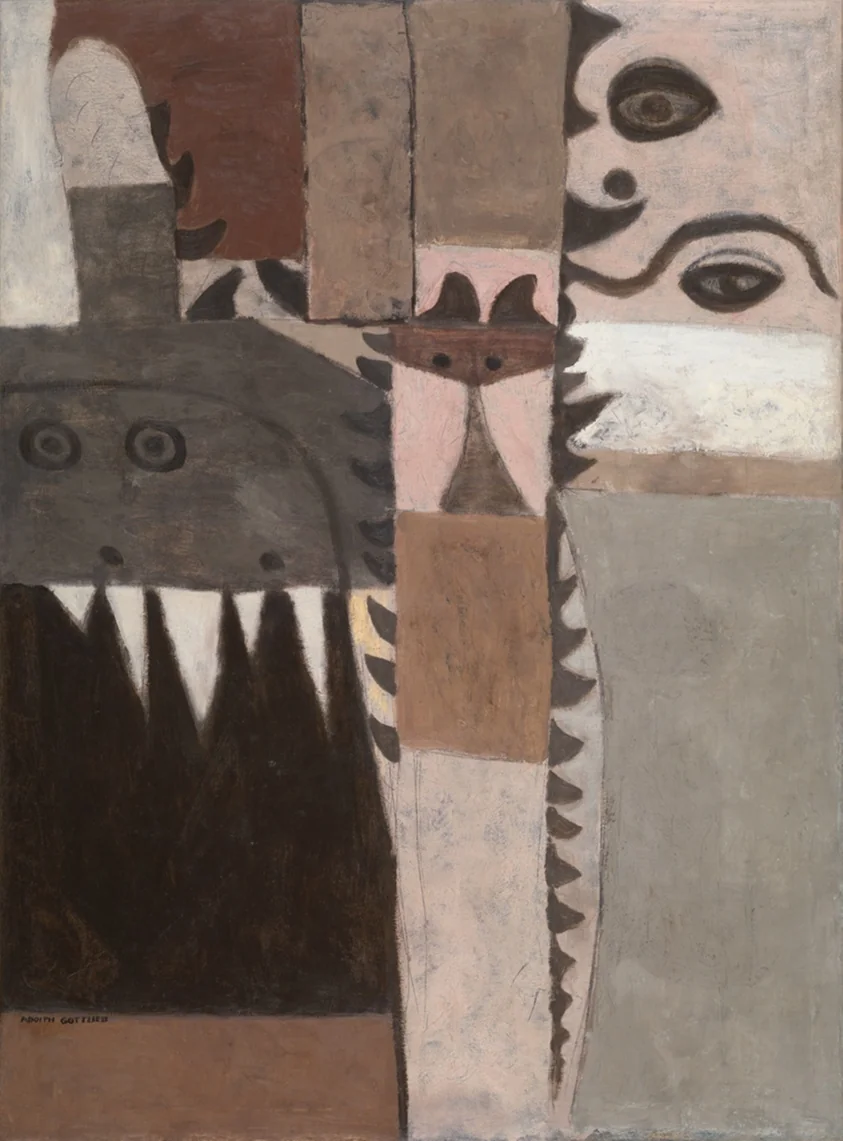
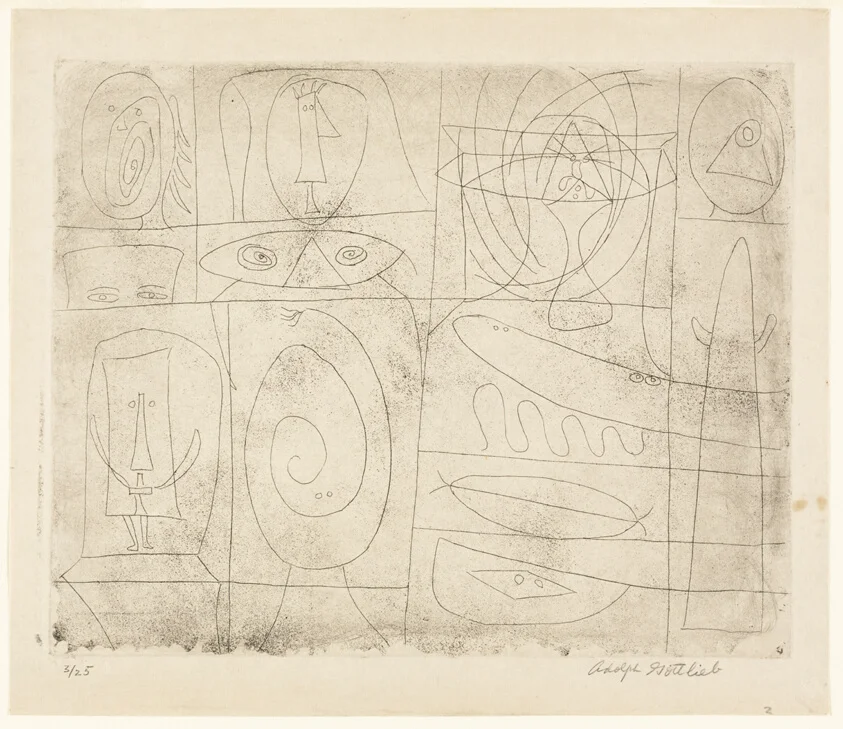
In 1941 Adolph Gottlieb began a series of paintings, prints, and drawings that he called Pictographs. These represent the artist’s first efforts at reconciling elements of abstraction with an exploration of the unconscious drawn from Surrealism. His aim was to create a new, uniquely American expression that would bring significant content to abstraction. The ideas Gottlieb explored in his Pictographs were so varied and complex that the series occupied him for more than 10 years. This print was created in the course of Gottlieb’s intensive exploration of the theme.
Accession Number
102156
Medium
Etching on tan wove paper
Dimensions
Plate: 20.2 × 25.1 cm (8 × 9 15/16 in.); sheet: 23.9 × 27.7 cm (9 7/16 × 10 15/16 in.)
Classification
etching
Credit Line
Joseph Brooks Fair Memorial Collection
Background & Context
Background Story
Adolph Gottlieb created his Pictograph series during the early 1940s as a radical departure from conventional painting, developing a grid-based format in which symbolic images occupy individual compartments rather than conforming to traditional compositional logic. This etching from around 1944 translates that pictographic structure into print, with cryptic forms—an eye, a hand, geometric shapes, organic contours—arranged in loosely defined cells that suggest a personal hieroglyphic language. Gottlieb had been deeply influenced by his study of non-Western art, particularly African sculpture, Oceanic masks, and Native American pictographs, all of which employed reductive symbolic imagery to communicate complex ideas. The Pictograph works emerged alongside the Surrealist emphasis on automatism and the unconscious, but Gottlieb's symbols are not simply random—they carry the weight of archetypal forms that resonate across cultures. The etching medium lends the composition a graphic precision and archaic quality, as though the image were an artifact from a lost civilization rather than a mid-20th-century print.
Cultural Impact
Gottlieb's Pictograph series was instrumental in establishing a uniquely American path to abstraction that was symbolic rather than purely formal. The series demonstrated that abstract art could communicate meaning through culturally resonant symbols rather than purely aesthetic arrangements, influencing the development of myth-based abstraction in postwar American painting.
Why It Matters
A key etching from Gottlieb's Pictograph series that established symbol-based abstraction as an American alternative to European formalism, drawing on cross-cultural archetypes to create a universal visual language.