


Curated Museum Collections
artory
An art story for every artwork — from the world's greatest museums, with context, provenance, and the lives behind the brush.
Feature Story
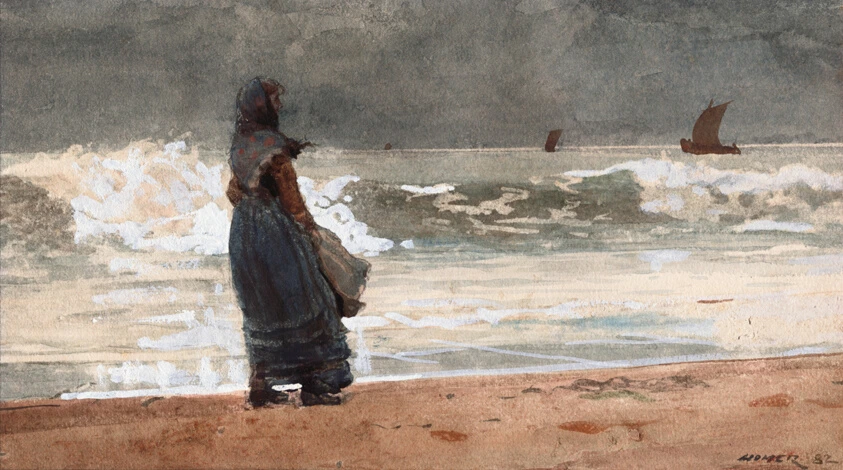
“During his sojourn in England, from 1881 to 1882, Homer settled in the small fishing village of Cullercoats, located about two miles from the city of Tynemouth.”
During his sojourn in England, from 1881 to 1882, Homer settled in the small fishing village of Cullercoats, located about two miles from the city of Tynemouth. He often drew and painted the women of the village, as they watched and waited on the shore, eyes always trained on the frequently treacherous sea. The Watcher, Tynemouth emphasizes the woman's loneliness and anxiety as she faces the raw forces of nature. Homer chose to represent the woman with her back to the viewer. She is clad in dark blue and reddish-brown clothing, and her face is obscured by a headscarf, so as to shield her from probing eyes. The muted palette of this watercolor—overcast blue-gray sky, murky green and blue waves—exaggerates the stark whiteness of the foamy caps on the waves. Their peaks punctuate the horizon line, as do the sails of the two boats in the distance.
Explore
Curated Collections
Artworks organized by movement, subject, and theme — from Impressionism to Hidden Gems, discover stories behind every piece.
Browse CollectionsJourney Through Time
Travel across centuries of art history — from ancient civilizations to modern masterpieces, each era tells its own story.
Explore TimelineImpressionism
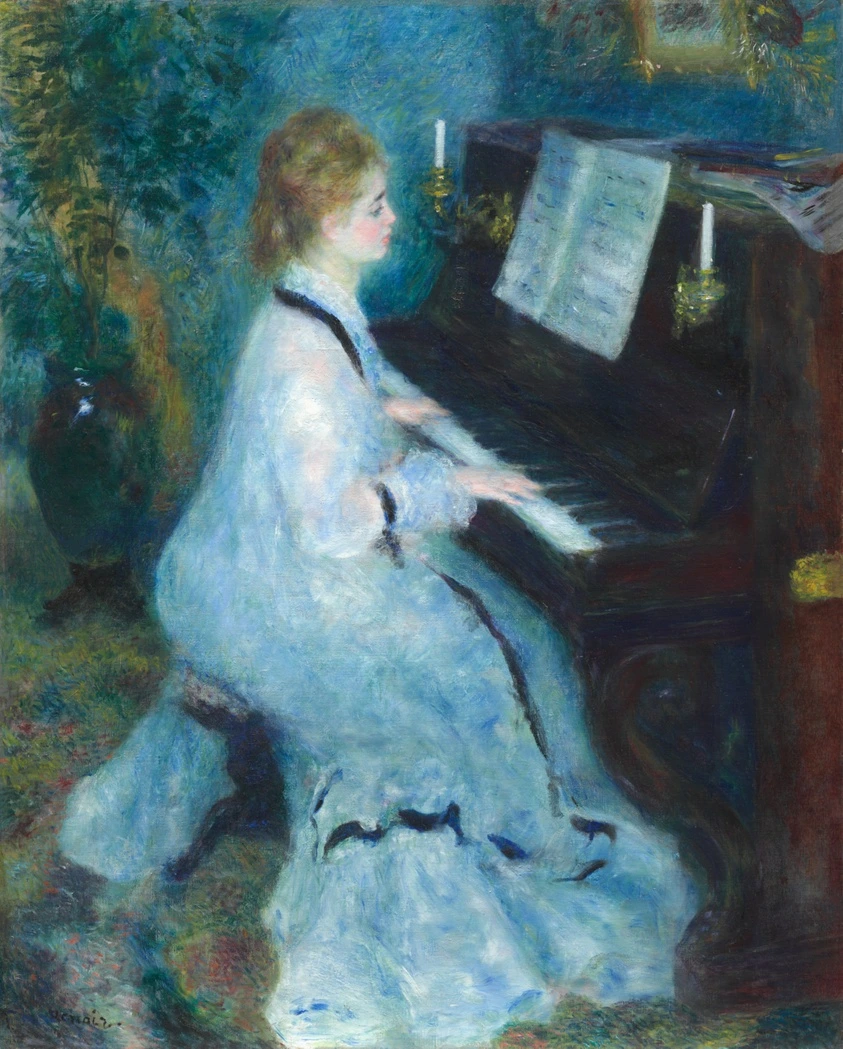
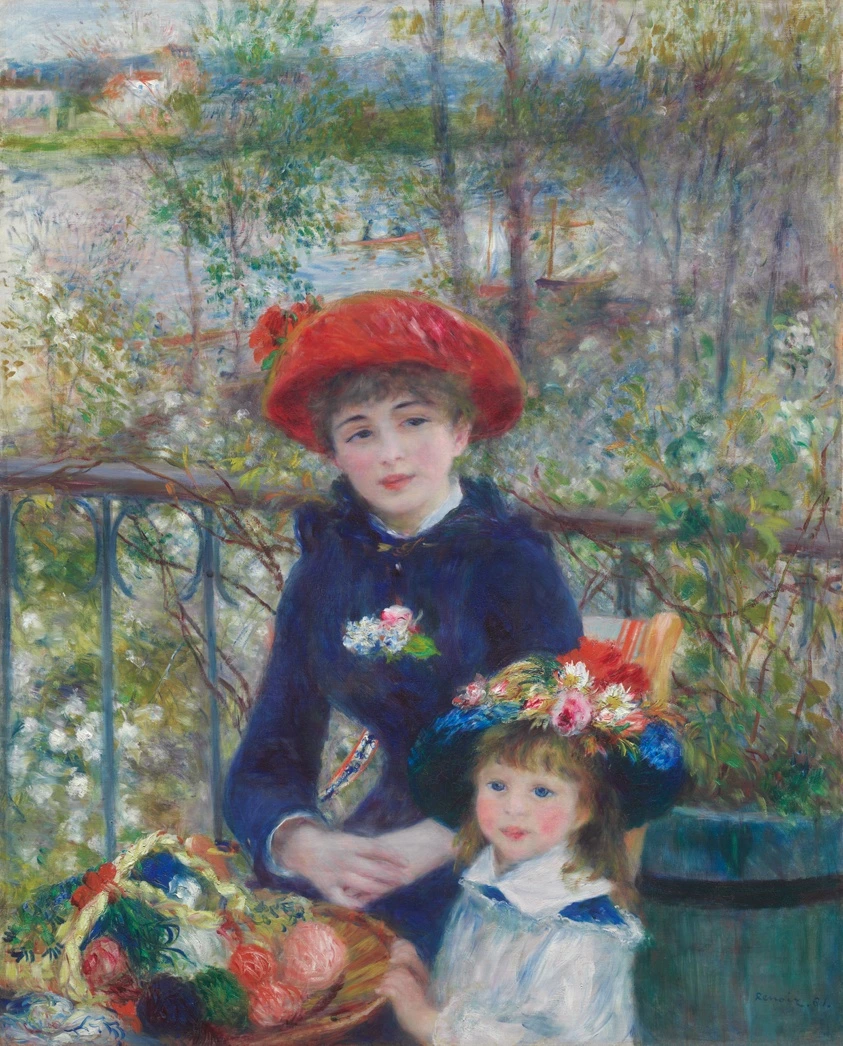
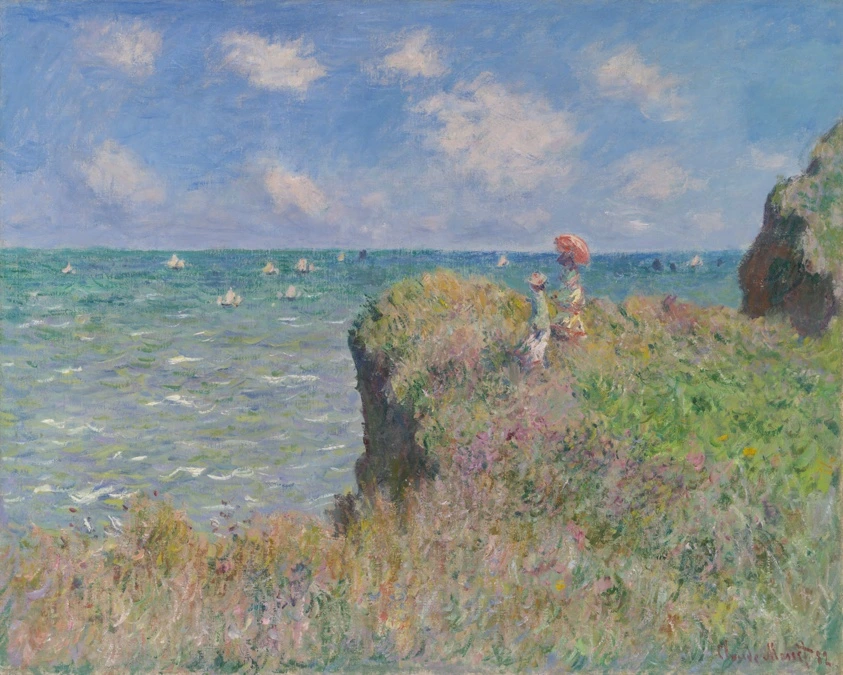
Originating in 19th-century France, capturing fleeting light and visual impressions. Led by Monet, Renoir, and Pissarro.
Masterpieces
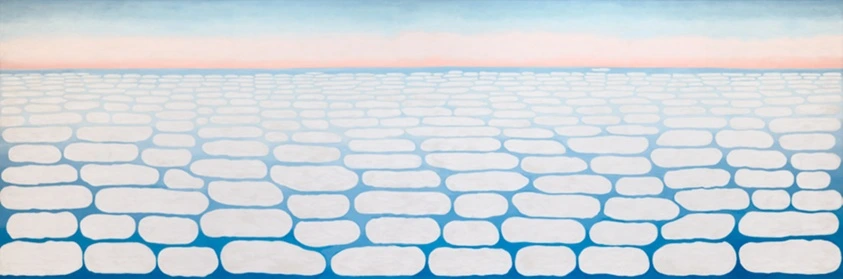
The pinnacle of human artistic achievement across eras and movements.
Hidden Gems
Underrated masterpieces waiting to be discovered.
Meet the Masters

Zhou Wenju
942–961
Chinese
Zhou Wenju (Chinese: 周文矩) (fl. 942–961), also known as Chou Wen-chu, was a Chinese painter during the Five Dynasties and Ten Kingdoms period (907–960). His exact birth and death dates are not known. Zhou was born in Jurong, and specialized in figure painting. He worked as a painter in attendance at the Painting Academy of the Southern Tang court. It is recorded that Zhou participated in executing a joint work at the banquet held by Emperor Yuanzong of Southern Tang on New Year's Day, 947. A follower of Zhou Fang in the Tang. Quite a few paintings are attributed to him, but none with much evidence. Most works attributed to him are later copies or misattributions. Four scroll monochrome copies before 1140 are a little plausible, one of which is in the Metropolitan Museum of Art.

Zheng Xie
1693–1765
Chinese
Zheng Xie (Chinese: 鄭燮; pinyin: Zhèng Xiè), courtesy name Kerou (克柔), art name Banqiao (板橋) or Banqiao Daoren (板橋道人), commonly known as Zheng Banqiao (鄭板橋), was a Chinese official, painter and calligrapher of the Qing dynasty. He began life in poverty, but rose in the imperial examination system to become a magistrate in Shandong. However, after 12 years, he became critical of the life of an official as he refused to ingratiate himself with senior officials. When he was reportedly criticized for building a shelter for the poor, he resigned. After that, he expressed himself in art and became one of the Eight Eccentrics of Yangzhou. He was noted for his drawing of orchids, bamboo, and stones. In 1748 he briefly resumed an official career as "official calligrapher and painter" for the Qianlong Emperor. Zheng was also a calligrapher who created a new calligraphy style influenced by his orchid drawings. Added to this, he had an interest in literature and poetry. He preferred to write about ordinary people in a natural style.

Zhao Mengfu
1254–1322
Chinese
Zhao Mengfu (Chinese: 趙孟頫; pinyin: Zhào Mèngfǔ; Wade–Giles: Chao Meng-fu; courtesy name Zi'ang (子昂); pseudonyms Songxue (松雪, "Pine Snow"), Oubo (鷗波, "Gull Waves"), and Shuijing-gong Dao-ren (水精宮道人, "Master of the Water Spirits Palace"); 1254–1322), was a Chinese calligrapher, painter, and scholar during the Yuan dynasty. He was a descendant of the Song dynasty's imperial family through Emperor Xiaozong's brother Zhao Bogui who married a lady surnamed Song who was the granddaughter of Emperor Huizong. Zhao Bogui was a descendant of Emperor Taizu, through his son Zhao Defang. He was recommended by the Censor-in-chief Cheng Jufu to pay an audience with Kublai Khan in 1286 at the Yuan capital of Dadu, but was not awarded an important position in office. His work was however, greatly appreciated later by the Confucian-inspired Yuan Emperor Renzong. Zhao was a member of the "Academy of Worthies". He was married to Guan Daosheng, who was also an accomplished poet, painter and calligrapher. His rejection of the refined, gentle brushwork of his era in favour of the cruder style of the eighth century is considered to have brought about a revolution that created the modern Chinese landscape painting...

Zhang Ruoai
1713–1746
Chinese
Zhang Tingyu (Chinese: 張廷玉; pinyin: Zhāng Tíngyù; Wade–Giles: Chang T'ingyü, October 29, 1672 – May 19, 1755) was a Han Chinese politician and historian who lived in the Qing dynasty.

Zha Shibiao
1615–1698
Chinese
Zha Shibiao or Cha Shih-piao (Chinese: 查士标; 1615 – 1698) was a Chinese calligrapher and landscape painter from Anhui. He was affiliated with the Anhui School, also known as the Xin'an School, which is noted for dry brushstrokes and sparse compositions. His family, and himself, were art collectors and Ming dynasty aristocrats. He had studied for the civil service exam under the Ming and received the xiucai degree in his twenties. However he abandoned any attempt at an official career after the Manchu conquest. Subsequent to the 1670s he moved, or fled, depending on the source, to Yangzhou. As a calligrapher he was influenced by Dong Qichang and Mi Fu. His landscapes were more influenced by Hong Ren and Ni Zan. His later works are considered to have had a more moist and expressive feel than those of Hong Ren. As a person he was said to be easy-going, but slightly reclusive. He also had a fondness for drink, indulging into the late hours.

Yun Shouping
1633–1690
Chinese
Yun Shouping (Chinese: 惲壽平; 1633 – 1690), also known as Nantian (Chinese: 南田), was a Chinese calligrapher and painter. He was a major artist of the early Chinese Qing dynasty. Along with the Four Wangs and Wú Lì, he was regarded as one of the "Six Masters" of the Qing period.

Yosa Buson
1716–1783
Japanese
Yosa (no) Buson (与謝 蕪村; Japanese pronunciation: [joꜜ.sa | bɯꜜ.soɴ]) was a Japanese poet and painter of the Edo period. He lived from 1716 – January 17, 1784. Along with Matsuo Bashō and Kobayashi Issa, Buson is considered among the greatest poets of the Edo Period. He is also known for completing haiga as a style of art, working with haibun prose, and experimenting with a mixed Chinese-Japanese style of poetry.

Yanagawa Shigenobu
1787–1832
Japanese
Yanagawa Shigenobu (柳川 重信; 1787–1832) was a Japanese artist in the ukiyo-e style.

Xie Shichen
Chinese
Xiè Shíchén (Hsieh Shih-ch'en, traditional: 謝時臣, simplified: 谢时臣); ca. (1488-unknown) was a Chinese landscape painter during the Ming dynasty (1368–1644). His specific date of death is not known. Xie was born in Suzhou in the Jiangsu province. His style name was 'Sizhong' and his sobriquet was 'Chuxian'. Xie's landscapes followed the style of Guo Xi and Shen Zhou.

Xia Gui
1209–1243
Chinese
Xia Gui (Chinese: 夏珪; Wade–Giles: Hsia Kui; fl. 1195–1224), courtesy name Yuyu (禹玉), was a Chinese landscape painter of the Song dynasty. Very little is known about his life, and only a few of his works survive, but he is generally considered one of China's greatest artists. He continued the tradition of Li Tang, further simplifying the earlier Song style to achieve a more immediate, striking effect. Together with Ma Yuan, he founded the so-called Ma-Xia (馬夏) school, one of the most important of the period. Although Xia was popular during his lifetime, his reputation suffered after his death, together with that of all Southern Song academy painters. Nevertheless, a few artists, including the Japanese master Sesshū, continued Xia's tradition for hundreds of years, until the early 17th century.
Start Your Art Journey
Explore thousands of masterpieces from the world's finest museums — each with a story waiting to be discovered.