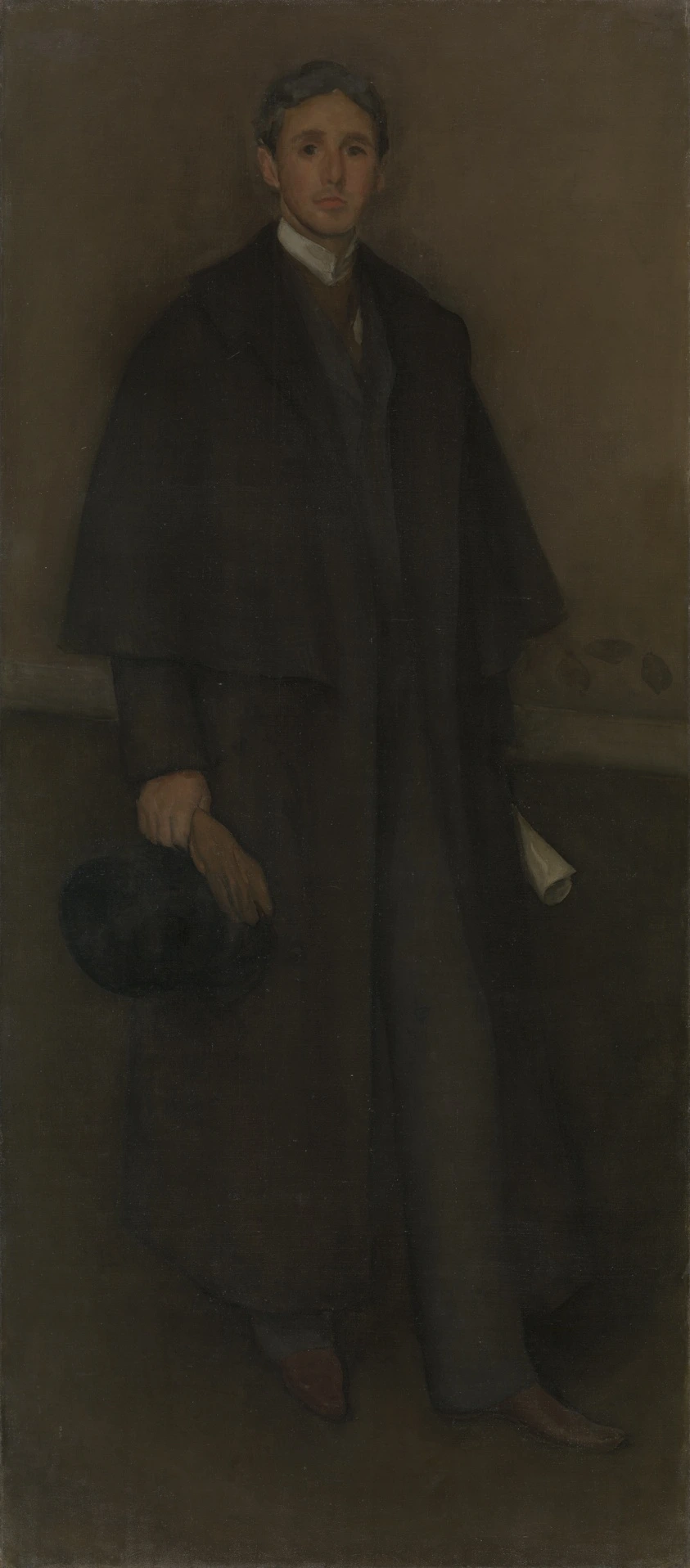
Arrangement in Flesh Color and Brown: Portrait of Arthur Jerome Eddy

Description

James McNeill Whistler created thinly painted compositions with flat, nearly abstract passages, purposefully subtle in character. He called works such as this one an “arrangement,” emphasizing formal elements rather than subject matter. The painting still serves as a portrait—it was commissioned by Chicago attorney Arthur Jerome Eddy, a collector and advocate of modern art. After seeing Whistler’s work at the 1893 World’s Columbian Exposition in the city, Eddy traveled to the artist’s studio in Paris expressly to sit for this portrait. The two became lasting friends, and Eddy published a book on Whistler after the artist’s death in 1903.

Provenance

Commissioned by Arthur Jerome Eddy (1859–1920), Chicago, 1894; by descent to his wife, Lucy “Lulu” Crapo Orrell Eddy (1863–1931), and son, Jerome Orrell Eddy (1891–1951), Chicago, 1920; given to the Art Institute of Chicago, 1931.

Arrangement in Flesh Color and Brown: Portrait of Arthur Jerome Eddy

James McNeill Whistler

1894

Accession Number

8958

Medium

Oil on canvas

Dimensions

210.7 × 93.3 cm (82 15/16 × 36 3/4 in.)

Classification

Painting

Museum

The Art Institute of Chicago

Chicago, United States

Credit Line

Arthur Jerome Eddy Memorial Collection
Background & Context

Background Story

Painted in 1894, this portrait of the Chicago lawyer and collector Arthur Jerome Eddy is one of the largest and most imposing of Whistler's late society portraits, a canvas over two meters high that presents the sitter as a vertical presence against a field of muted brown and flesh tones. The title—"Arrangement in Flesh Color and Brown"—asserts Whistler's belief that the portrait was primarily a color composition and only secondarily a likeness, a theory that had antagonized critics since the 1870s but was by now accepted by advanced collectors like Eddy. The sitter himself was an important figure in American cultural history: his 1895 lecture "Two Thousand Years of Art" helped introduce Impressionism to a Chicago public that had previously known only academic European painting. Whistler's rendering of Eddy is severe and hieratic, the elongated figure wrapped in a dark coat that falls in vertical folds, the face emerging from shadow with the pallor and precision of a Byzantine icon. The palette is extraordinarily restricted—warm browns, cool grays, and the pink of living flesh against the dead tones of the background—demonstrating Whistler's commitment to color harmony over descriptive accuracy. The scale was unusual for Whistler at this late date; most of his portraits from the 1890s were smaller, more intimate works, and the grandeur of this canvas suggests that Eddy commissioned it as a public statement of his cultural authority. The painting influenced American portraiture of the Gilded Age, particularly the society portraits of William Merritt Chase and Robert Henri, who admired Whistler's ability to make the wealthy appear both formidable and remote.

Cultural Impact

This monumental portrait fused Whistler's color-theory aesthetics with Gilded Age American ambition, influencing a generation of American society painters who sought to make wealth look dignified.

Why It Matters

It matters because a Chicago lawyer became a brown-and-pink monument—Whistler proving that Americans could look as mysterious as Europeans if the palette was right.