Description
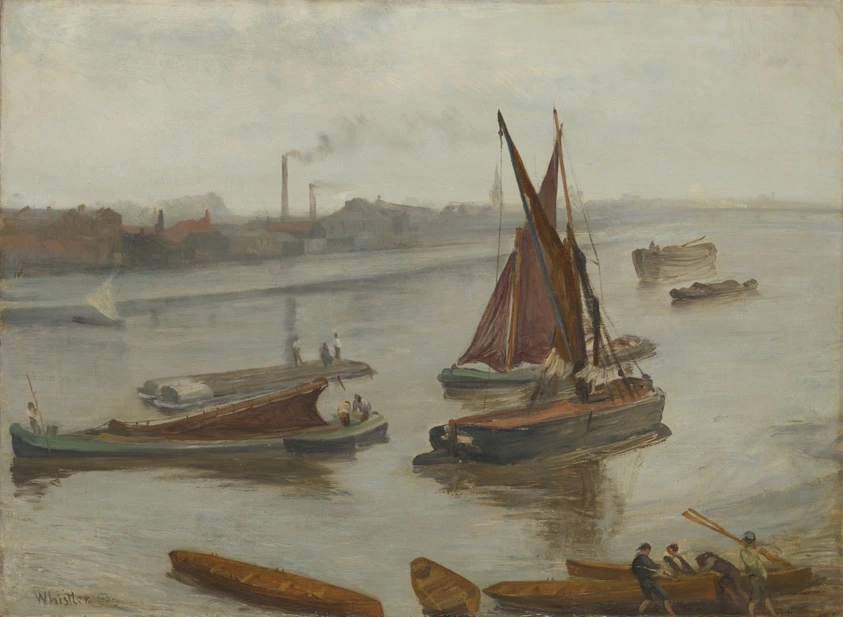
James McNeill Whistler painted marine scenes throughout his career, including this depiction of the Thames River, which was a frequent subject in Whistler’s work when he lived in London. Here, he focused on the river’s industrial elements: boats and barges, laboring men, and smoking chimneys. Whistler unified the composition with deft brushwork and a subtle palette of brown and gray that anticipated his later interest in delicate tonal harmonies. The painting’s bold realism and thickly painted surface were inspired by French artist Gustave Courbet, whose work Whistler encountered during his stays in Paris in the mid-1850s and 1860s.
Provenance
The artist, from 1863 to about 1889; sold to Mrs. Aglaia Coronio (born Ionides, 1834–1906), London, from about 1889 to 1892 [according to letter from James McNeill Whistler to Aglaia Coronio, undated (December 1888?), GUW 07900, note 3; letter from James McNeill Whistler to Aglaia Coronio, undated (1889?), GUW 00693, note 3; letter from Aglaia Coronio to James McNeill Whistler, undated (1889?), GUW 11034, note 4; letter from James McNeill Whistler to Aglaia Coronio, dated June 2 (1889), GUW 00691, note 3]; consigned to Boussod, Valadon & Co., Paris, by May 30, 1892; sold to Mrs. Potter Palmer (Bertha Palmer, born Honoré, 1849–1918), Chicago, May 30, 1892, for £450 [Goupil & Cie / Boussod, Valadon & Co. Stock Books, Livre no. 13, 1891–1895, p. 97, no. 22337, as Old Battersea Chelsea, Special Collections, Getty Research Institute, copy in curatorial object file; letter from Boussod, Valadon and Co. to James McNeill Whistler, dated May 28, 1892, GUW 05742]; by descent to her sons, Honoré Palmer (1874–1964) and Potter Palmer II (1875–1943), 1918; given to the Art Institute of Chicago, 1922.
Accession Number
81574
Medium
Oil on canvas
Dimensions
50.8 × 68.6 cm (20 × 27 in.)
Classification
Painting
Credit Line
Gift of Honoré and Potter Palmer
Background & Context
Background Story
"Grey and Silver: Old Battersea Reach" is one of the earliest and most radical of Whistler's Thames nocturnes, painted in 1863 when the artist was still living on the river's south bank and exploring the tonal harmonies that would define his mature style. The canvas shows a view across the river toward Chelsea, with the water occupying the lower half and a pale, misty sky above; between them, the distant shore appears as a dark band punctuated by faint lights. The palette is restricted to gray, silver, and black, with the barest suggestion of warm tones where the setting sun penetrates the London haze. This tonal austerity was unprecedented in British landscape painting: Constable had used gray skies, but always as a prelude to luminous clarity; Whistler embraced the gray as an end in itself, a subject worthy of sustained contemplation. The composition anticipates the abstract landscapes of the twentieth century, particularly the muted canvases of Rothko and de Stael, by decades. The title's musical analogy—"Grey and Silver" as a tonal chord rather than a topographical description—signals Whistler's ambition to align painting with music, an idea that would become central to fin de siècle aesthetic theory. The painting also documents a vanishing London: the Battersea riverfront in 1863 was still dominated by boatyards and wharves, before the industrial expansion of the later nineteenth century transformed the Thames into a corridor of factories and warehouses. Whistler's image preserves a quieter, more atmospheric river, human activity visible only as distant lights and occasional hulls emerging from the mist.
Cultural Impact
This early Nocturne anticipated abstract tonal painting by half a century, preserving a vanished Thames while establishing color-as-music as a foundational modernist theory.
Why It Matters
It matters because Whistler looked at fog on a river and saw music—making London's gray into a chord that would echo through Rothko.