Provenance
The artist, Sedona, AZ; Julien Levy (1906-1981), New York and later Bridgeport, CT, by April 24, 1944 [New York 1944]; by descent to his wife, Jean Farley Levy (1912-2003), 1981; given to the Art Institute of Chicago, 1983.
Accession Number
101518
Medium
Oil on canvas
Dimensions
28 × 43.2 cm (11 × 17 in.)
Classification
Painting
Credit Line
Gift of Mrs. Julien Levy
Background & Context
Background Story
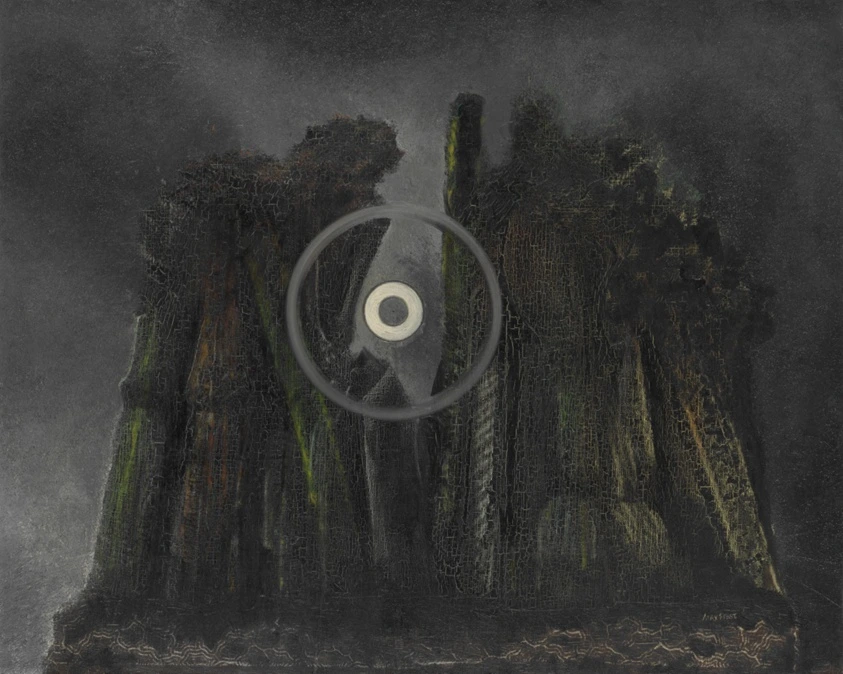
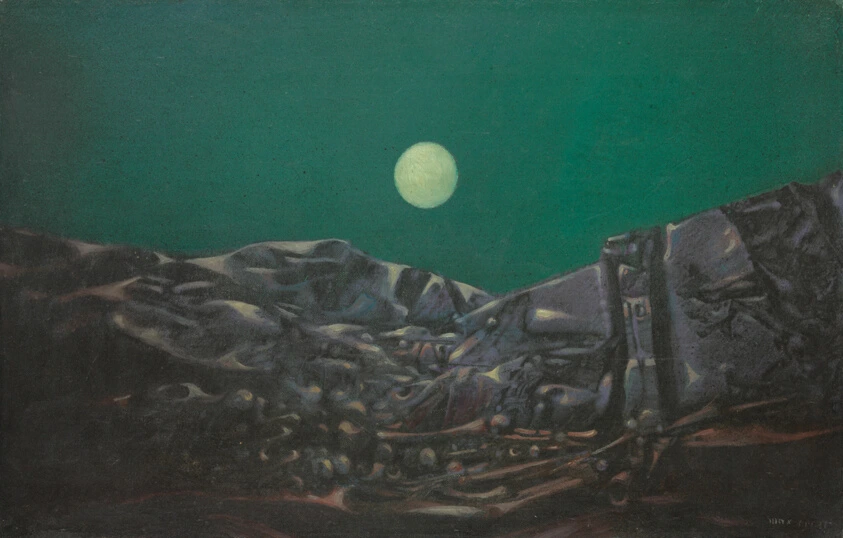
"Summer Night in Arizona" is a 1944 oil on canvas by Max Ernst that captures the German Surrealist in one of his most hauntingly atmospheric and technically experimental works from his American exile period, the image showing a desert landscape rendered with the same hallucinatory clarity and psychological depth that made Ernst the defining master of Surrealist painting. The composition is a small canvas—28 × 43.2 centimeters—showing a summer night in the Arizona desert with the oil on canvas creating a surface of extraordinary atmospheric density and dreamlike suggestion. The small scale enhances the sense of intimate nightmare and private vision, the painting suggesting both the physical reality of the desert landscape and the psychological landscape of the European exile. The 1944 date places this work in the period of Ernst's residence in Sedona, Arizona, when he was producing the paintings that documented his encounter with the American Southwest and established his reputation as a master of the landscape of the unconscious. Art historians have connected this painting to the broader tradition of the desert landscape in modern art, from the paintings of O'Keeffe to the photographs of the period, noting that Ernst's treatment is more focused on the hallucinatory effect and the psychological suggestion, the transformation of observed landscape into dreamlike vision, than the topographical accuracy or the naturalistic observation of these other traditions.
Cultural Impact
This 1944 oil canvas made Arizona desert hauntingly dreamlike through small 28cm atmospheric density and intimate private-nightmare suggestion, using Sedona exile-period Southwest encounter to transform observed landscape into unconscious hallucinatory vision beyond O'Keeffe topographical naturalistic observation.
Why It Matters
It matters because Ernst painted a desert night and made the canvas feel like it was whispering secrets from another world—proving that even a landscape could be a dream if the oil was dark enough.