Accession Number
1943.3.2749
Medium
color drypoint and aquatint
Dimensions
plate: 29.8 x 24.1 cm (11 3/4 x 9 1/2 in.) | sheet: 47.2 x 29.4 cm (18 9/16 x 11 9/16 in.)
Classification
Credit Line
Rosenwald Collection
Tags
Print Impressionist & Modern (1851–1900) American
Background & Context
Background Story
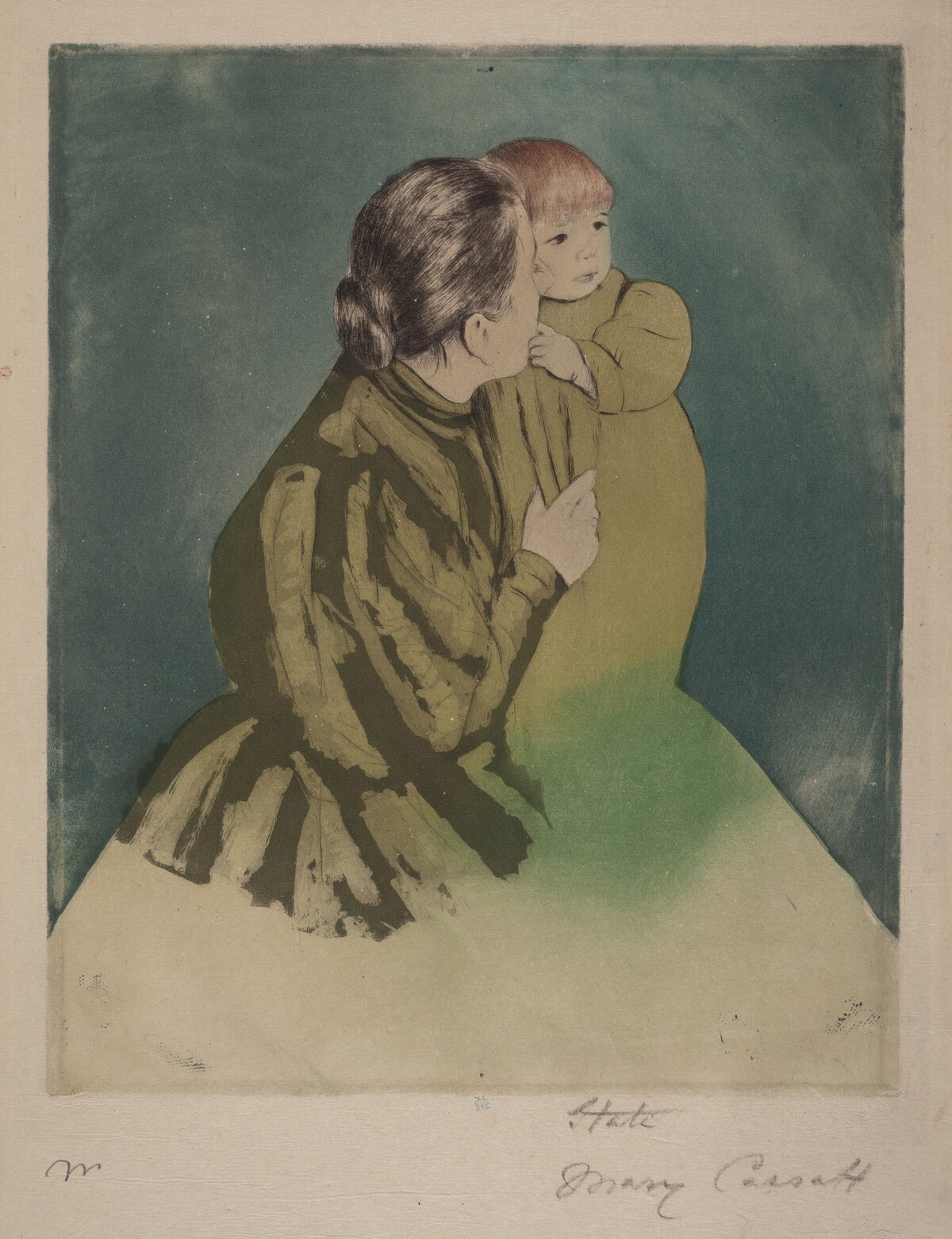
Peasant Mother and Child (c. 1894) applies Cassatt's signature mother-and-child subject to a rural working-class context, distinguishing this work from the more familiar bourgeois treatments of the same theme. The peasant mother—working class, rural, and likely poor—represents the maternal bond in its most universal form, stripped of the bourgeois interior's comforts and conventions. Cassatt's choice to depict a peasant rather than a bourgeois mother reflects her democratic artistic convictions and her interest in representing maternity across class boundaries. The 1894 date places this during Cassatt's later period, when her style had become increasingly graphic and simplified—partly under the influence of Japanese prints and partly through her own artistic development toward bolder, more economical compositions. The peasant setting provides a different visual context from Cassatt's usual domestic interiors: the mother and child exist within a working landscape rather than a comfortable parlor, and their relationship is defined by practical necessity as well as emotional attachment. Cassatt's treatment of the peasant mother—less idealized than her bourgeois mothers, more specifically physical in its rendering of the maternal body—demonstrates her ability to adapt her signature subject to different social contexts without losing its essential emotional power.
Cultural Impact
Cassatt's peasant mother and child paintings influenced how maternal subjects were represented across class boundaries, challenging the assumption that mother-and-child painting was a bourgeois genre. The paintings influenced later social realist painters who similarly depicted maternal bonds in working-class contexts. The subject also influenced how class differences in maternal experience were understood, connecting emotional bonds to material conditions.
Why It Matters
This painting matters because it demonstrates that the maternal bond—which Cassatt made her central subject—exists across all social classes and is not defined by material comfort or social position. The peasant mother and child represent maternity in its most essential form, arguing that the emotional core of the mother-and-child relationship transcends the material circumstances in which it occurs.