Provenance
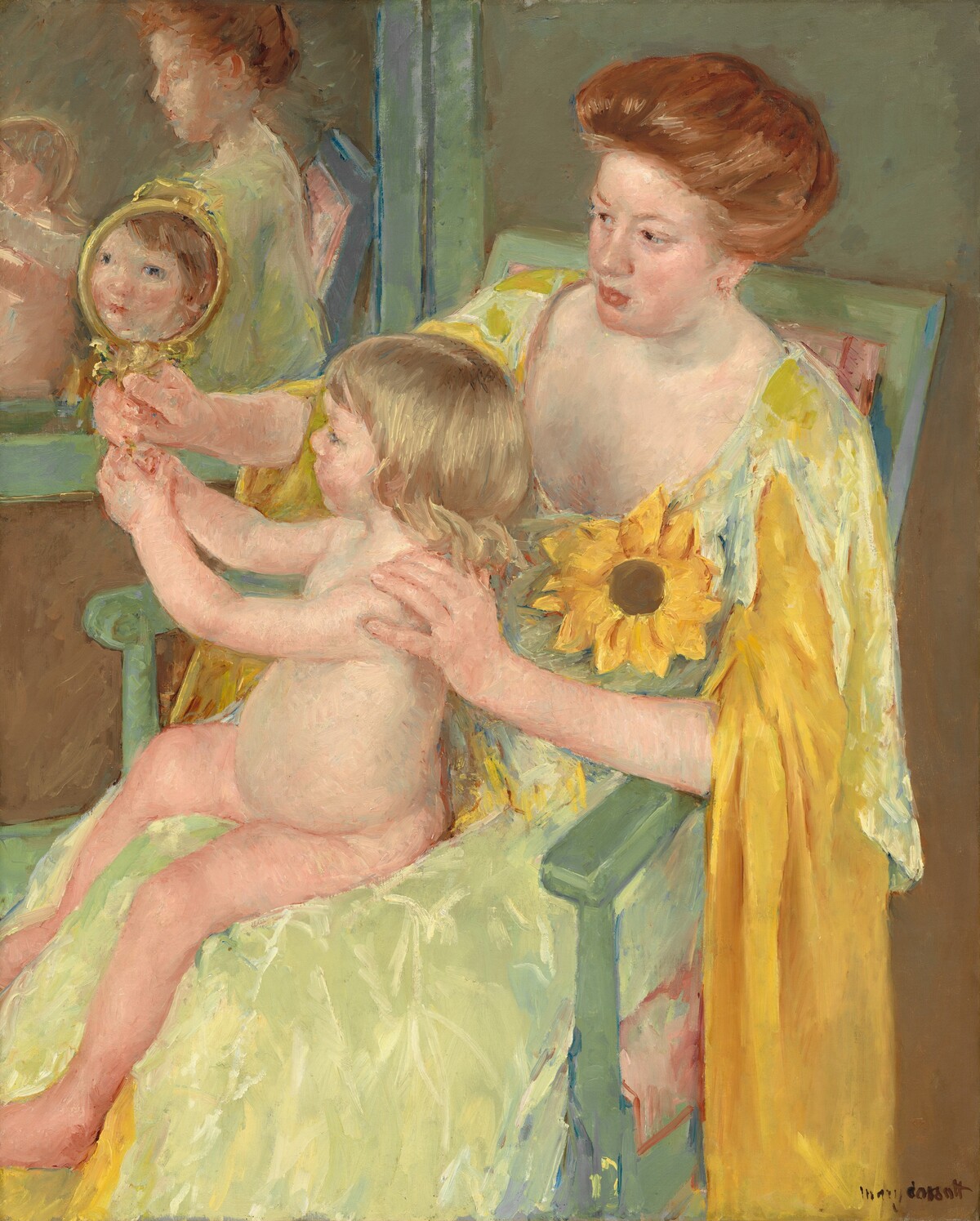
Roger Marx [1859-1913], Paris; on deposit 1908 with (Durand-Ruel, Paris, deposit no. 11393); (Roger Marx sale, Galerie Manzi-Joyant, Paris, 11-12 May 1914, no. 15); acquired by (Durand-Ruel, Paris) for Louisine Waldron Havemeyer [1855-1929], New York; (her sale, American Art Association Anderson Galleries, New York, 10 April 1930, no. 82, as _La Femme au Tournesol_); purchased by Chester Dale [1883-1962], New York; bequest 1963 to NGA.
Accession Number
1963.10.98
Medium
oil on canvas
Dimensions
overall: 92.1 x 73.7 cm (36 1/4 x 29 in.) | framed: 114.3 x 95.2 cm (45 x 37 1/2 in.)
Classification
Painting
Credit Line
Chester Dale Collection
Tags
Painting Early Modern (1901–1950) Oil Painting Canvas American
Background & Context
Background Story
Woman with a Sunflower (c. 1905) is one of Cassatt's later works, depicting a woman holding a sunflower—a subject that combines flower painting with portraiture in a composition rich with symbolic resonance. The sunflower, with its characteristic heliotropism (turning toward the sun), had been used as a symbol of devotion, faith, and the soul's orientation toward the divine. Cassatt's choice of the sunflower—rather than the roses or lilies more common in female portraiture—reflects her interest in finding alternatives to conventional feminine symbolism. The year 1905 places this during Cassatt's later period, when she had largely shifted from oil painting to pastel and printmaking, and the painting likely reflects the increasingly graphic quality of her late style. The woman holding the sunflower is not merely posing with a decorative prop—the flower and the figure are integrated into a single visual concept where the sunflower's large, bold form and the woman's presence create a unified image. Cassatt's treatment demonstrates her ability to combine large-scale form (the sunflower's dramatic shape) with intimate observation (the woman's gesture and expression), creating compositions that operate at multiple scales simultaneously. The painting also reflects Cassatt's feminist convictions: the woman with the sunflower is not defined by her relationship to a man but by her own engagement with nature and beauty.
Cultural Impact
Cassatt's sunflower portrait influenced how flower symbolism was used in women's portraiture, offering alternatives to conventional feminine iconography. The painting influenced later women artists who similarly sought to redefine female portraiture's terms. The sunflower subject influenced how non-traditional flower symbolism was understood in art, connecting the flower's heliotropic character to themes of independence and self-direction.
Why It Matters
This painting matters because it represents Cassatt's late engagement with portraiture on her own terms—using unconventional symbolism and bold composition to create images of women that challenge rather than confirm convention. The woman with the sunflower argues that female identity can be constructed through engagement with nature rather than through social roles.