Accession Number
1950.1.40
Medium
color drypoint, softground etching, and aquatint on laid paper
Dimensions
plate: 34.61 × 21.11 cm (13 5/8 × 8 5/16 in.) | sheet: 44.6 x 27.5 cm (17 9/16 x 10 13/16 in.)
Classification
Credit Line
Rosenwald Collection
Tags
Print Impressionist & Modern (1851–1900) Etching Paper American
Background & Context
Background Story
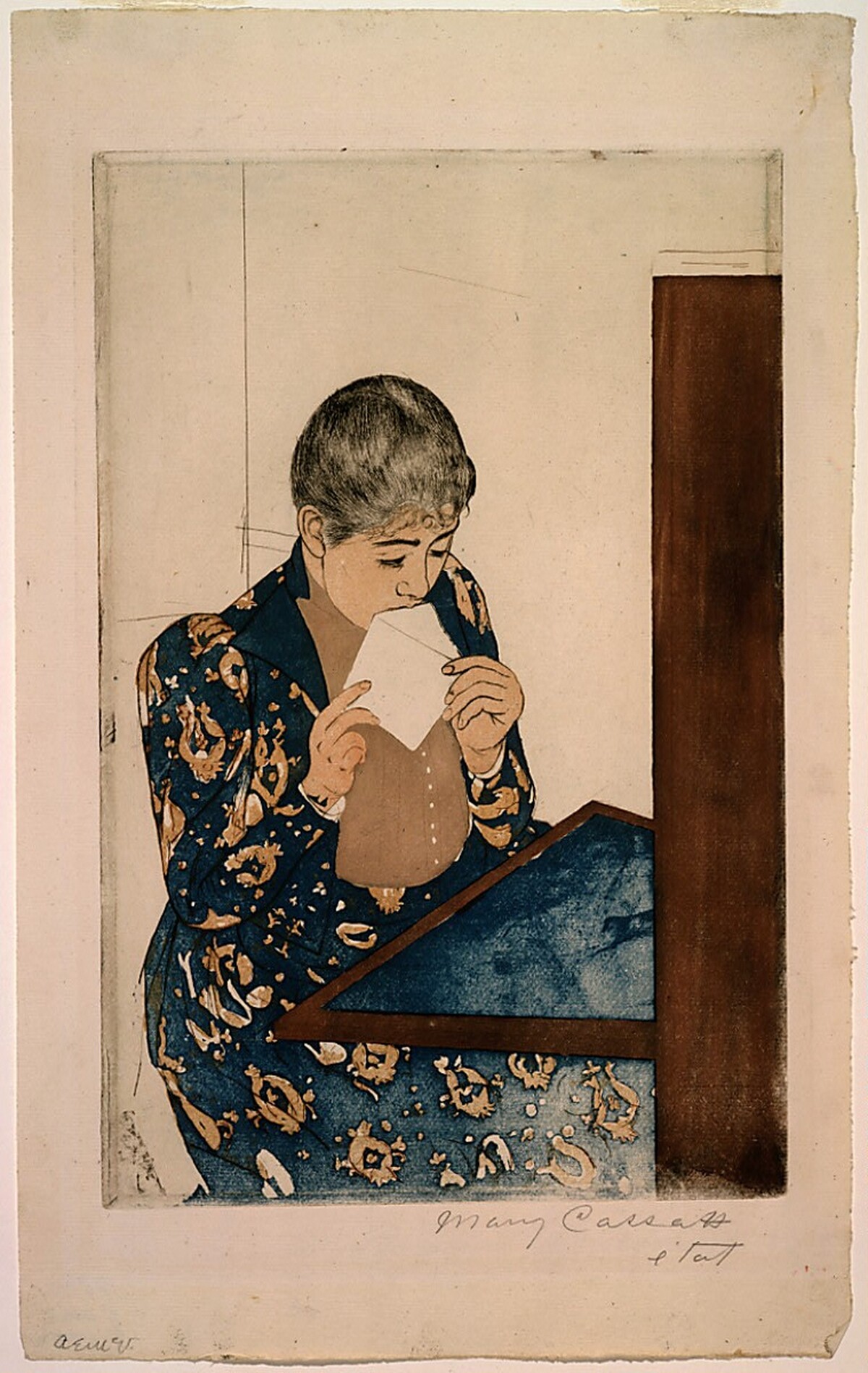
The Letter (1890-1891) is one of Cassatt's most celebrated prints, created during her intensive engagement with the color drypoint technique that produced some of the finest prints in the Impressionist canon. The work was inspired by Cassatt's exposure to Japanese woodblock prints at the 1890 Exposition Universelle, and the print's composition reflects the Japanese aesthetic principles she absorbed: asymmetrical balance, bold cropping, and the elimination of background detail in favor of the figure. The letter itself—a woman reading correspondence—was a common subject in both Western and Japanese art, but Cassatt's treatment transforms it through her distinctive blend of Japanese composition and Impressionist color. The woman seated at her writing desk, absorbed in her letter, represents the private interior life of the bourgeoisie—a world of personal communication, emotional intimacy, and domestic ritual that Cassatt knew from personal experience. The print's technical achievement—color drypoint requiring multiple plates for different colors—demonstrates Cassatt's mastery of printmaking at its most demanding. Her handling of the medium produces effects of extraordinary delicacy—subtle tonal transitions, precise line work, and the luminous quality of drypoint's characteristic burr that gave the printed line its velvety richness.
Cultural Impact
Cassatt's color prints influenced the development of Western printmaking by demonstrating how Japanese aesthetic principles could be adapted to Western subjects. The prints influenced later printmakers from the Nabis to the Fauves who similarly sought to integrate Japanese composition with Western content. The Letter specifically influenced how private correspondence was represented in art, establishing the reading woman as a subject of Impressionist interior painting.
Why It Matters
This painting matters because it represents one of the most successful fusions of Japanese and Western aesthetics in art history—the moment when Cassatt integrated the lessons of Japanese printmaking into her Impressionist practice without simply imitating her models. The Letter succeeds because the Japanese composition serves the Western subject rather than overwhelming it, creating an image that is both culturally hybrid and artistically unified.