Accession Number
1943.3.2743
Medium
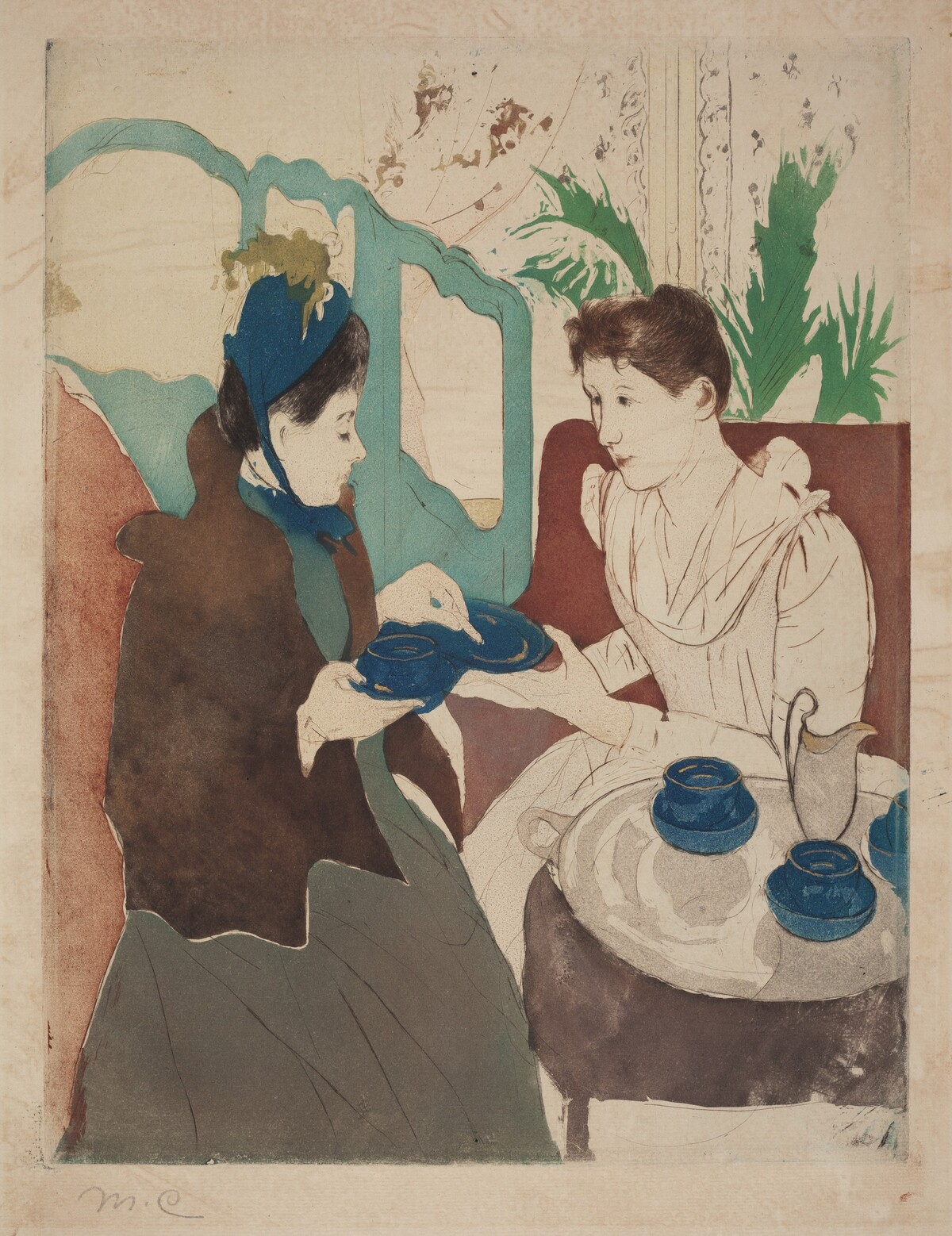
color drypoint, softground etching, and aquatint with touches of gold metallic paint on laid paper
Dimensions
plate: 34.77 × 26.35 cm (13 11/16 × 10 3/8 in.) | sheet: 48.3 x 31.1 cm (19 x 12 1/4 in.)
Classification
Credit Line
Rosenwald Collection
Tags
Print Impressionist & Modern (1851–1900) Etching Gold Leaf Paper American
Background & Context
Background Story
Afternoon Tea Party (1890-1891) belongs to Cassatt's series of color prints inspired by Japanese woodblock aesthetics, depicting the social ritual of afternoon tea that was central to bourgeois women's lives. The tea party—where women gathered to converse, share refreshment, and maintain the social networks that supported their communities—was one of the few socially acceptable occasions for women to meet outside the family. Cassatt's print captures this ritual with the compositional boldness derived from Japanese models: the figures are cropped, the viewpoint is unusual, and the decorative elements—the tea service, the costumes, the interior setting—are treated as visual patterns rather than realistic details. The 1890-91 date places this during Cassatt's most intensive engagement with printmaking, when she was producing the color drypoints that represent some of the finest achievements in Western print history. The tea party subject, treated with Japanese-inspired composition, produces images that are simultaneously intimate and formal—a visual equivalent of the tea party's social character, where personal intimacy and formal ritual coexist. Cassatt's women, engaged in their tea ritual, are not merely decorative—they are conducting the social business that sustained their communities, and Cassatt's treatment honors the significance of this work without sentimentalizing it.
Cultural Impact
Cassatt's tea party prints influenced how women's social rituals were represented in art, establishing afternoon tea as a subject worthy of serious artistic treatment. The prints influenced later women artists who similarly engaged with domestic social rituals. The Japanese-inspired composition influenced how interior genre scenes were constructed in Western art, introducing compositional principles that broke with Western conventions of balanced symmetry.
Why It Matters
This painting matters because it demonstrates how women's social rituals—often dismissed as trivial—could serve as subjects for art of the highest quality when treated with the seriousness and formal innovation that Cassatt brought to her printmaking. The tea party is not merely a genre scene—it is a document of the social infrastructure that sustained women's communities.