Provenance
Probably Hugh Hammersley [1774-1840]; (his estate sale, Alexander Rainy, London, 21 August 1841, no. 57); (Charles J. Nieuwenhuys, Brussels and London).[1] William Bingham Baring, 2nd baron Ashburton [1799-1864], Grange Park, Hampshire, by 1854;[2] by inheritance to his brother, Francis Baring, 3rd baron Ashburton [1800-1868], Grange Park; by inheritance to his son, Alexander Hugh Baring, 4th baron Ashburton [1835-1889], Grange Park; by inheritance to his son, Francis Denzil Edward Baring, 5th baron Ashburton [1866-1938], Grange Park; jointly purchased 1907 by (Thos. Agnew & Sons, Ltd., Arthur J. Sulley & Co., and Charles J. Wertheimer, all in London); sold 1909 by (Arthur J. Sulley & Co.) to Peter A.B. Widener, Lynnewood Hall, Elkins Park, Pennsylvania; inheritance from Estate of Peter A.B. Widener by gift through power of appointment of Joseph E. Widener, Elkins Park, Pennsylvania; gift 1942 to NGA.
[1] The name is cited as "H. Hammersley" in John Smith, _A Catalogue Raisonné of the Works of the Most Eminent Dutch, Flemish and French Painters_, 9 vols., London, 1829-1842: 9:729; and Cornelis Hofstede de Groot, _A Catalogue Raisonné of the Works of the Most Eminent Dutch Painters of the Seventeenth Century_, 8 vols., trans. by Edward G. Hawke, London, 1907-1927: 4:433. Although the title page of the sale catalogue does not provide the seller(s) name(s), The Getty Provenance Index Databases record for Sale Catalogue BR-15070 indicates the sellers as Skammers and Hammersley. The sale is listed in Frits Lugt, _Répertoire des catalogues de ventes_, 4 vols., The Hague, 1938: 2:no. 16295, where the seller is given as Skammers. Hammersley (sometimes spelled Hamersley) was a member of a prominent banking family in London. The annotated copy of the sale catalogue held by the Rijksbureau voor Kunsthistorische Documentatie, The Hague, provides the buyer's name.
[2] Lady Marian Jervis-White-Jervis, _Painting and Celebrated Painters, Ancient and Modern_, 2 vols., London, 1854, 2:344. The painting is not listed in Gustav Friedrich Waagen, _Works of Art and Artists in England_, 3 vols., London, 1838, or Gustav Friedrich Waagen, _Treasures of Art in Great Britain: being an account of the Chief Collection of Paintings, Drawings, Sculptures, and Illuminated Mss._, 3 vols., London, 1854-1857.
Accession Number
1942.9.30
Medium
oil on canvas
Dimensions
overall: 96.5 x 108 cm (38 x 42 1/2 in.)
Classification
Painting
Credit Line
Widener Collection
Tags
Painting Baroque (1600–1750) Oil Painting Canvas Dutch
Background & Context
Background Story
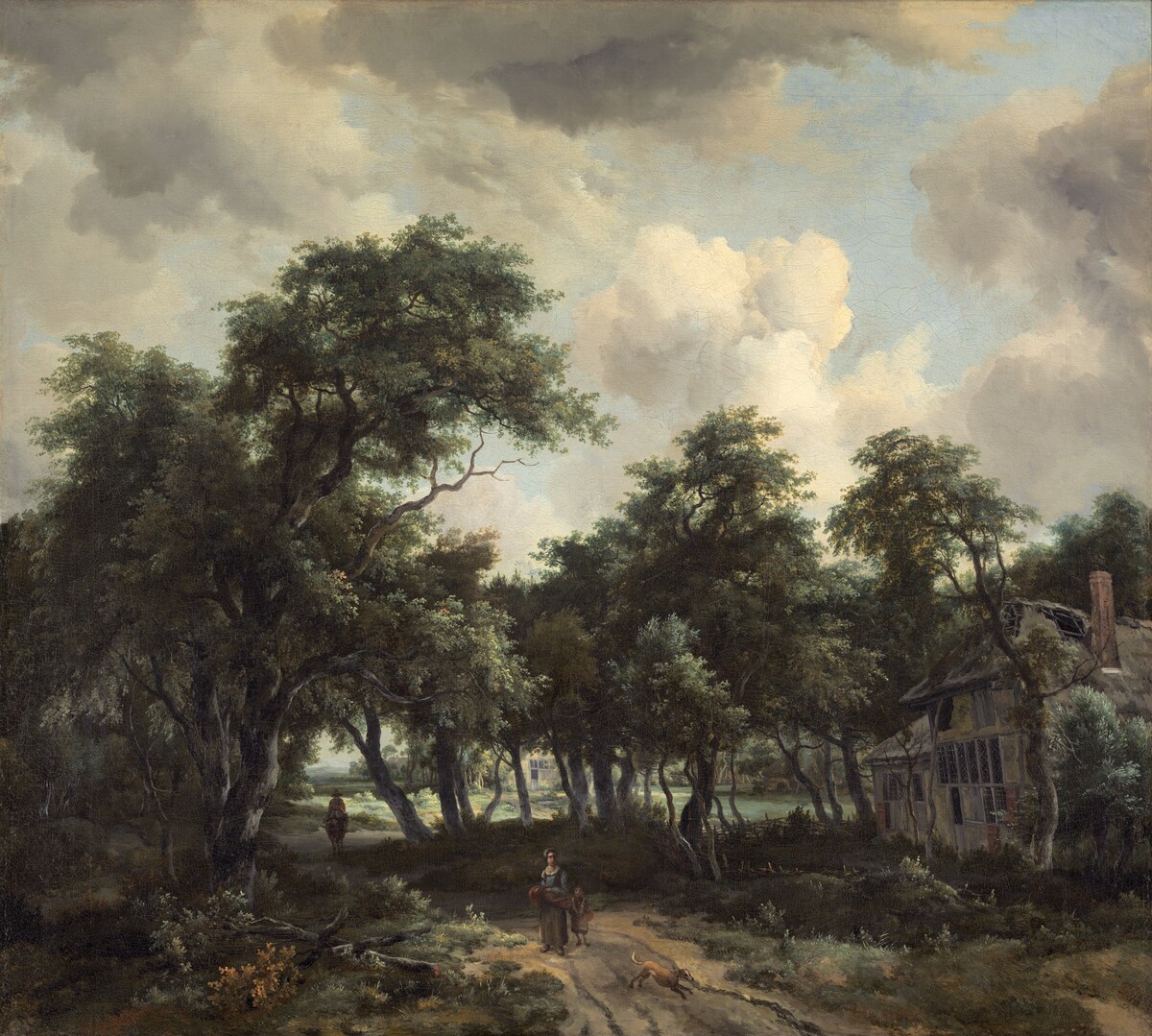
Hut among Trees (c. 1664) represents the humble end of Hobbema's landscape spectrum—a woodland scene centered on a simple cottage or hut rather than a grand avenue or prosperous farm. The painting demonstrates Hobbema's ability to find visual interest in modest rural architecture, treating the hut's thatched roof and weathered walls with the same compositional attention he gave to more impressive structures. The trees surrounding the hut create a sheltering canopy that integrates human dwelling with natural growth—suggesting that the hut and the forest are parts of the same ecological system rather than separate domains. The choice of such a modest subject reflects the Dutch Republic's democratic visual culture: unlike French or Italian painting, which privileged aristocratic and classical subjects, Dutch art celebrated ordinary life and ordinary places. A hut among trees could be a subject only in a culture that valued the commonplace as worthy of artistic attention. The 1664 date places this among Hobbema's most productive works, when he was varying his landscape subjects with confident creativity. The painting's intimacy—its focus on a single dwelling within its immediate environment—creates a sense of shelter and belonging that contrasts with the expansive views of his avenue paintings.
Cultural Impact
Hobbema's cottage paintings influenced the tradition of humble rural landscape painting in European art, establishing a convention for depicting simple dwellings within natural settings that persisted through Constable's cottage scenes to the Barbizon School. The paintings influenced how European rural vernacular architecture was valued and preserved, contributing to the cultural recognition of thatched cottages and farm buildings as worthy of conservation rather than replacement.
Why It Matters
This painting matters because it demonstrates that artistic value does not require impressive subjects. A hut among trees receives the same compositional intelligence and technical mastery as a grand avenue or a prosperous farm, establishing the democratic principle that every built structure—and by extension every human life—is worthy of serious artistic attention. For contemporary artists working in overlooked communities, Hobbema's cottage paintings provide historical precedent for treating humble subjects with aesthetic dignity.