Provenance
Gosen Geurt Alberda van Dyksterhuys [d. 1830], Château Dyksterhuys, Province of Groningen, by 1829; R. Gockinga and P. van Arnhem, Groningen, after 1829; (sale, Amsterdam, 5 July 1833, no. 11);[1] R. Gockinga, Groningen. Colonel Biré, Brussels;[2] (sale, Bonnefons de Lavialle, Paris, 25-26 March 1841, no. 2); William Williams Hope [1802-1855], Rushton Hall, Northamptonshire, and Paris;[3] (sale, Christie & Manson, London, 14-16 June 1849, no. 124); purchased by Fuller or perhaps bought in;[4] (William Williams Hope sale, Pouchet, Paris, 11 May 1858, no. 2). William Ward, 1st earl of Dudley [1817-1885, created earl 1860], Witley Court, Worcestershire, by 1871; by inheritance to his son, William Humble Ward, 2nd earl of Dudley [1867-1932], Witley Court; (sale, Christie, Manson & Woods, London, 25 June 1892, no. 9); (P. & D. Colnaghi & Co., London);[5] sold 1894 to Peter A.B. Widener, Lynnewood Hall, Elkins Park, Pennsylvania; inheritance from Estate of Peter A.B. Widener by gift through power of appointment of Joseph E. Widener, Elkins Park, Pennsylvania; gift 1942 to NGA.[6]
[1] Both Van Arnhem and Gockinga had individually offered to buy the two pictures by Hobbema, including NGA 1942.9.31, that Gosen Geurt Alberda van Dyksterhuys owned. Before either had closed the deal, however, the owner died. It was later arranged that the two would purchase the paintings together; see Charles J. Nieuwenhuys, _A Review of the Lives and Works of Some of the Most Eminent Painters_, London, 1834:147-149.
[2] The catalogue of this sale bears the title _Catalogue d'une riche collection de tableaux des écoles flamande et hollandaise, recueillie par M. Héris de Bruxelles..._, but although the collection was "recueillie" (collected/gathered) by Héris and was offered for sale under his name, he may not himself have been the owner of the paintings. In the copy of the sale catalogue at the Philadelphia Museum of Art, the words "Recueillie par M. Héris de Bruxelles" in the title are followed by the handwritten addition, "pour M. le Colonel Biré," and alongside the title in the Victoria and Albert Museum's copy is written "mais c'est la collection de M. le Colonel Biré," which suggests that Héris may have been acting as Biré's agent in acquiring and selling the pictures.
[3] The buyer's name is noted in the Philadelphia copy of the sale catalogue as "hoppe," which is probably a misspelling of Hope. (The 1858 Hope sale catalogue states that Hope bought the picture at the Héris sale.)
[4] Cornelis Hofstede de Groot, _A Catalogue Raisonné of the Works of the Most Eminent Dutch Painters of the Seventeenth Century..._, 8 vols., trans. by Edward G. Hawke, London, 1907-1927: 4:406, lists the 1849 sale in the provenance of his no. 100, a painting that may or may not be identical with his no. 94, 4:403-404 (which is definitely _The Travelers_). The compositional descriptions given in both these Hofstede de Groot entries are similar, but the dimensions listed for no. 100, 51 x 54 inches, are impossible for the National Gallery picture. The identity and whereabouts of Hofstede de Groot no. 100 remain unclear; it is possible that Hofstede de Groot was mistaken in the dimensions that he gave for this picture, and that it was indeed the same painting as his no. 94. Hofstede de Groot further confuses the issue by listing part of the provenance of _The Travelers_ under no. 94, and part (the 1841 Héris sale) under no. 100. The 1849 Hope sale catalogue does not give dimensions, so it is impossible to establish whether the painting offered there was _The Travelers_ or the unknown, and perhaps apocryphal, "Hofstede de Groot 100." The picture in question fetched £367.10, and Hofstede de Groot, citing as his source a handwritten note in Smith's own copy of his _Catalogue Raisonné_, says that it was bought in. (In this copy, which is at the Rijksbureau voor Kunsthistorische Documentatie, The Hague, Smith gives the buyer as "Fuller," but this is not necessarily contradictory, as Fuller may have been a Christie's employee.) Smith's statement is probably correct, for the National Gallery of Art's painting remained in the possession of W.W. Hope until 1858, when it was sold in Paris.
[5] Colnaghi lent the painting to the Royal Academy of Art’s 1894 Winter Exhibition, which ran from January to March. The sale to Widener must have occurred later in the year.
[6] A label from the Art Institute of Chicago shipping room, dated 27 January 1943, was removed from the painting’s stretcher in 1981, but neither the Art Institute nor the NGA registrar’s office records this movement.
Accession Number
1942.9.31
Medium
oil on canvas
Dimensions
overall: 101 x 145 cm (39 3/4 x 57 1/16 in.)
Classification
Painting
Credit Line
Widener Collection
Tags
Painting Baroque (1600–1750) Oil Painting Canvas Dutch
Background & Context
Background Story
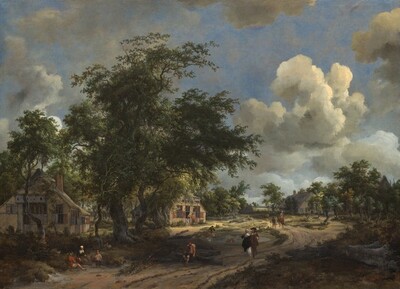
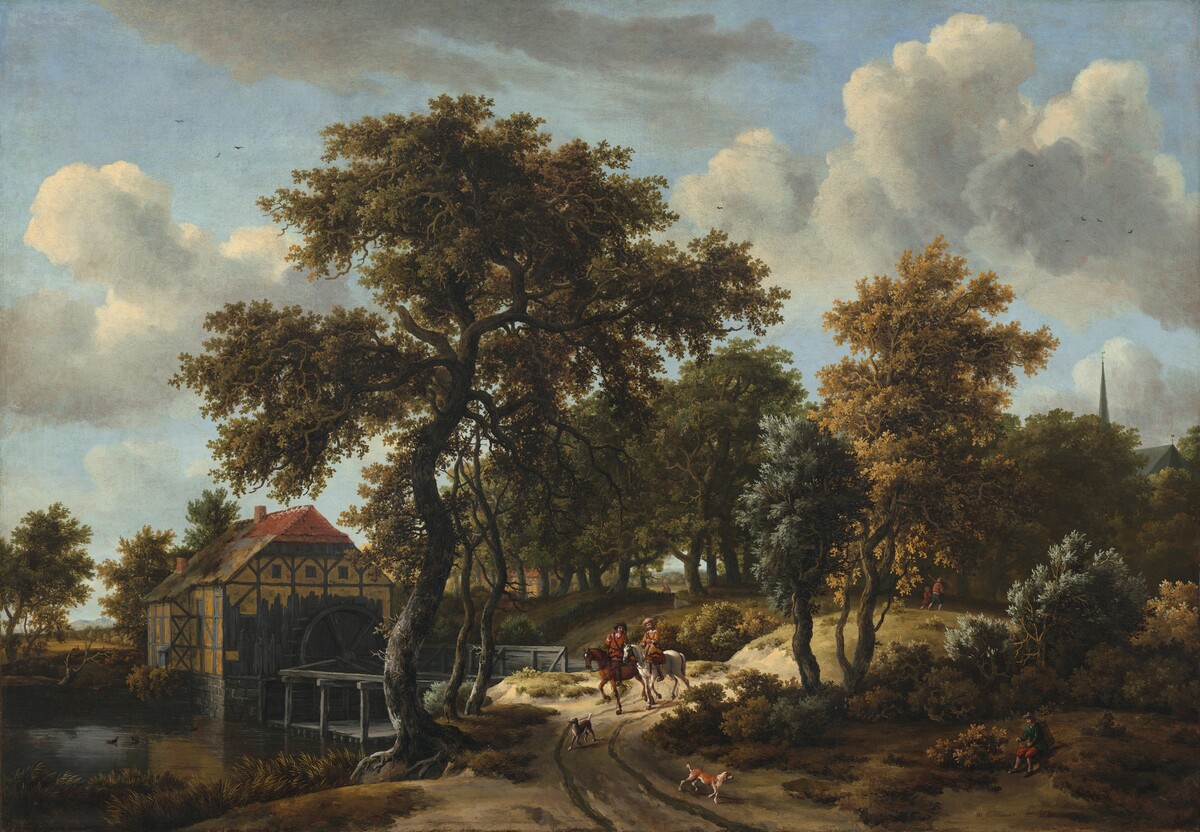
Meindert Hobbema's The Travelers (1662) depicts a quintessential Dutch landscape motif: travelers on a country road, making their way through a landscape of trees, water, and sky that epitomizes the Golden Age vision of the Dutch countryside. Hobbema, a student of Jacob van Ruisdael, developed a distinctive approach to landscape that emphasized sun-drenched woodland scenes with dramatic avenues of trees and expansive skies. The travelers in Hobbema's painting provide scale and narrative suggestion without dominating the composition—they are figures in a landscape rather than landscape serving as backdrop for figures. The year 1662 falls within Hobbema's most productive period, before his appointment as a tax official in 1668 effectively ended his painting career. The subject of travelers on a road connects to the broader Dutch tradition of representing mobility and commerce—the Dutch Republic's prosperity depended on the movement of goods and people, and landscape paintings of roads and canals celebrated this mobility. The painting also reflects the Dutch Republic's unique relationship with its landscape: much of the country had been reclaimed from water through engineering, making the landscape itself a product of national effort and collective achievement.
Cultural Impact
Hobbema's landscape formula influenced Dutch landscape painting for generations and, through the export of Dutch paintings, influenced the development of landscape painting across Europe. His compositional approach—avenues of trees leading to a central vanishing point, expansive skies, and sun-dappled woodland—became a convention of European landscape painting that persisted through Constable and into 19th-century academic art. The painting also influenced how the Dutch countryside was imagined by people who never visited it, creating a visual shorthand for Dutch landscape that remains active today.
Why It Matters
This painting matters because it represents the Dutch Golden Age's achievement at its most characteristic: the transformation of a specific national landscape into a universally appealing visual experience. Hobbema's travelers move through a landscape that is recognizably Dutch yet aesthetically universal, demonstrating that the particular can serve the general when rendered with skill and conviction. The painting also matters as a document of the Dutch countryside before modernization—a landscape that has largely disappeared.