Provenance
Thomas Cobbe [1733-1814], Newbridge House, Donabate, near Dublin, by 1770;[1] gift 1810, with the Cobbe estates and painting collection, to his grandson, Charles Cobbe [1782-1857]; sold 1839 through Michael Gernon to (Thomas Brown, London); sold 4 April 1840 to Robert Stayner Holford, M.P. [1808-1892], Dorchester House, London, and Westonbirt, Gloucestershire;[2] by inheritance to his son, Lieut.-Col. Sir George Lindsay Holford, K.C.V.O. [1860-1926];[3] purchased 1901 through (Charles J. Wertheimer, London) by J. Pierpont Morgan [1837-1913], New York;[4] by inheritance to his son, J.P. Morgan, Jr. [1867-1943], New York; consigned February 1935 to (M. Knoedler & Co., New York); sold 13 December 1935 to Andrew W. Mellon, Pittsburgh and Washington, D.C.; deeded 24 June 1937 to The A.W. Mellon Educational and Charitable Trust, Pittsburgh;[5] gift 1937 to NGA.
[1] Thomas Cobbe may have acquired the painting by Hobbema upon the recommendation of the Rev. Matthew Pilkington (1701–1774), who was private secretary to Thomas’ father, Charles Cobbe (1686–1765), the Archbishop of Dublin. Pilkington wrote enthusiastically about the Hobbema, then in Cobbe’s collection, in his book _The Gentleman’s and Connoisseur’s Dictionary of Painters_ (London, 1770), 288. The Knoedler prospectus for the painting (in NGA curatorial files) says the painting was owned by the elder Charles Cobbe (Thomas’ father) and then inherited by the younger Charles Cobbe, who is incorrectly identified as the elder Charles’ grandson, when he was in fact the great-grandson. The prospectus does not name Thomas.
[2] For the painting’s early provenance see Alastair Laing, ed., _Clerics & Connoisseurs: The Rev. Matthew Pilkington, the Cobbe Family and the Fortunes of an Irish Art Collection through Three Centuries_, Exh. cat., The Iveagh Bequest, Kenwood House, London, 2001: 9, 50-51, 71, 87-89, 116, no. 24, 373 n. 11 for Wheelock and Cobbe essay.
[3] _The Holford Collection, Dorchester House_, 2 vols., Oxford, 1927, 2: ix, produced by the executors of Sir G.L. Holford's estate, says that the Hobbema that had belonged to "Mr." (i.e. R.S.) Holford was sold to help pay his death duties. Holford also owned another painting that came to the National Gallery of Art by way of the Andrew W. Mellon Collection, Anthony van Dyck's portrait of Marchesa Balbi (1937.1.49).
[4] "In the Sale Room," _Connoisseur_ 1 (September-December 1901): 190. The Knoedler prospectus (in NGA curatorial files) says this sale took place in 1905.
[5] The painting was Knoedler no. CA 787. See the letter from Nancy C. Little, librarian, M. Knoedler & Co., New York, to Gregory M.G. Rubinstein, 12 September 1987; the Knoedler bill of sale to Mellon; and Mellon collection records, all in NGA curatorial files.
Accession Number
1937.1.61
Medium
oil on canvas
Dimensions
overall: 94.7 x 130.5 cm (37 5/16 x 51 3/8 in.)
Classification
Painting
Credit Line
Andrew W. Mellon Collection
Tags
Painting Baroque (1600–1750) Oil Painting Canvas Dutch
Background & Context
Background Story
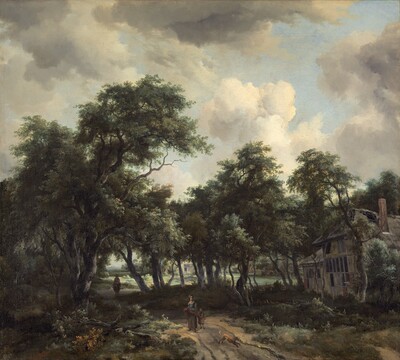
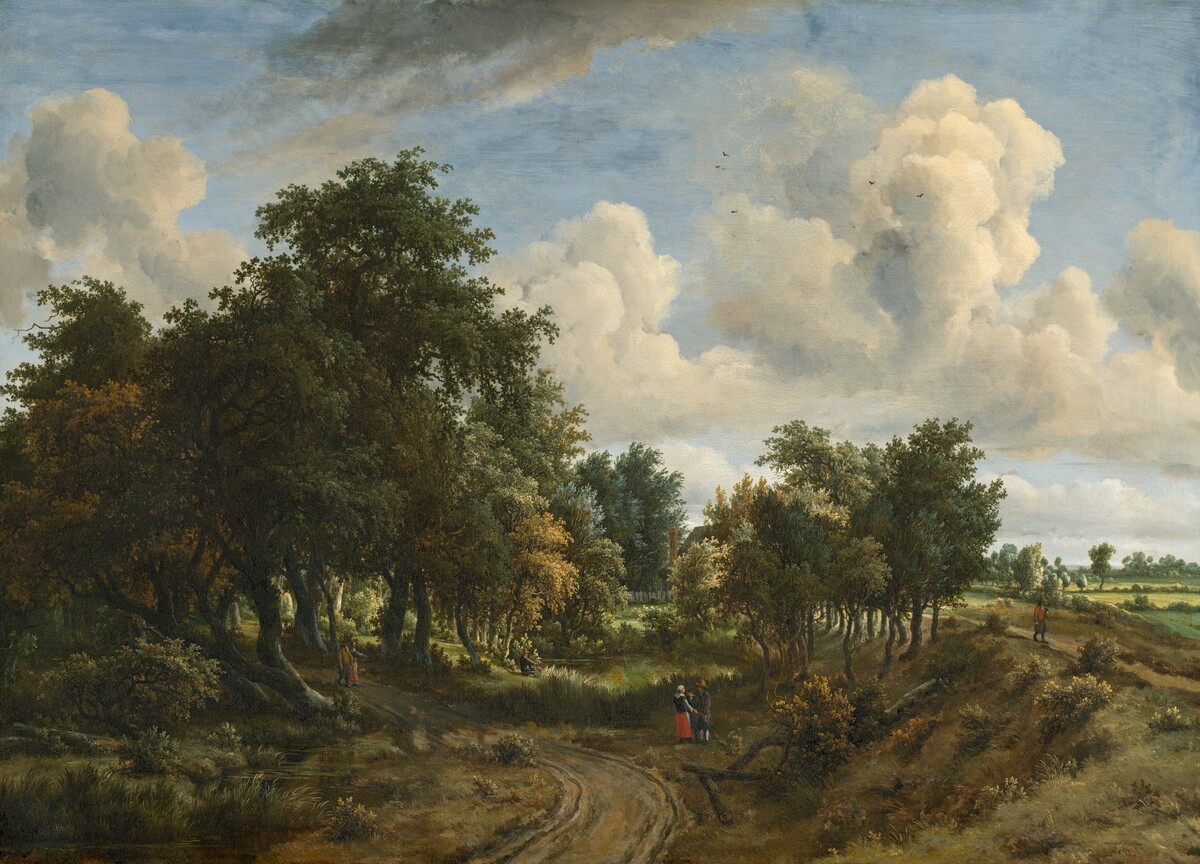
A Wooded Landscape (1663) exemplifies Hobbema's signature subject: the sun-dappled woodland scene that became his most recognizable contribution to Dutch landscape painting. The painting depicts a forest interior with the characteristic Hobbema effects: light filtering through canopy, creating pools of sunlight on the forest floor; trees with individually rendered trunks and foliage; and a sense of depth created through atmospheric perspective—near trees painted in full detail, distant trees dissolving into green-gray haze. The year 1663 falls within Hobbema's most productive and inventive period, when he was creating variations on his woodland theme with apparently inexhaustible invention. Hobbema's approach to woodland differs significantly from his teacher Ruisdael's: where Ruisdael favored dramatic, often stormy forest scenes with emphatic structure, Hobbema preferred lighter, more sun-filled compositions that emphasize the play of light through leaves. This difference reflects temperamental divergence as much as aesthetic choice—Ruisdael was drawn to nature's power, Hobbema to nature's charm. The painting also illustrates the Dutch Republic's relationship with its forests: the nation had few forests and valued them as economic resources and aesthetic subjects, making woodland paintings simultaneously celebrations and documents of a scarce national asset.
Cultural Impact
Hobbema's woodland paintings established the sun-dappled forest interior as one of landscape painting's most enduring conventions. His approach influenced John Constable, who admired Hobbema's light effects, and through Constable influenced the Barbizon School and the Impressionists. The woodland motif influenced tourism imagery for forested regions and contributed to the cultural understanding of forests as sites of beauty rather than mere economic resources. Hobbema's influence persisted in European landscape painting well into the 19th century.
Why It Matters
This painting matters because it represents a specifically Dutch approach to landscape that influenced the entire subsequent tradition of European woodland painting. Hobbema's achievement—finding infinite variations within a single compositional type—demonstrates that artistic invention is not a function of subject variety but of perceptual sensitivity. Each of his woodland paintings is simultaneously similar to and different from every other, creating a body of work that rewards both individual attention and comparative study.