Provenance
Mme Jean Etienne Fizeau [née Marie Anne Massé, d. 1790], Amsterdam; (sale, Amsterdam, 27 April 1791);[1] Welbore Ellis Agar [1735-1805], London; by inheritance to his illegitimate sons, Welbore Felix Agar [d. 1836] and Sir Emmanuel Felix Agar [1781-1866]; sold 1806 to Robert Grosvenor, 1st marquess of Westminster [1767-1845];[2] by inheritance to his grandson, Hugh Lupus Grosvenor, 1st duke of Westminster [1825-1899], Grosvenor House, London; purchased 1912 by Baron Alfred Charles de Rothschild [1842-1918], London and Halton House, near Wendover, Buckinghamshire;[3] bequeathed to his illegitimate daughter, Almina Victoria, Countess of Carnarvon [c. 1877-1969, later Mrs. Ian Onslow Dennistoun], London; sold 1924 to (Duveen Brothers, Inc., London, New York, and Paris);[4] sold November 1924 to Andrew W. Mellon, Pittsburgh and Washington, D.C.; deeded 28 December 1934 to The A.W. Mellon Educational and Charitable Trust, Pittsburgh; gift 1937 to NGA.
[1] The Fizeau (variously spelled Fiseau, Fezeau, or Fiziau) sale was known to Frits Lugt not from an actual example of the catalogue, but because it is listed in Adriaan van der Willigen, _Naamlijst van Nederlandsche kunst catalogi veelal met derzelver prijzen en namen, van af 1731-1861, welke de verzameling uitmakern van A. van der Willigen_, Haarlem, 1873.
[2] The Ellis Agar Collection was to be sold at Christie's, London, 2-3 May 1806, and a sale catalogue was produced, but before the auction could take place the complete collection was instead sold to Lord Grosvenor, for 30,000 guineas (George Redford, _Art Sales, 1628-1887_, 2 vols., London, 1888: 1:95). The bill of sale is preserved at the Grosvenor Estate Office Archive; the Hobbema is number 42 on this list (information kindly provided by Michael Hall, curator to Edmund de Rothschild, letter of 5 March 2002, in NGA curatorial files).
[3] The date of Alfred's acquisition of the picture was kindly provided by Michael Hall, curator to Edmund de Rothschild; see his "Rothschild Picture Provenances" from 1999 and his letter of 27 February 2002, in NGA curatorial files, in which he cites relevant documents in The Rothschild Archive, London.
[4] Duveen Brothers Records, accession number 960015, Research Library, Getty Research Institute, Los Angeles: reel 292, box 437, folders 4 and 5; copies in NGA curatorial files.
Accession Number
1937.1.62
Medium
oil on canvas
Dimensions
overall: 93.1 x 127.8 cm (36 5/8 x 50 5/16 in.) | framed: 122.6 x 158.4 cm (48 1/4 x 62 3/8 in.)
Classification
Painting
Credit Line
Andrew W. Mellon Collection
Tags
Painting Baroque (1600–1750) Oil Painting Canvas Dutch
Background & Context
Background Story
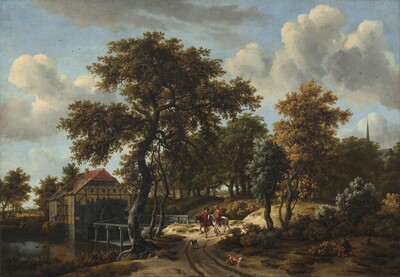
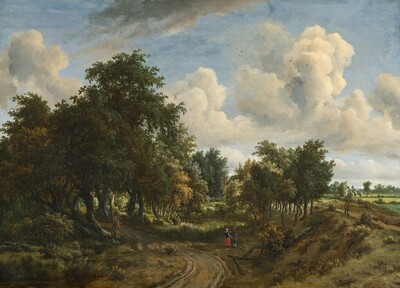
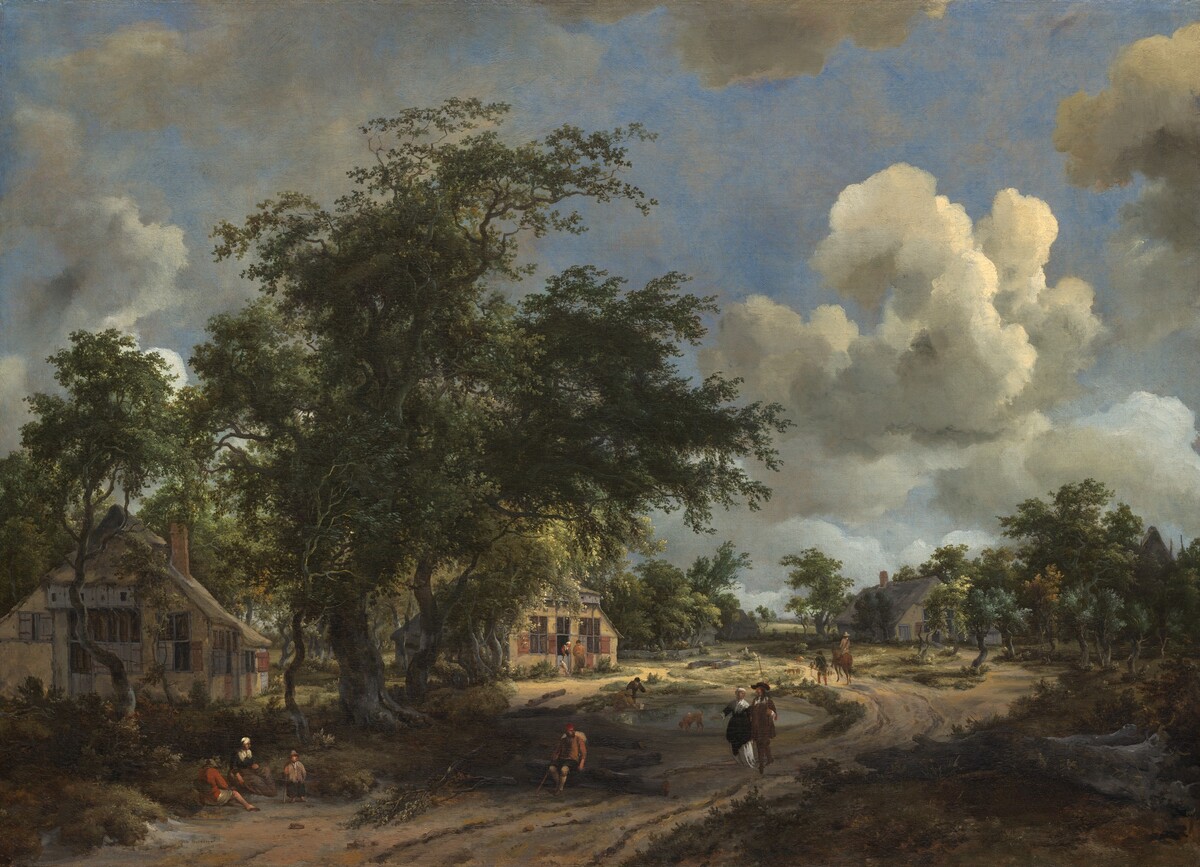
A View on a High Road (1665) depicts one of the most characteristic subjects in Dutch landscape painting: a road receding into depth, creating a powerful perspective structure that organizes the composition. Hobbema's high road likely features the tree-lined avenue motif that became his most recognizable contribution to Dutch landscape convention—the parallel lines of trees creating a dramatic perspective corridor leading to a distant church spire, town, or vanishing point. The road itself was a significant feature in the Dutch Republic: the nation's road system supported the commercial traffic that drove the Republic's economy, and roads connected the network of towns and cities that made the Netherlands Europe's most urbanized society. The travelers on the road—often including carts, riders, and pedestrians—provided narrative interest and scale while representing the mobility that characterized Dutch society. The year 1665 was a difficult one for the Dutch Republic: the Second Anglo-Dutch War was ongoing, and plague ravaged Amsterdam. Yet Hobbema's painting shows no trace of turmoil—the road is peaceful, sunlit, and inviting, creating an image of normality and continuity that must have been as comforting to contemporary viewers as it is to modern ones.
Cultural Impact
Hobbema's high road paintings influenced the perspective road tradition in European landscape painting, establishing a compositional formula that persisted through 18th-century Venetian vedute to 19th-century academic landscape. The avenue motif influenced actual landscape architecture—the tree-lined avenues of European country estates and public parks draw partly on the visual conventions that Hobbema helped establish. The paintings also influenced how Dutch infrastructure and mobility were represented in art.
Why It Matters
This painting matters because it demonstrates how landscape painting can encode social and economic meaning within apparently simple visual structures. The road is not just a compositional device—it is the Republic's circulatory system, the infrastructure that sustained Dutch prosperity. Hobbema's painting celebrates this infrastructure by rendering it beautiful, demonstrating that art's function includes revealing the aesthetic dimension of the utilitarian.