Description
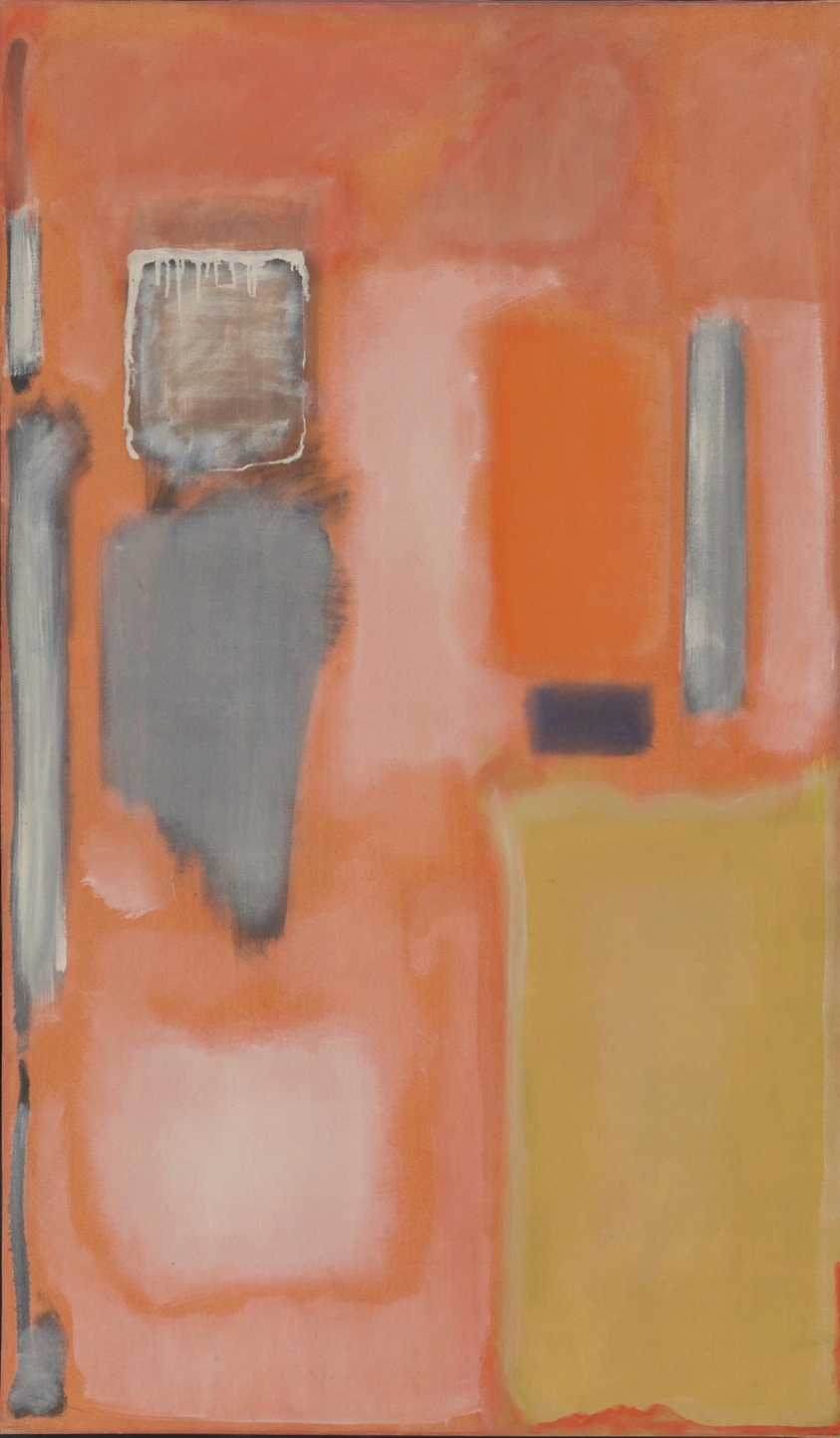
Like many of the New York School painters of the 1940s, Mark Rothko was largely influenced by Surrealism, creating symbolic abstractions comprised of biomorphic and mythological forms. By 1947 he abandoned such suggestive imagery and began working exclusively with how ideas of color, light, and space could be manifested in paint. Number 19 follows the characteristic format of his transitional canvases, in which loosely defined shapes hover against a thinly brushed background. Color had become a defining force for Rothko, as had the atmospheric—even ghostly—layering of oil paint, which would lead to his signature color-field of the 1950s.
Provenance
Betty Parsons Gallery, New York, by 1950; sold to private collectors, Chicago, 1950; given anonymously to the Art Institute, 1957.
Accession Number
6010
Medium
Oil on canvas
Dimensions
172.8 × 101.8 cm (68 × 40 1/8 in.)
Classification
Painting
Credit Line
Anonymous gift
Background & Context
Background Story
"Number 19" is a 1949 oil on canvas by Mark Rothko that captures the American Color Field painter in his most transitional and chromatically exploratory mode, the image showing an abstract composition rendered with the same bold, flat color fields and subtle tonal variations that would characterize his mature work. The composition is a large canvas—172.8 × 101.8 centimeters—showing floating rectangles of color with the oil on canvas creating a surface of extraordinary luminosity and emotional depth. The 1949 date places this work in the critical transitional year of Rothko's career, when he was moving from the more figurative and symbolic works of the 1940s toward the classic color field compositions of the 1950s. Art historians have connected this painting to the broader tradition of the abstract composition in modern art, from the paintings of Newman to the color field works of the Washington School, noting that Rothko's treatment is more focused on the chromatic resonance and the emotional suggestion, the transformation of color into spiritual experience, than the compositional structure or the formal analysis of these other traditions.
Cultural Impact
This 1949 oil canvas made transitional color field chromatically exploratory through large 172cm floating rectangles luminosity and emotional depth, using critical 1940s-to-1950s shift to transform flat color into spiritual experience beyond Newman compositional structural analysis.
Why It Matters
It matters because Rothko painted rectangles and made the canvas feel like it was meditating on the meaning of being alive—proving that even a block of color could be a prayer if the oil was deep enough.