Description
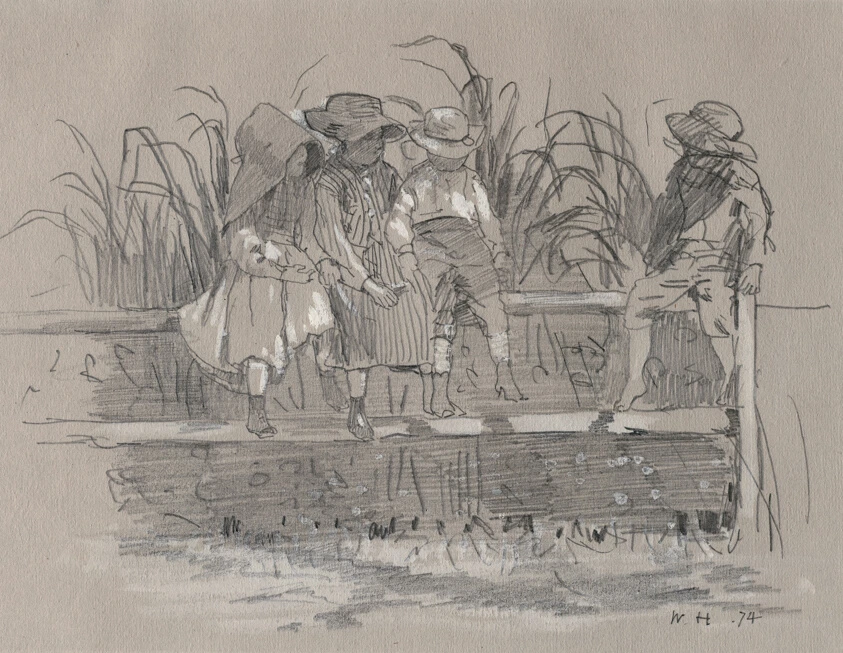
During the years of Reconstruction (1865–1876), children and childhood were popular subjects in art and literature, representing both the nation’s hope for the future and its nostalgia for the simpler, more innocent era that preceded the great social and economic upheavals of the Civil War. Homer understood and fostered this conception of childhood; small groups of children in rural settings dominate his work of the early 1870s. The graphite study Children Sitting on a Fence, on which the watercolor Children on a Fence (1874) is based, shows how Homer used monochrome drawings to study figure relationships and to map out the primary patterns of light and shadow. Although the small figure group of children poised on the upper rail of a fence remains essentially the same between the drawing and the watercolor, the white highlights on the children’s hats and bodies in the drawing differ from the highlights Homer employed in the watercolor, suggesting that his treatment of light was sometimes improvised away from the scene. His preparatory drawings served as guides but did not prevent experimentation in the studio.
Provenance
Accession Number
45349
Medium
Various graphites, heightened with opaque white watercolor, on medium weight, slightly textured gray wove paper
Dimensions
19.3 × 23.9 cm (7 5/8 × 9 7/16 in.)
Classification
graphite
Credit Line
The Charles Deering Collection