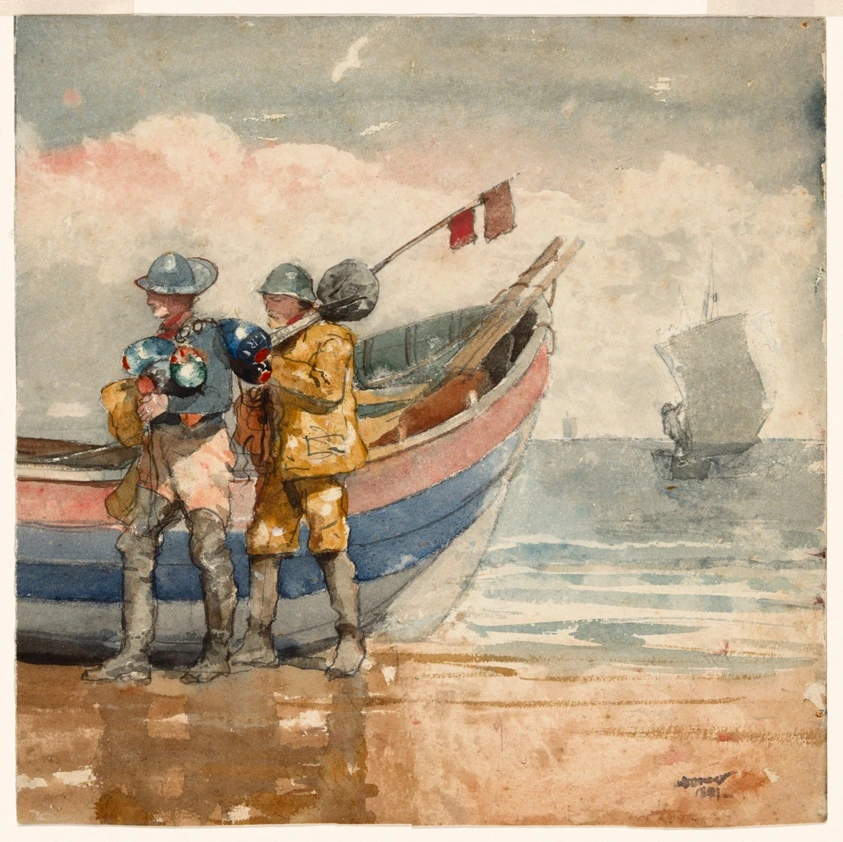
The Return, Tynemouth (recto) Study (verso)

Description

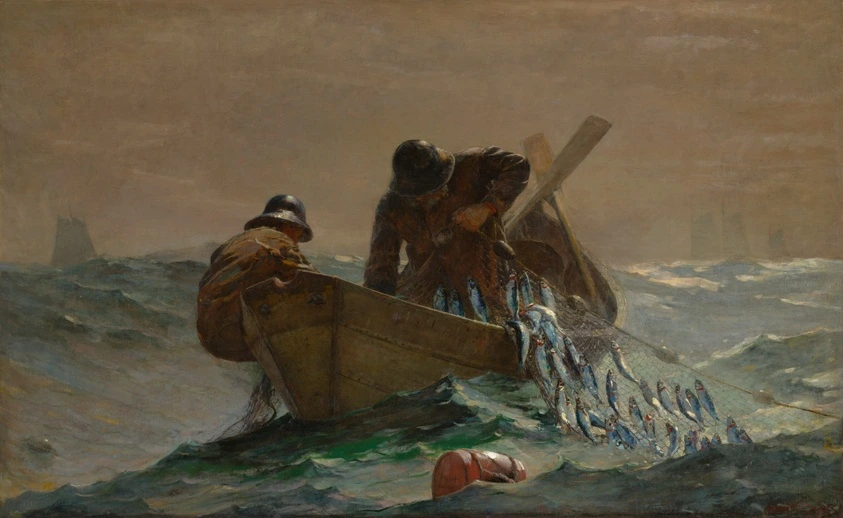
During Homer's sojourn in England from 1881 to 1882, he rented a studio on a cliff overlooking Cullercoats Harbor, where he observed the comings and goings of fishing boats. The Return, Tynemouth depicts two fishermen who have arrived on shore in early morning. Because this watercolor was painted with light-fast pigments, it retains the pale, orange-pink washes that have faded from many of the extant watercolors he painted with fugitive red pigments; for this reason, it offers a more complete idea of his developing powers in decorative color. Homer's study of the British Library's drawings by Michelangelo and Raphael during this 1881-82 trip to England may have improved his skill for rendering figures in motion, which are emphasized here by the artist's graphite underdrawing.

Provenance

The artist to his brother, Charles S. Homer, Jr. (1834–1917), New York, by 1910 [according to correspondence from Abigail Booth Gerdts to the Art Institute, February 10, 2007]. Charles W. Gould (1849–1931), New York, by 1915 [Brooklyn exh. cat. 1915]. Sold by Knoedler and Company, New York, to Martin A. Ryerson (1856–1932), Chicago, November 11, 1915 [invoice]; given to the Art Institute, 1933.

The Return, Tynemouth (recto) Study (verso)

Winslow Homer

1881

Accession Number

113064

Medium

Transparent watercolor, with touches of opaque watercolor, rewetting, blotting, and scraping, heightened with gum glaze, over graphite, on moderately thick, moderately-textured, ivory wove paper (left and lower edges trimmed)

Dimensions

34.2 × 34.3 cm (13 1/2 × 13 9/16 in.)

Classification

watercolor

Museum

The Art Institute of Chicago

Chicago, United States

Credit Line

Mr. and Mrs. Martin A. Ryerson Collection
Background & Context

Background Story

"The Return, Tynemouth" is one of Winslow Homer's most masterful English watercolors, painted in 1881 during a two-year sojourn in the fishing village of Cullercoats on the North Sea coast. The composition shows fishermen returning from the sea, their boats tossed by waves against the harbor wall of Tynemouth, the village that provided Homer with the subject matter that would transform his career from illustrator to painter of the sea's sublime power. The watercolor medium is pushed to extraordinary physical complexity here: transparent washes describe the sky and water, while opaque highlights pick out the foam and the wet clothing of the figures. Homer used every technique at his disposal—rewetting, blotting, scraping, and gum glaze—to create a surface that rivals oil painting in its material richness while retaining watercolor's inherent luminosity. The scene belongs to the genre of the fisherman's return that was common in Victorian narrative painting, but Homer's treatment is less sentimental, more attuned to the physical danger of the work. The sailors are not heroic figures but tired men returning from exhausting labor, their bodies bent against the wind and waves. This unidealized treatment aligns Homer with the social realism of European painting while maintaining the American directness that distinguished his work from British contemporaries. Art historians have linked this watercolor to Homer's later Maine seascapes, particularly the 1890s oils of fishermen battling Atlantic storms, seeing in the English period the apprenticeship that prepared him for his mature themes. The recto-verso format also reveals Homer's working method: the verso contains a study that shows the artist testing compositions before committing to the finished sheet.

Cultural Impact

This English watercolor transformed Homer's career from illustration to sea painting, combining Victorian narrative with American directness through virtuosic mixed-watercolor technique on the North Sea coast.

Why It Matters

It matters because Homer watched English fishermen come home cold and made them look like heroes without lying—proving that honesty could be as dramatic as any made-up story.