Croquet Scene

Description

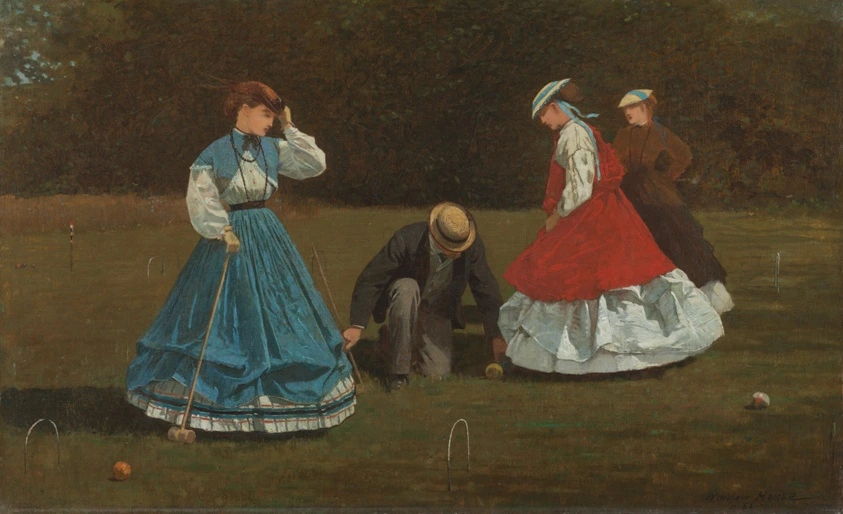
One of America’s foremost painters, Winslow Homer began his career as an illustrator during the Civil War. In the late 1860s, he turned his acute observational and technical skills toward oil painting, depicting figures bathed in sunlight out-of-doors. These early paintings, often executed in series, feature scenes of upper-class leisure pursuits—in this case, women and men competing with one another in the popular sport of croquet, which had recently been introduced to the United States from the British Isles. In Croquet Scene, one of five paintings Homer completed on the subject, progress on “the grand round” seems fairly advanced. The crouching male figure positions the ball belonging to the woman dressed in red. She is about to croquet (or “send up the country”) another ball, probably belonging to the woman in the left foreground, who shields her eyes against the bright afternoon sun. Notable for its bold patterning, strong contours, and brilliant light effects, the painting epitomizes the spirit of a breezy summer afternoon.

Provenance

William Sumner Appleton, Boston, from 1871 to 1903; by descent to William Sumner Appleton, Jr., Boston, from 1903. C.C. Childes, Boston, by 1941; sold to the Art Institute of Chicago, 1942.

Croquet Scene

Winslow Homer

1866

Accession Number

44018

Medium

Oil on canvas

Dimensions

40.3 × 66.2 cm (15 7/8 × 26 1/16 in.)

Classification

Painting

Museum

The Art Institute of Chicago

Chicago, United States

Credit Line

Friends of American Art Collection; Goodman Fund
Background & Context

Background Story

"Croquet Scene" is an 1866 oil on canvas by Winslow Homer that captures the American painter in his most charmingly social and compositionally sophisticated early mode, the image showing a croquet game rendered with the same attention to social observation and atmospheric effect that characterized his Civil War era paintings. The composition is a medium-sized canvas—40.3 × 66.2 centimeters—showing a group of young women playing croquet with the oil on canvas creating a surface of extraordinary freshness and social warmth. The 1866 date places this work in the immediate post-Civil War period, when Homer was producing the paintings that documented American social life with the same unflinching observation and subtle irony that characterized his later, more powerful works. Art historians have connected this painting to the broader tradition of the leisure scene in American art, from the paintings of Mount to the photographs of the period, noting that Homer's treatment is more focused on the social observation and the atmospheric suggestion, the transformation of leisure activity into visual poetry, than the anecdotal detail or the moral commentary of these other traditions.

Cultural Impact

This 1866 oil canvas made croquet charmingly sophisticated through medium 40cm post-Civil-War fresh social warmth and oil-on-canvas leisure-atmosphere, using early-career social observation to transform American pastime into visual poetry beyond Mount anecdotal moral commentary.

Why It Matters

It matters because Homer painted women playing croquet and made the canvas feel like it was still hearing the gentle thwack of mallets and summer laughter—proving that even a game could be a glimpse into American life if the oil was fresh enough.