Description
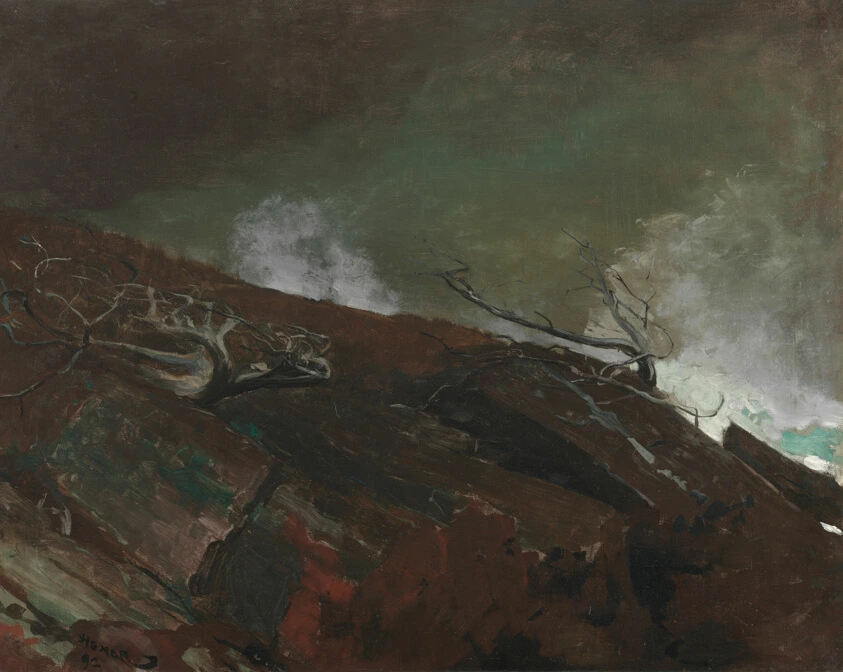
Winslow Homer observed the shoreline in various weather conditions and seasons after moving to live in near isolation in Prouts Neck, Maine, in 1883. Amid the remote and dramatic landscape, he depicted seascapes void of human life, focusing instead on an emotional response to nature. His marine scenes are larger than his earlier works, the size of the canvases emphasize the vastness and power of the sea. Homer alluded to the violence of water through the sharply diagonal shoreline and vigorous brushwork. The flat areas of color that he employed to represent the rugged rocks simultaneously hint at abstraction.
Provenance
Arthur Jerome Eddy, Chicago, from c. 1893 to 1931; given to the Art Institute of Chicago, 1931.
Accession Number
8971
Medium
Oil on canvas
Dimensions
61 × 76.2 cm (24 × 30 in.)
Classification
Painting
Credit Line
Arthur Jerome Eddy Memorial Collection
Background & Context
Background Story
"Coast of Maine" is one of Homer's most powerful late oil paintings, created in 1893 during the period when he had retreated to Prout's Neck, Maine, and was producing the seascapes that would cement his reputation as America's greatest marine painter. The composition is deceptively simple: waves breaking against dark rocks under a pale sky, the familiar Maine coast rendered with the stripped-down grandeur that characterized Homer's final decade. Yet the simplicity is achieved through profound technical mastery: the brushwork varies from thick impasto in the foam to thin glazes in the distant water, creating a range of textures that makes the modest canvas feel monumental. The palette is cool and restrained—blacks, grays, pale greens, and the white of the surf—suggesting the austerity of the northern Atlantic rather than the warmth of more southerly coasts. This chromatic severity is what distinguishes Homer's Maine paintings from the tropical brightness of his earlier Bahama watercolors: the world has narrowed to rock and water, and the artist accepts this limitation as a source of power rather than a constraint. The painting also reflects Homer's physical isolation in 1893: he lived alone at Prout's Neck, visited only by family and a few friends, and the seascapes increasingly absorbed his entire artistic energy. Art historians have connected these late oils to the broader tradition of American transcendentalism, particularly Emerson's belief that nature could reveal spiritual truths to the solitary observer. The composition itself is carefully constructed despite its apparent spontaneity: the rocks create a diagonal thrust that leads the eye toward the breaking wave, which functions as the painting's emotional climax. In the history of American art, "Coast of Maine" stands as evidence that the simplest subjects could sustain the most profound artistic ambition.
Cultural Impact
This late Maine seascape distilled Homer's artistic universe to rock and wave, using impasto and glaze to achieve monumental simplicity while connecting American transcendentalism to solitary observation.
Why It Matters
It matters because Homer looked at the same coast every day for years and never ran out of urgency—proving that repetition could deepen vision instead of flattening it.