Netting the Fish

Description

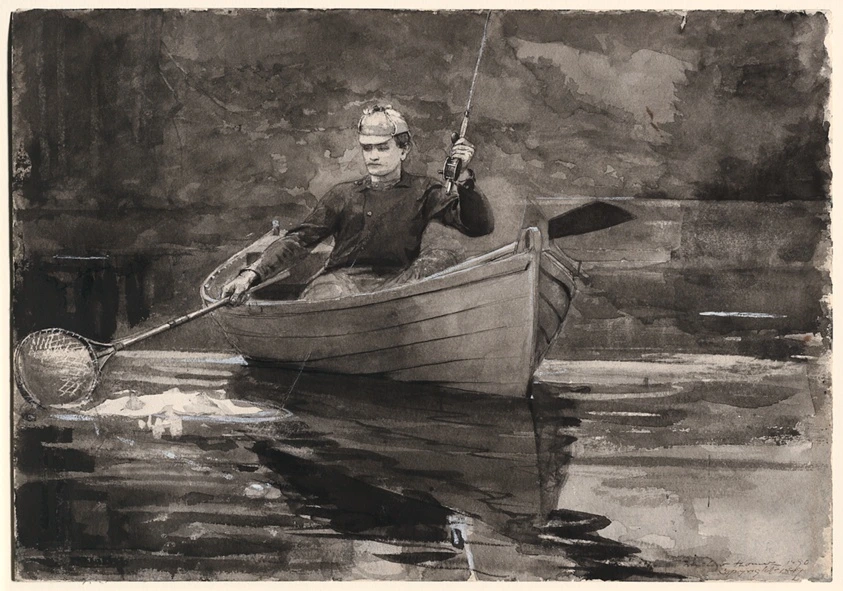
An avid angler and sportsman, Homer often depicted fishing and hunting scenes in his artwork. Many of his watercolors that explore these subjects were painted on frequent trips to the Adirondack Mountains. Netting the Fish is unusual in its focus on a gentleman sportsman. Young, well groomed, and neatly attired, the fisherman in this watercolor stands in contrast to the rustic guides featured in many of the artist’s other Adirondacks works. Homer’s fluid brushstrokes describe the smooth surface of the water, and his background washes evoke the wooded shoreline seen at a distance. Netting the Fish is one of Homer’s few grisaille, or monochrome, watercolors, painted as a study of values in preparation for the etching Fly Fishing, Saranac Lake.

Provenance

Mr. and Mrs. Lewis Larned Coburn, Chicago, by May 1, 1930 [Chicago 1930; see R4492]; given to the Art Institute of Chicago, 1933.

Netting the Fish

Winslow Homer

1889

Accession Number

14837

Medium

Transparent watercolor, heightened with opaque white watercolor, with rewetting, blotting, and scraping, over graphite, on moderately thick, slightly textured, cream wove paper

Dimensions

35.3 × 50.8 cm (13 15/16 × 20 in.)

Classification

ink or chalk wash

Museum

The Art Institute of Chicago

Chicago, United States

Credit Line

Olivia Shaler Swan Memorial Collection
Background & Context

Background Story

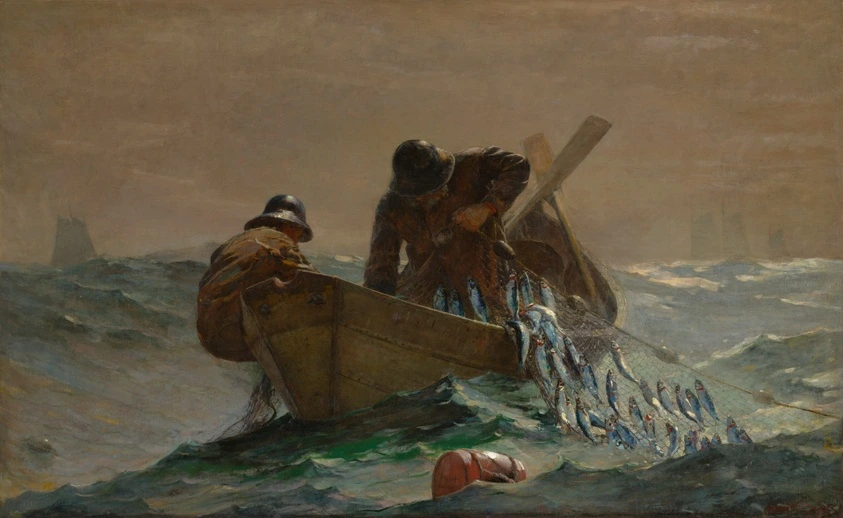
"Netting the Fish" is a masterful watercolor from 1889 executed during Homer's most productive period in the Cullercoats fishing community, showing the collaborative labor of hauling nets from the sea with a physical immediacy that few painters had achieved before. The composition focuses on the moment of capture: several figures strain against the weight of the net, their bodies angled in a choreography of shared effort that Homer renders with swift, summary strokes of watercolor and opaque white. The technique is characteristic of Homer's mature watercolors: graphite underdrawing establishes the compositional structure, then transparent washes build the atmospheric depth of sky and sea, while opaque highlights—applied with a loaded brush or scraped onto the surface—create the sparkle of water and the texture of wet clothing. The cream wove paper provides a warm middle tone that unifies the composition and prevents the cool blues and grays from becoming clinical. This scene also reflects Homer's growing interest in the collective labor of maritime communities: unlike his earlier paintings of solitary hunters or soldiers, the Cullercoats watercolors emphasize cooperation and mutual dependence, the social bonds that enable survival in a hostile environment. Art historians have compared these images to the rural labor scenes of Millet, noting that Homer's treatment is more dynamic, less static than the French master's. The painting also documents the technical sophistication of Victorian fishing: the nets shown here are not primitive traps but engineered tools of considerable complexity, and Homer's attention to their structure reveals his respect for the skill required to use them effectively.

Cultural Impact

This watercolor captured collaborative maritime labor with dynamic physicality, using mixed transparent and opaque watercolor to document Victorian fishing technology and community interdependence.

Why It Matters

It matters because Homer painted men pulling a net and made it look like a dance—proving that work could be beautiful when the bodies matched the waves.