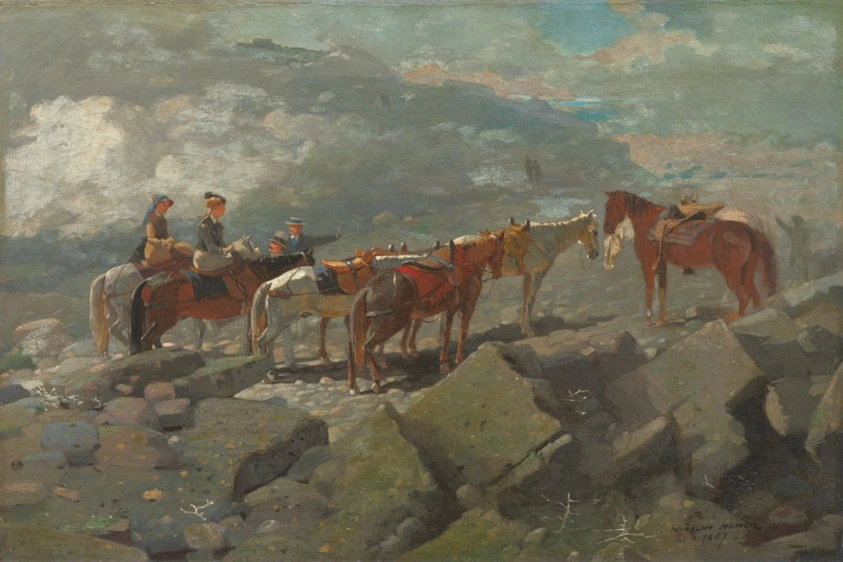
Mount Washington

Description

The White Mountains of New Hampshire were celebrated by artists, travel writers, and naturalists for their majestic wilderness. In the mid-19th century, Hudson River School painters reveled in the untamed scenery, but by the time Winslow Homer arrived on assignment from Harper's Weekly in 1868, the region was dominated by tourists and the comforts they demanded: grand hotels, railroads, and well-groomed trails for walking and riding. Homer depicted the eastern landscape as a stage for human activity, rather than as a sublime paradise fraught with Christian and nationalistic associations, which was a new approach to landscape painting in the years after the Civil War.

Provenance

Williams and Everett, Boston, 1869. Shadrack H. Pearce, Boston, to 1890; by descent to his son William H. S. Pearce and daughter-in-law Miriam B. Pearce (born Badlam), Newton, MA, 1890 [correspondence from Miriam B. Pearce and William H. S. Pearce, copy in curatorial object file]; Doll and Richards Gallery, Boston, by 1912; sold to J. W. Young, Young's Art Galleries, Chicago, 1912 [correspondence from J. Dudley Richards, March 13, 1912, original in curatorial object file]; sold to Marian Montgomery French (1849–1932, Mrs. Nathaniel French), Davenport, IA, 1912 [correspondence from W. H. Downes to Mrs. Nathaniel French, April 3, 1912, original in curatorial object file]. Charles Deering (1852–1927), Chicago and Miami, FL, by 1923; bequeathed to his daughters Barbara Deering Danielson (1888–1982, Mrs. Richard E. Danielson) and Marian Deering McCormick (1886–1965, Mrs. Chauncey McCormick), 1927; given to the Art Institute of Chicago, 1951.

Mount Washington

Winslow Homer

1869

Accession Number

75957

Medium

Oil on canvas

Dimensions

41.3 × 61.8 cm (16 1/4 × 24 5/16 in.)

Classification

painting

Museum

The Art Institute of Chicago

Chicago, United States

Credit Line

Gift of Mrs. Richard E. Danielson and Mrs. Chauncey McCormick