Accession Number
110855
Medium
Etching and drypoint on buff Japanese paper
Dimensions
Image: 22.6 × 17.7 cm (8 15/16 × 7 in.); Plate: 24.5 × 19 cm (9 11/16 × 7 1/2 in.); Sheet: 42 × 33.5 cm (16 9/16 × 13 1/4 in.)
Classification
drypoint
Credit Line
Print and Drawing Club Fund
Background & Context
Background Story
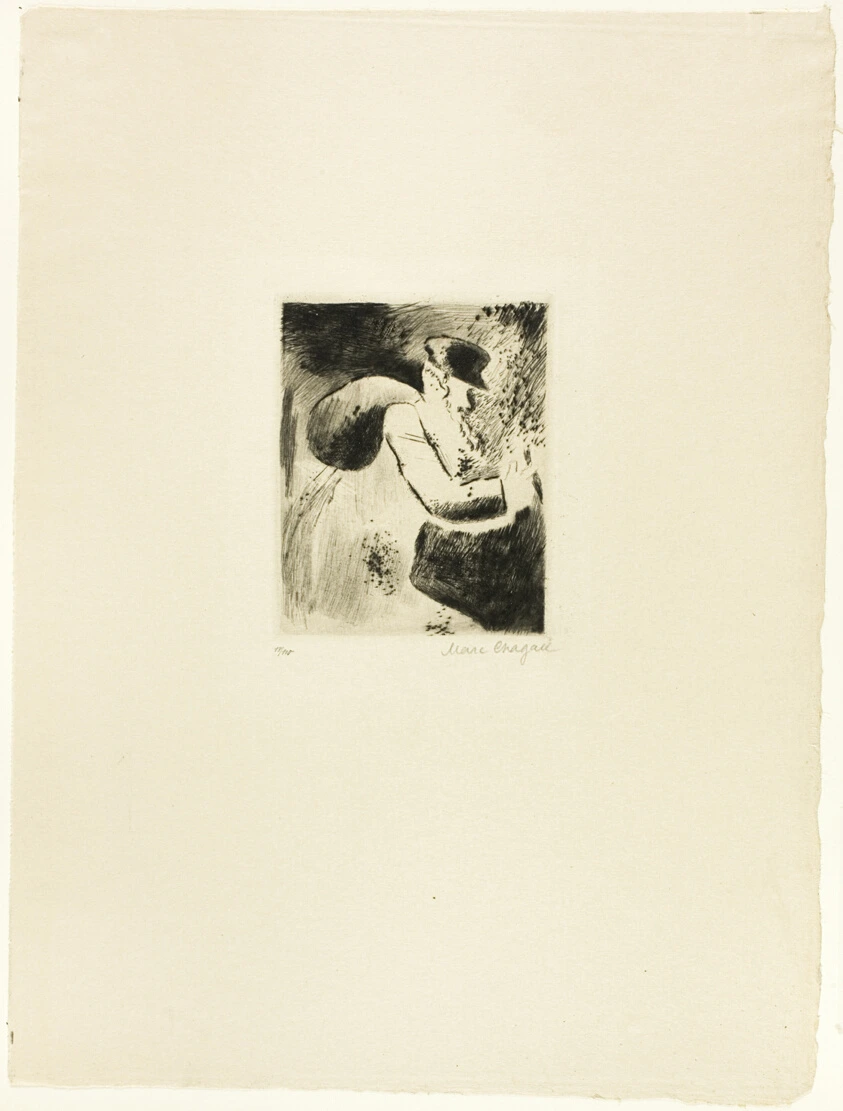
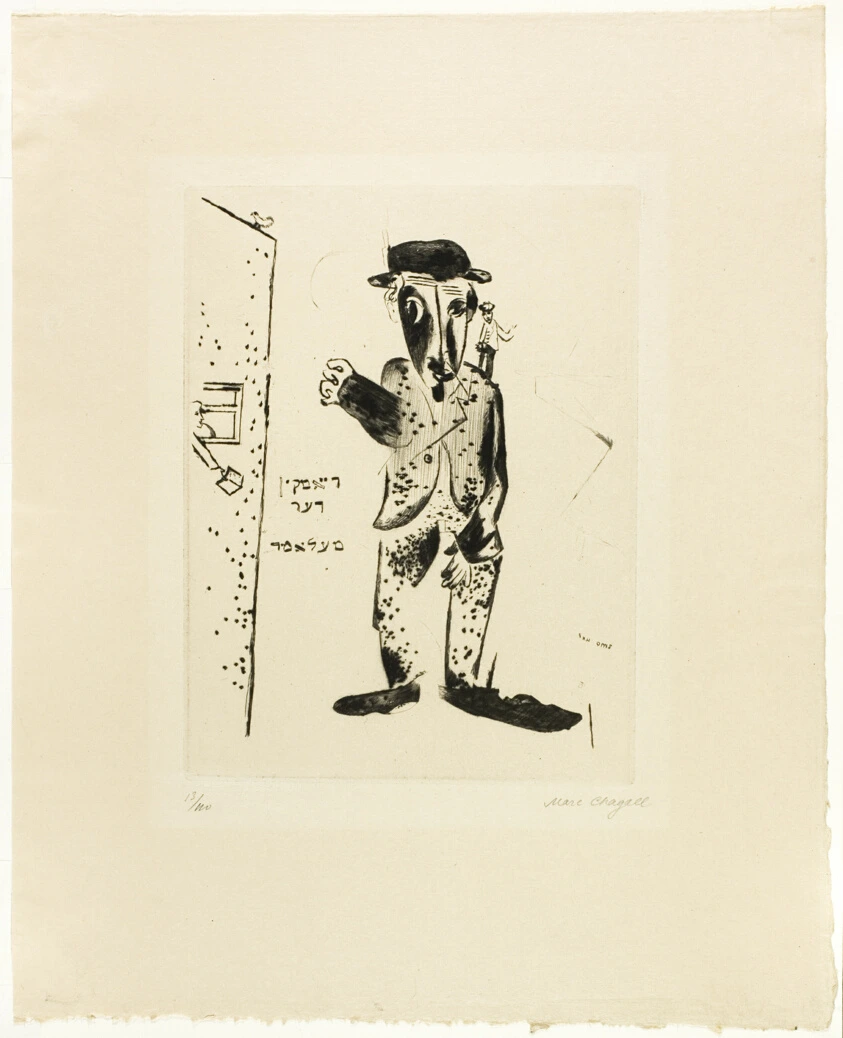
"The Teacher of Talmud, plate nine from Mein Leben" is a 1922 etching and drypoint that belongs to Marc Chagall's most important early print project, the series of illustrations for his autobiographical memoir "Mein Leben" (My Life) that documented his childhood in Vitebsk and his journey toward becoming an artist. The image shows a Talmudic scholar, his face bent over an open book in the posture of intense study that Chagall remembered from the traditional Jewish education of his youth. The technique of etching and drypoint creates a rich tonal range: the drypoint burr adds velvety depth to the shadows while the etched lines describe the architectural framework of the room and the scholar's absorbed presence. The buff Japanese paper provides a warm, luminous ground that makes the image feel intimate and precious, like a page from a family album. This print is autobiographical rather than merely descriptive: Chagall is not recording a generic Jewish type but memorializing the specific teachers who had shaped his early intellectual life, the men who introduced him to Hebrew letters and the narrative traditions of the Torah. The 1922 publication context is significant: Chagall was living in Berlin at this period, separated from his native Russia by revolution and civil war, and the "Mein Leben" prints functioned as a form of nostalgic return, a way of preserving the vanished world of Eastern European Jewry through art. Art historians have compared these etchings to the contemporaneous woodcuts of Ernst Ludwig Kirchner and the prints of Käthe Kollwitz, noting that Chagall's treatment is more lyrical, less politically charged than these German contemporaries. The work also influenced the development of Jewish American art in the mid-twentieth century, particularly the social realism of the Works Progress Administration.
Cultural Impact
This 1922 drypoint etching memorialized specific Vitebsk teachers through autobiographical nostalgic return, using velvety burr and buff Japanese paper to preserve vanished Eastern European Jewish intellectual life.
Why It Matters
It matters because Chagall drew his teacher reading and made the page look like a door to a lost home—proving that even exile couldn't erase what had been learned.