The Praying Jew

Description

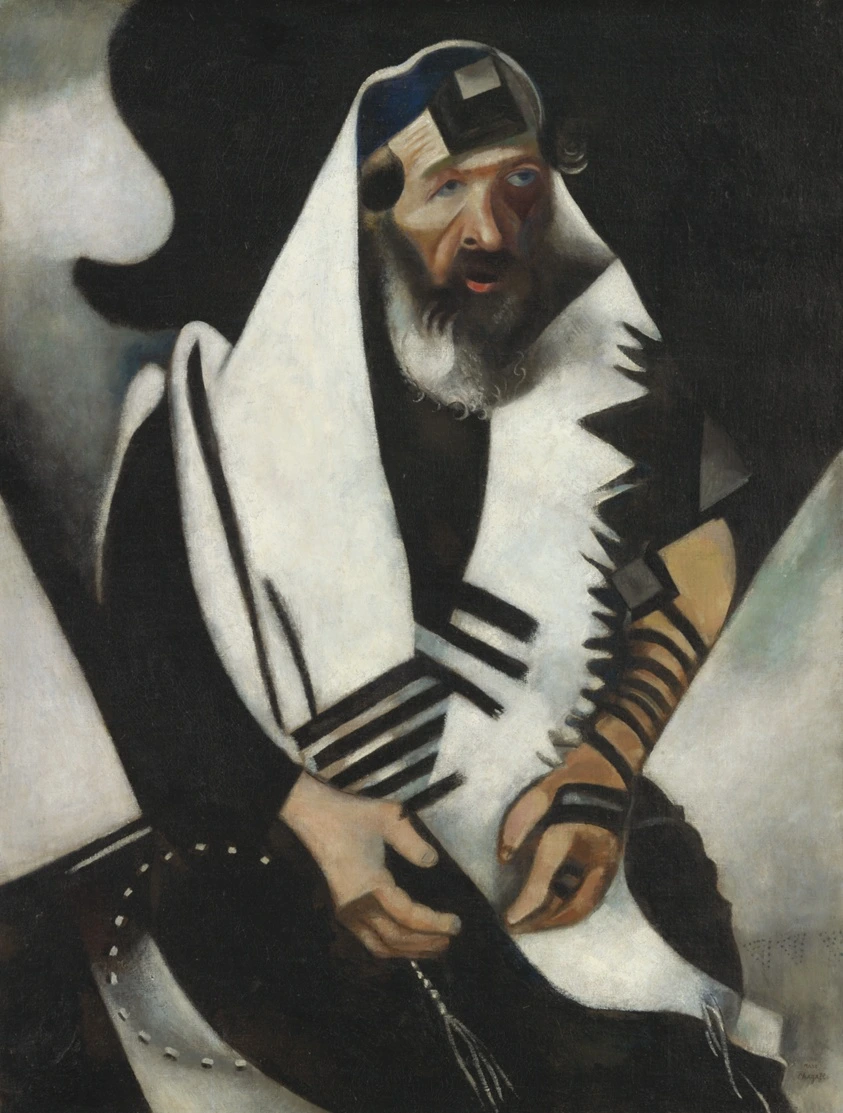
In his 1931 autobiography, My Life, Chagall related how, while visiting Vitebsk (present-day Belarus), the city in which he was born, he realized that the traditions in which he had grown up were fast disappearing and that he needed to document them. He paid a man to pose in his father’s prayer clothes and then painted him, limiting his palette primarily to black and white, as befit the solemnity of the subject. This portrait is noteworthy for the simplicity of its execution; nonetheless, its striking patterns, abstract background, and the slightly distorted features of the model demonstrate Chagall’s absorption of modern trends, especially Cubism.

Chagall often painted variants or replicas of works he particularly loved. The Art Institute’s Praying Jew is one of three versions of this composition. He painted the original canvas in 1914, and when he traveled back to Paris in 1923, he took this painting with him. He learned upon his return that much of the work he had left in France had been lost during World War I. This prompted him to make two versions of The Praying Jew before it left his studio: they are the present work and another in the Ca’ Pesaro, Venice; the original is now in the Kunstmuseum, Basel. The later compositions differ from the original only in small details.

This is one of thirty-five works that comprise the Winterbotham Collection. Click here to learn more about the collection.

Provenance

Sold through Pierre Loeb (1897–1964), Paris, to Patrick M. Sweeney, New York, 1924 [letter from James Sweeney, Sept. 1, 1975, in curatorial file]; sold to the Art Institute of Chicago, 1937.

The Praying Jew

Marc Chagall

1923 (one of two versions after a 1914 composition)

Accession Number

23700

Medium

Oil on canvas

Dimensions

116.8 × 89.4 cm (46 × 35 3/16 in.)

Classification

Painting

Museum

The Art Institute of Chicago

Chicago, United States

Credit Line

Joseph Winterbotham Collection
Background & Context

Background Story

"The Praying Jew" is one of Marc Chagall's most iconic and emotionally powerful paintings, executed in 1923 as one of two versions after a 1914 composition that had been lost, a work that encapsulates the artist's complex relationship with his Jewish heritage and his modernist aspirations. The image shows a Jewish man in prayer, his body bent forward in the traditional posture of devotion, his face obscured by the tallit (prayer shawl) that drapes over his shoulders and head. The figure is rendered with the floating, dreamlike quality that characterizes Chagall's mature style: the background is not a specific synagogue but a cosmic space of blues and greens where houses and trees drift like memories half-remembered from childhood. The scale is imposing—nearly 117 × 89 centimeters—making the solitary figure feel monumental, a representative of Jewish spirituality rather than an individual portrait. The 1923 date places this work in the period after Chagall's return to France from revolutionary Russia, when he was reestablishing his career in Paris and reconsidering the themes of his early work in light of the destruction of the world he had known. The painting also reflects the influence of Cubism, which Chagall had absorbed during his first Paris period: the figure is fractured into multiple perspectives, the space flattened and reassembled in ways that suggest both modernist sophistication and folk-art directness. Art historians have connected this work to the broader tradition of Jewish art in the twentieth century, from the biblical illustrations of Lipchitz to the abstracted Hebrew letters of Newman, noting that Chagall's treatment maintains a narrative and emotional accessibility that more abstract contemporaries sacrificed.

Cultural Impact

This 1923 monumental painting fused Cubist fragmentation with floating Jewish dream-memory, re-creating a lost 1914 composition to assert spiritual monumentality after revolutionary destruction.

Why It Matters

It matters because Chagall painted a man praying and made the room around him disappear into blue—proving that faith could be bigger than any synagogue if the colors were high enough.