Provenance
The artist. The Ford Foundation, New York; given to the Art Institute of Chicago, Mar. 18, 1964.
Accession Number
20430
Medium
Magna on canvas
Dimensions
335.3 × 228.6 cm (132 × 90 in.)
Classification
Painting
Credit Line
Gift of the Ford Foundation
Background & Context
Background Story
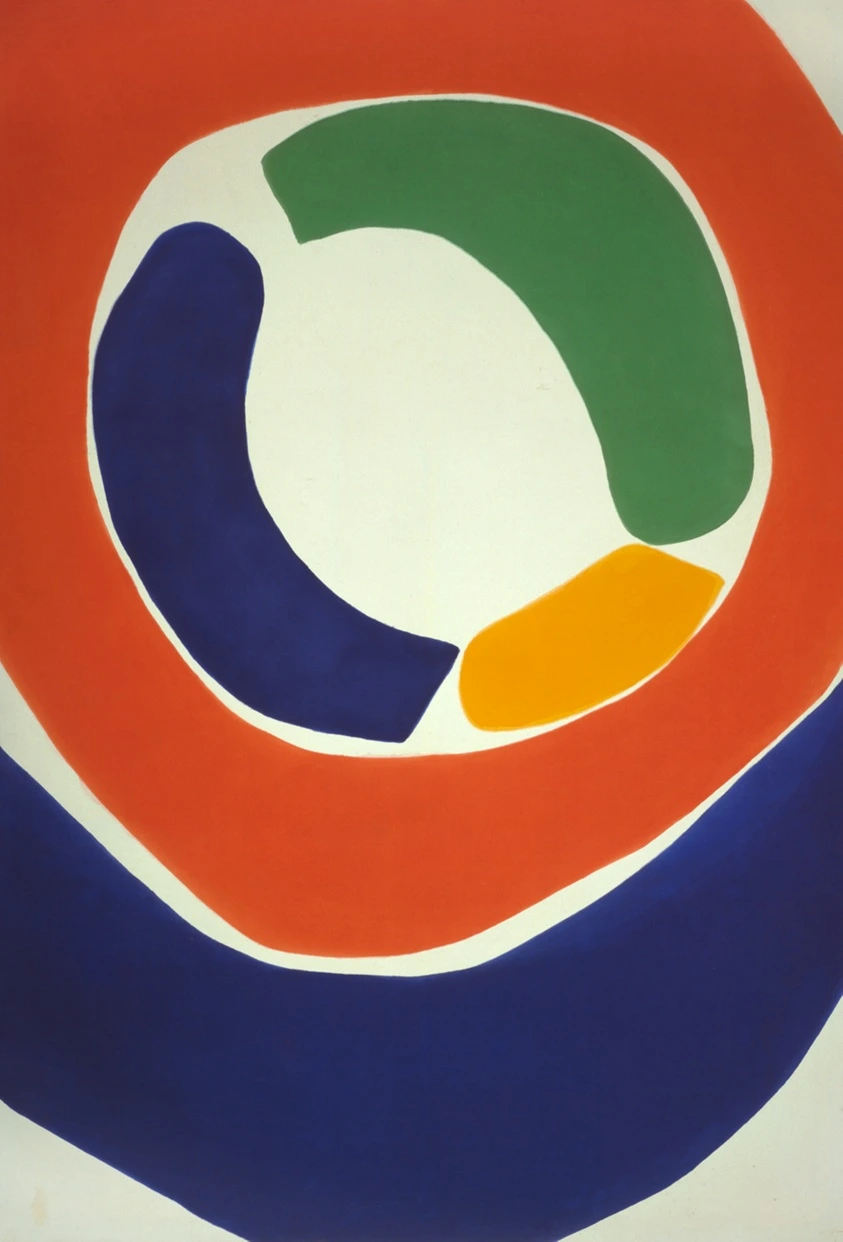
"Born in Snovsk" is a 1962 Magna on canvas by Jules Olitski that captures the Russian-American artist in his most monumental and coloristically daring mode, the image showing a vast field of color with the same attention to atmospheric effect and optical sensation that made Olitski one of the leading figures of the Color Field movement and a pioneer of the stained-canvas technique. The composition is a monumental canvas—335.3 × 228.6 centimeters—showing a single, unified field of color that suggests both the infinite space of the cosmos and the intimate presence of the artist's hand, the Magna medium creating a surface of extraordinary depth and luminosity that seems to glow from within. The 1962 date places this work in the period of Olitski's breakthrough to the color-field style, when he was producing the paintings that established his reputation as the leading innovator in acrylic technique and the critic Clement Greenberg's chosen exemplar of post-painterly abstraction. Art historians have connected this painting to the broader tradition of the monochrome in modern art, from the white paintings of Malevich to the black paintings of Ad Reinhardt, noting that Olitski's treatment is more focused on the materiality and the atmosphere, the optical effects of the stained surface, than the conceptual reduction or the spiritual transcendence of these other traditions.
Cultural Impact
This 1962 Magna canvas made color-field monumentally atmospheric through 335cm unified luminous field and acrylic stain depth, using 1962s breakthrough technique to establish post-painterly abstraction optical sensation beyond Malevich conceptual monochrome.
Why It Matters
It matters because Olitski poured paint onto a canvas the size of a wall and made the color feel like it was breathing—proving that even a single hue could be a world if the stain was deep enough.