White Crucifixion

Description

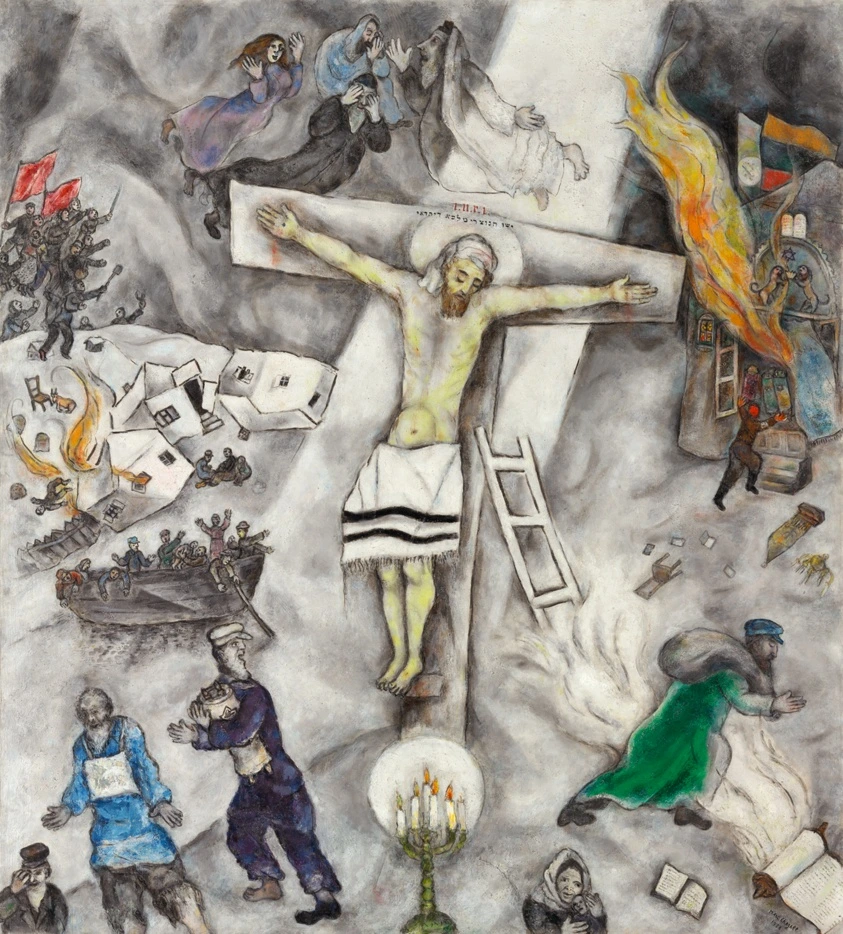
White Crucifixion is the first in Marc Chagall’s series of compositions that feature Jesus as a Jewish martyr and dramatically call attention to the persecution and suffering of Jews in 1930s Germany at the hands of the National Socialist Party. Chagall stressed Jesus’s religious identity by depicting him and the biblical figures above him in traditional Jewish garments. The surrounding images show the devastation of pogroms, violent attacks against Jewish communities often organized or sanctioned by local governments. Combining the Crucifixion with contemporary events, Chagall’s painting links the martyred Jesus with the Jewish people being persecuted across Europe and implicitly compares the Nazis with Jesus’s tormentors.

Provenance

The artist; given to his daughter, Ida Gordey (1916-1994), 1944 [letter from Marc Chagall to Daniel Catton Rich, Dec. 8, 1946, in curatorial file]; sold to the Art Institute of Chicago, 1946.

White Crucifixion

Marc Chagall

1938

Accession Number

59426

Medium

Oil on canvas

Dimensions

154.6 × 140 cm (60 7/8 × 55 1/16 in.)

Classification

Painting

Museum

The Art Institute of Chicago

Chicago, United States

Credit Line

Purchased with funds provided by Alfred S. Alschuler
Background & Context

Background Story

Marc Chagall (1887-1985) painted White Crucifixion in 1938, creating what has become the most politically powerful painting of his career and one of the most powerful artistic responses to the persecution of Jews in the 20th century. The painting depicts Christ on the cross, wearing a Jewish prayer shawl instead of a loincloth, surrounded by scenes of persecution—a synagogue burning, a fleeing family, a Torah scroll being desecrated—all rendered in Chagall's characteristic floating figures and luminous color. The 1938 date places this at the moment of Kristallnacht (November 9-10, 1938), when the Nazis destroyed Jewish synagogues, businesses, and homes across Germany and Austria, and the painting was created in direct response to the persecution of Jews that was escalating toward the Holocaust.

Cultural Impact

White Crucifixion is important in the history of 20th-century art because it is one of the most powerful artistic responses to the persecution of Jews in the Nazi era. Chagall's identification of Christ with the persecuted Jews of Europe—Christ wearing a Jewish prayer shawl, surrounded by scenes of Jewish suffering—creates a type of religious painting that is simultaneously devotional and political, making White Crucifixion one of the most morally powerful paintings of the 20th century.

Why It Matters

White Crucifixion is Chagall's moral response to Kristallnacht: Christ on the cross wearing a Jewish prayer shawl, surrounded by scenes of Jewish persecution—the burning synagogue, the fleeing family, the desecrated Torah scroll. The 1938 painting, created in direct response to the escalating persecution of Jews, is one of the most morally powerful paintings of the 20th century.