Provenance
Gunnar A. Sadolin [1874-1955], Dragor, Denmark, by 1939.[1] (sale, Sotheby's, London, 1 December 1965, no. 146); (P. & D. Colnaghi & Co., London and New York); sold 1965 to Mr. Paul Mellon Upperville, VA; gift 1985 to NGA.
[1] Published in Sadolin collection in Pissarro/Venturi 1939, no. 5.
Accession Number
1985.64.30
Medium
oil on canvas
Dimensions
overall: 27.7 x 41 cm (10 7/8 x 16 1/8 in.) | framed: 49.2 x 35.9 x 3.8 cm (19 3/8 x 14 1/8 x 1 1/2 in.)
Classification
Painting
Credit Line
Collection of Mr. and Mrs. Paul Mellon
Tags
Painting Impressionist & Modern (1851–1900) Oil Painting Canvas French
Background & Context
Background Story
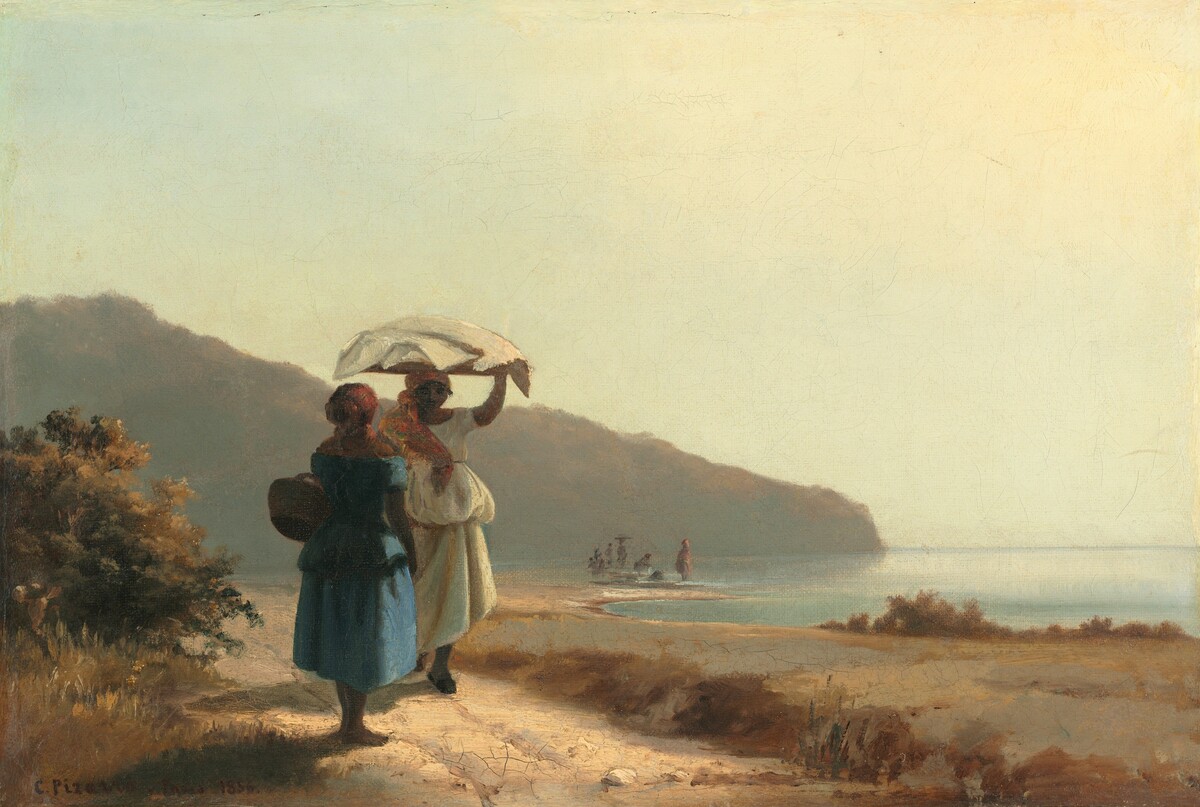
Two Women Chatting by the Sea, St. Thomas, painted in 1856, is one of Pissarro earliest surviving works and a document of his Caribbean origins. The painting depicts two women in colonial dress conversing on a shoreline, the Caribbean Sea stretching to a horizon under a tropical sky.
Pissarro was born in 1830 in Charlotte Amalie, St. Thomas (then part of the Danish West Indies), to a Sephardic Jewish family. He grew up in the Caribbean and did not settle permanently in France until 1855, when he was 25. This early painting, executed while he was still living in St. Thomas, reveals the origins of his art in a landscape and a social world far removed from the French countryside that would become his primary subject.
The painting most distinctive quality is its treatment of light. The Caribbean light - brighter, flatter, and more intense than any northern European equivalent - already shows the quality that would define Pissarro Impressionist paintings: a commitment to rendering the specific character of light in a specific place. Pissarro, who would become the most consistently plein-air of the Impressionists, learned to paint outdoors in the Caribbean, where the intensity of the light made every other method of working impossible.
Cultural Impact
Pissarro Caribbean paintings document the multicultural origins of Impressionism and reveal the movement roots in a colonial experience far from the Parisian suburbs where it flourished. His early Caribbean works influenced his lifelong commitment to painting the rural poor and his democratic vision of art proper subjects.
Why It Matters
This painting captures the origin of Pissarro art: a Caribbean shoreline, a tropical sky, and two women talking - the simplest of subjects, painted with the directness that would become Impressionism defining virtue. Pissarro never forgot the lesson of St. Thomas: that the world, seen directly and painted honestly, is beautiful enough.