Provenance
By inheritance from the artist [1830-1903] to his wife, Mme. Camille [Julie] Pissarro; (Pissarro sale, Galerie Georges Petit, Paris, 3 December 1928, no. 44); purchased by Van Riel.[1] Bruno Stahl [1892-1958], Berlin, later Brussels and New York;[2] sold 5 January 1949 to (Wildenstein & Co., London, New York and Paris);[3] sold 30 March 1949 to Ailsa Mellon Bruce [1901-1969], New York;[4] bequest 1970 to NGA.
[1] According to annotated sales catalogues, copies in NGA curatorial records.
[2] This painting was confiscated by the ERR in France during World War II, with other objects from the Stahl collection that were stored in a bank vault with objects from the Wildenstein collection (ERR card UNB331, as _Ansicht des Louvres, Paris_. National Archives RG260/Property Division/Box 22, copy in NGA curatorial files). The collection was likely established by Bruno's father, Heinrich Stahl [1868-1942] of Berlin. Bruno left Germany for Brussels in 1933 where he remained until 1940. He and his family eventually emigrated to the United States after 1941. The Pissarro was transferred to the Jeu de Paume and taken by Hermann Goering on 17 March 1941, as _Louvreansicht_, (No. 20 on the _Nachtrag zur Liste v. 20.10.42 der für die Sammlung des Reichsmarschalls Hermann Göring abgegebenen Kunstgegenstände_ dated 9 April 1943 in OSS Consolidated Interrogation Report #2, The Goering Collection, Attachment 5, National Archives RG239/Entry 75/Box 85, copy in NGA curatorial files). Goering traded the picture to Gustave Rochlitz in exchange for a Raffaellino del Garbo and a Wouters (OSS Consolidated Interrogation Report #1, Activities of the Einsatzstab Reichsleiter Rosenberg, p. 30, National Archives RG239/Entry 75/Box 85, copy in NGA curatorial files). The painting remained with Rochlitz, in whose possession it was found after the war (Detailed Interrrogation Report #4, Gustave Rochlitz, p. 9, National Archives RG239/Entry 74/Box 84, copy in NGA curatorial files). The painting was restituted to France on 27 March 1946 (Munich property card #8040/6; French Receipt for Cultural Objects no. 5A, item no. 289, copies in NGA curatorial files). It was exhibited in 1946 in _Les Chefs-d'oeuvre des collections privées françaises retrouvés en Allemagne par la Commission de Récuperation artistique et les Services alliés_, no. 33. It was restituted to Wildenstein, from whose vault it had been removed, on 24 October 1947, and returned to Stahl that same year. Stahl sold the picture to Wildenstein on 5 January 1949.
[3] See letter from Wildenstein dated 31 January 2001 in NGA curatorial files.
[4] Bill of sale from Wildenstein dated 30 March 1949, in NGA curatorial files.
Accession Number
1970.17.55
Medium
oil on canvas
Dimensions
overall: 54.9 x 65.4 cm (21 5/8 x 25 3/4 in.) | framed: 79.7 x 89.5 x 10.1 cm (31 3/8 x 35 1/4 x 4 in.)
Classification
Painting
Credit Line
Ailsa Mellon Bruce Collection
Tags
Painting Impressionist & Modern (1851–1900) Oil Painting Canvas French
Background & Context
Background Story
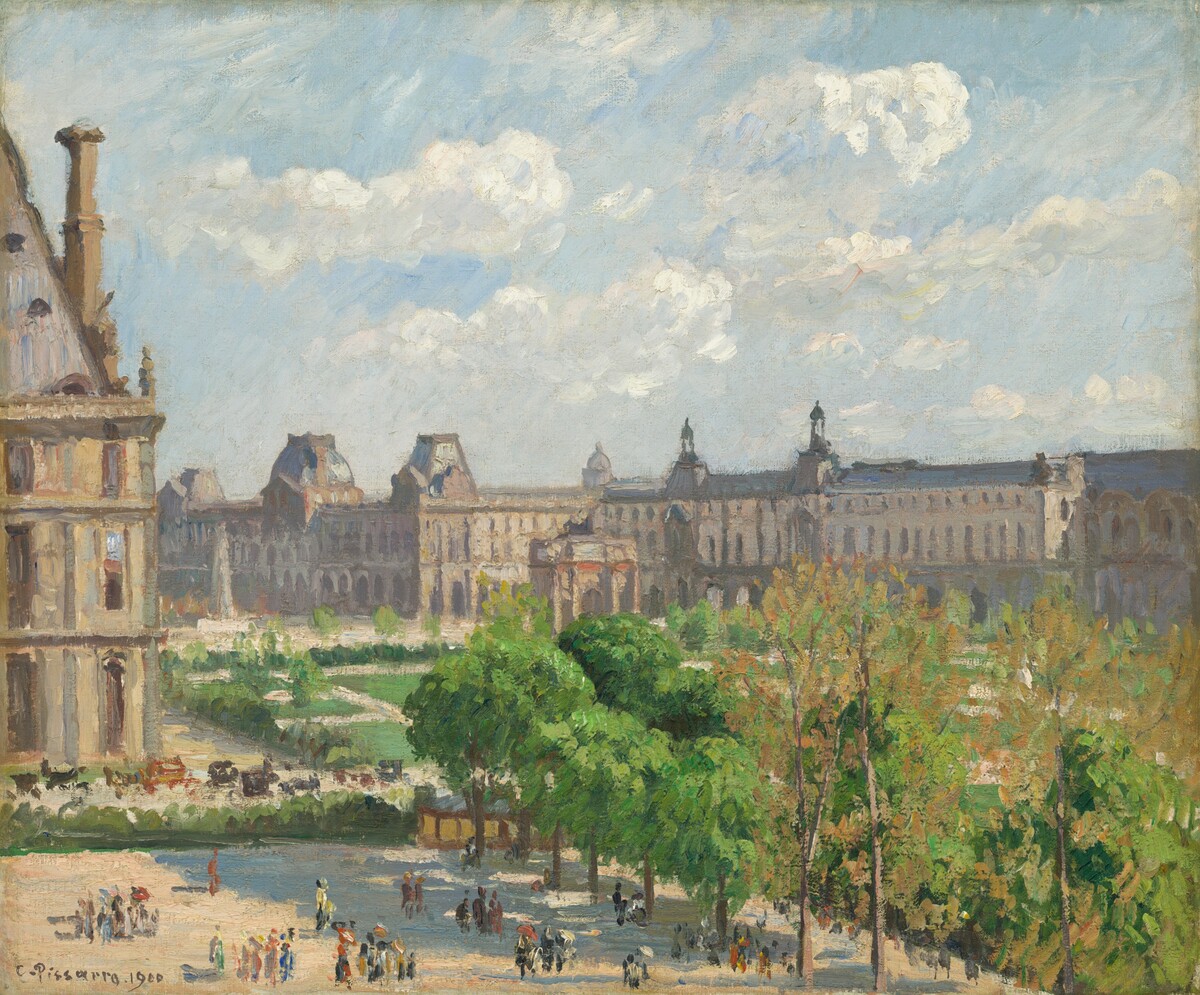
Camille Pissarro's Place du Carrousel, Paris (1900) depicts one of Paris's most historically charged public spaces—the square between the Louvre and the Tuileries Gardens, at the very heart of French power and culture. By 1900, Pissarro was seventy years old and had been painting Parisian views for over a decade from his apartment windows—the high viewpoints that gave his urban paintings their characteristic compositional format. The Place du Carrousel had been the site of revolutionary violence, imperial ceremony, and Republican celebration—it was where the Tuileries Palace had burned during the Commune of 1871, and where generations of French citizens had demonstrated for their rights. Pissarro's painting, created during the Belle Époque's optimistic opening, captures the square's everyday life rather than its historical drama: carriages, pedestrians, and the routine circulation of a city at work and play. The year 1900 was also the year of the Exposition Universelle—the world's fair that celebrated French achievement and attracted millions of visitors to Paris. Pissarro's view of the Place du Carrousel during this exceptional year provides a ground-level counterpoint to the Exposition's spectacular self-presentation, showing how Paris actually looked to its residents rather than its visitors.
Cultural Impact
Pissarro's Parisian urban views influenced how the modern city was represented in Impressionist art, establishing the high-viewpoint format that became a convention of urban landscape painting. The paintings influenced later urban painters from the Cubists to the Street photographers who similarly found their subjects from elevated viewpoints. The Place du Carrousel subject influenced how Paris's historical spaces were represented in art, connecting everyday life to historical significance.
Why It Matters
This painting matters because it demonstrates how Impressionism could serve urban subjects as effectively as rural ones—a crucial expansion of the movement's range that Pissarro pioneered. The everyday life of the Place du Carrousel, painted in the year of the Exposition Universelle, provides both a record of Paris at its cultural peak and an argument for the artistic significance of ordinary urban experience.