Provenance
(Worth Gallery, Palm Beach, Florida); acquired 1 April 1954 by Ailsa Mellon Bruce [1901-1969]; bequest 1970 to NGA.
Accession Number
1970.17.165
Medium
pen with brown and black ink, gray wash, and graphite on gray-blue laid paper
Dimensions
overall: 24 x 31.3 cm (9 7/16 x 12 5/16 in.)
Classification
Drawing
Credit Line
Ailsa Mellon Bruce Collection
Tags
Drawing Impressionist & Modern (1851–1900) Ink Graphite & Pencil Paper French
Background & Context
Background Story
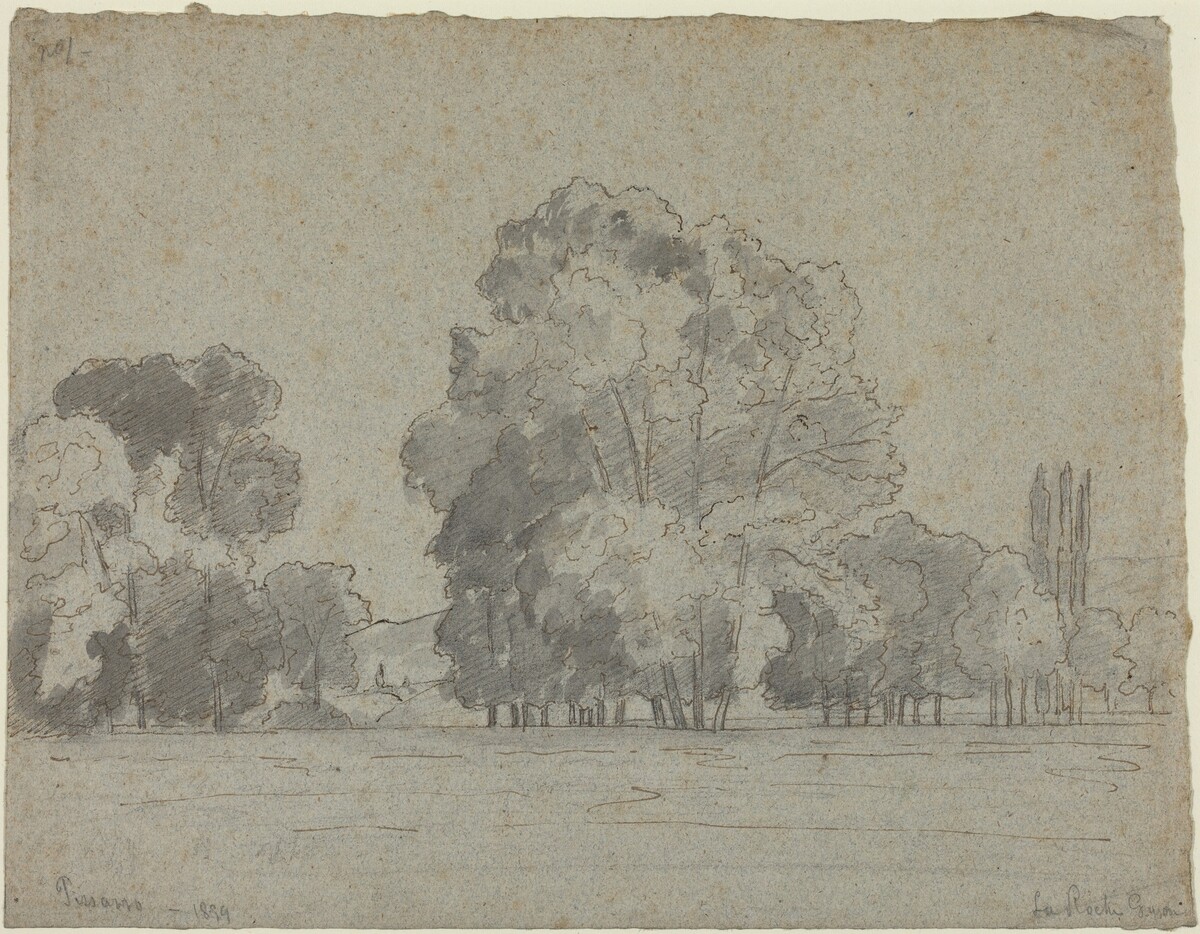
Grove of Trees (1859) is one of Pissarro's earliest surviving works, revealing the artistic foundations that would produce one of Impressionism's most important figures. The year 1859 places this work during Pissarro's formative period, when he had recently arrived in Paris from the Danish West Indies (now US Virgin Islands) and was studying the landscape tradition that would inform his entire career. The grove of trees—a modest, intimate landscape subject rather than the spectacular vistas favored by the Hudson River School—reveals Pissarro's early preference for unassuming natural subjects. This preference would distinguish his Impressionism from Monet's more dramatic landscapes and would influence the movement's democratic engagement with ordinary scenery. The painting's handling likely shows the influence of Corot, whom Pissarro admired and whose gentle, atmospheric approach to landscape provided an alternative to the Academic tradition's more rhetorical style. The grove of trees, as a subject, also connects Pissarro to the Barbizon School's engagement with forest interiors—Millet, Rousseau, and Daubigny painted similar subjects, and the young Pissarro was clearly learning from their example while developing his own approach to the same material.
Cultural Impact
Pissarro's early landscape paintings influenced how Impressionism's origins were understood, revealing the Barbizon School's direct influence on the movement that would supersede it. The paintings influenced how forest and grove subjects were treated in French art, establishing a tradition of intimate woodland painting that contrasted with the Hudson River School's more grandiose approach. The 1859 grove painting influenced how Pissarro's development was traced, providing evidence of his earliest artistic convictions.
Why It Matters
This painting matters because it reveals the origins of Pissarro's art in the Barbizon tradition that preceded Impressionism. The grove of trees—modest, atmospheric, and intimate—contains the seeds of the democratic landscape painting that would characterize Pissarro's entire career, arguing that artistic significance is not a function of spectacular subjects but of attentive looking.