Provenance
John Saulnier, Bordeaux, by 1886; his sale, Paris, Hôtel Drouot, June 5, 1886, lot 73 for 24,500 francs to Brogue et Cie, possibly as agent for Eugène Secrétan [price and buyer according to an annotated sale catalogue in the Rijksbureau voor Kunsthistorische Documentatie, The Hague]. Eugène Secrétan, Paris, by 1889; his sale Galerie Sedelmeyer, July 1, 1889, lot 71. Henry Field (died 1890), Chicago; his widow Mrs. Florence Lathrop Field; given to the Art Institute, 1894.
Accession Number
894
Medium
Oil on panel
Dimensions
42.2 × 54 cm (15 5/8 × 21 1/4 in.); Framed: 71.8 × 85.1 cm (28 1/4 × 33 1/2 in.)
Classification
Painting
Credit Line
Henry Field Memorial Collection
Background & Context
Background Story
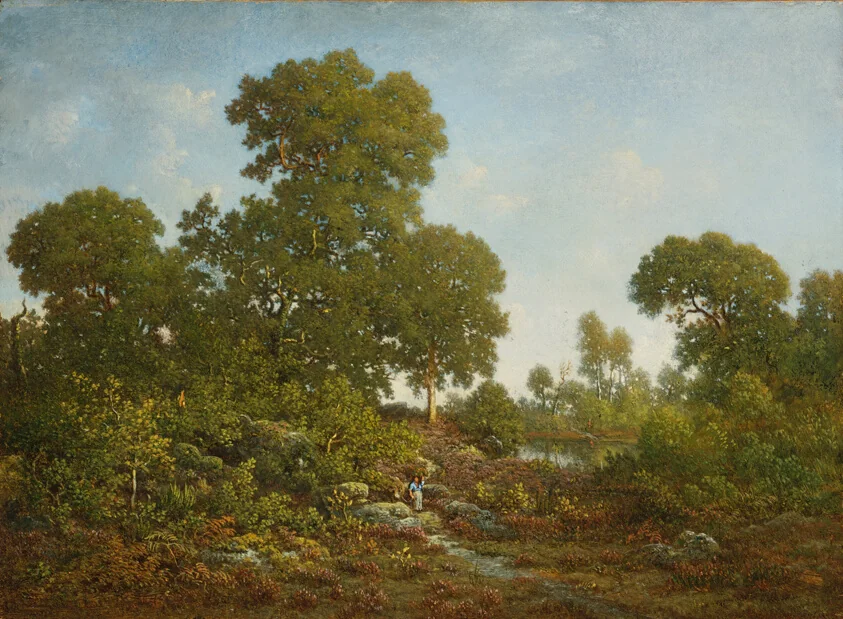
"Springtime" is a c. 1860 oil on panel by Théodore Rousseau that captures the French Barbizon School painter in his most tender and seasonally evocative mode, the image showing a spring landscape with the same attention to the details of nature that Rousseau brought to all his works, but transformed by the theme of renewal and growth into something more hopeful and delicate. The composition is a view of fields and trees in the early spring, the new leaves and the fresh grass rendered with a palette of greens, yellows, and soft browns that suggests both the physical reality of the season and the emotional warmth of the artist's response to it. The oil on panel technique creates a surface of extraordinary smoothness and luminosity, the medium allowing for the subtle gradations of tone and color that suggest the soft light and the gentle air of the springtime. The c. 1860 date places this work in the mature period of the Barbizon School, when Rousseau was producing the paintings that would influence the development of Impressionism and establish his posthumous reputation as one of the greatest French landscape painters. Art historians have compared this painting to the spring landscapes of Corot and the seasonal studies of the Dutch masters, noting that Rousseau's treatment is more naturalistic, more focused on the specific observations of the changing season than the poetic or the allegorical approaches of these other traditions.
Cultural Impact
This c. 1860 oil panel made spring renewal delicately hopeful through green-yellow-brown new-growth palette and panel-smooth luminosity, using mature Barbizon naturalistic observation to influence Impressionist seasonal sensibility beyond Corot's poetic allegory.
Why It Matters
It matters because Rousseau painted spring and made the panel feel like it was waking up—proving that even a landscape could be young again if the green was fresh enough.