Description
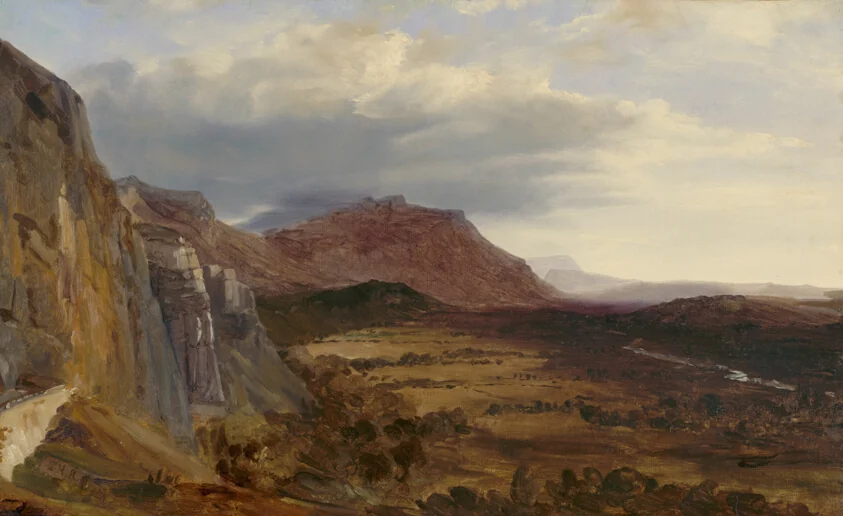
An ardent explorer of the remotest corners of France, Théodore Rousseau painted View of Salève, near Geneva during a three-month stay in the mountainous Jura region. Although his larger canvases were consistently excluded from the official Parisian art show known as the Salon, his smaller panoramic oil sketches found mainstream admirers. With a few deft strokes, Rousseau conveyed steep, rocky outcroppings; plains dotted with shrubs; and the luminosity of moisture-laden clouds and sky.
Accession Number
193926
Medium
Oil on paper, mounted to canvas
Dimensions
39 × 62 cm (15 3/8 × 24 3/8 in.); Framed: 52.8 × 76.2 cm (20 3/4 × 30 in.)
Classification
Painting
Credit Line
Through prior gift of Henry Morgen, Ann G. Morgen, Meyer Wasser, and Ruth G. Wasser
Background & Context
Background Story
"View of Salève, near Geneva" is an 1834 oil on paper mounted to canvas by Théodore Rousseau that documents the French Barbizon School painter in his early maturity, the image showing a view of the Salève mountain near Geneva with the panoramic sweep and atmospheric sensitivity that would make Rousseau the leading landscape painter of his generation. The composition is a wide, horizontal view, the mountain rising in the background with the villages and fields spread out in the foreground, the oil on paper creating a surface of extraordinary luminosity and freshness that suggests both the specific topography of the Swiss landscape and the general mood of alpine grandeur. The 1834 date places this work in the period of Rousseau's first major successes, when he was producing the landscapes that established his reputation as the leading painter of the emerging Barbizon School and the heir to the Dutch and English landscape traditions. Art historians have connected this painting to the broader tradition of the alpine landscape in European art, from the sublime peaks of Turner to the pastoral valleys of the Swiss painters, noting that Rousseau's treatment is more balanced, more focused on the harmonious relationship between the mountain and the human settlement than the dramatic terror or the idealized pastoralism of these other traditions.
Cultural Impact
This 1834 oil paper made alpine panorama luminously fresh through wide horizontal mountain-village sweep, using specific Swiss topography to balance Turner sublime terror with emerging Barbizon harmonious human-settlement relationship.
Why It Matters
It matters because Rousseau painted a mountain near Geneva and made the paper feel like it was looking back at the sky—proving that even a view could be a conversation if the valley was wide enough.


