Accession Number
4613
Medium
Etching on cream laid paper
Dimensions
Image: 12.5 × 16.7 cm (4 15/16 × 6 5/8 in.); Plate: 13.3 × 20.7 cm (5 1/4 × 8 3/16 in.); Sheet: 21 × 30 cm (8 5/16 × 11 13/16 in.)
Classification
etching
Credit Line
William McCallin McKee Memorial Endowment
Background & Context
Background Story
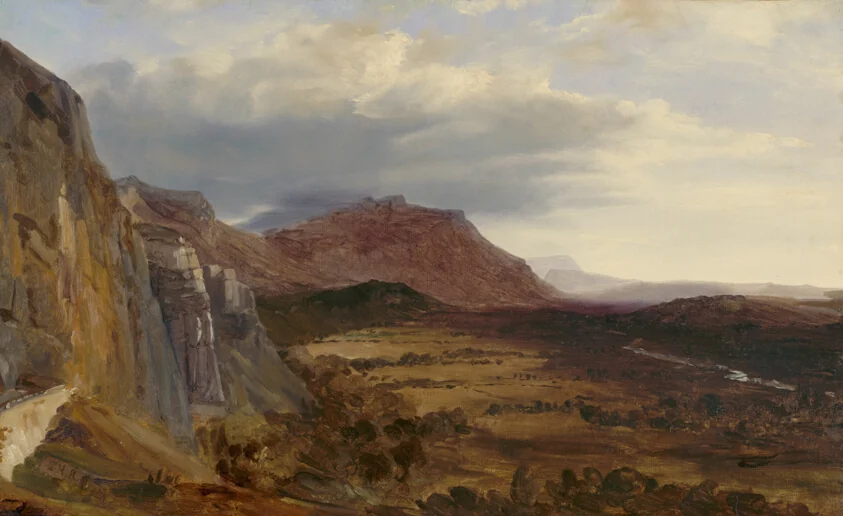
Theodore Rousseaus Rock Oaks from 1861 is an etching on cream laid paper that depicts oak trees growing among rocks with the atmospheric subtlety and tonal richness that distinguish the Barbizon masters approach to the French landscape, in which the specific topography of a particular place is transformed into a meditation on the relationship between nature and the human spirit. Rousseau, who was the leader of the Barbizon School and the most accomplished landscape painter in France during the mid-19th century, produced etchings throughout his career alongside his paintings, creating works that translate the atmospheric effects and tonal richness of his oil paintings into the graphic medium of etched lines and tonal areas. The rock oaks of the title, with their gnarled trunks and twisted branches growing among the boulders that characterize the landscape of the Forest of Fontainebleau, provided Rousseau with a subject that combined the specific character of the French countryside with the more general themes of growth, age, and persistence that are implicit in the image of trees growing in difficult conditions. The etching medium, with its capacity for both fine lines and broad tonal areas, allows Rousseau to create the contrast between the rough texture of the bark and rocks and the atmospheric depth of the forest interior that distinguishes his best landscapes. The year 1861 places this etching in the period of Rousseaus greatest public recognition, when he was producing some of his most accomplished landscapes of the Forest of Fontainebleau.
Cultural Impact
Rousseaus etchings are significant contributions to the history of French landscape printmaking, and Rock Oaks demonstrates the combination of specific topography and atmospheric depth that makes his work the model for Barbizon landscape. The etching influenced the development of landscape etching and the broader tradition of French landscape art.
Why It Matters
A 1861 etching by Rousseau on cream laid paper depicting oak trees growing among rocks in the Forest of Fontainebleau, combining the specific topography of the French countryside with atmospheric subtlety and tonal richness in the Barbizon tradition of landscape meditation.