View of IJsselmonde Seen Across the New Maas

Description

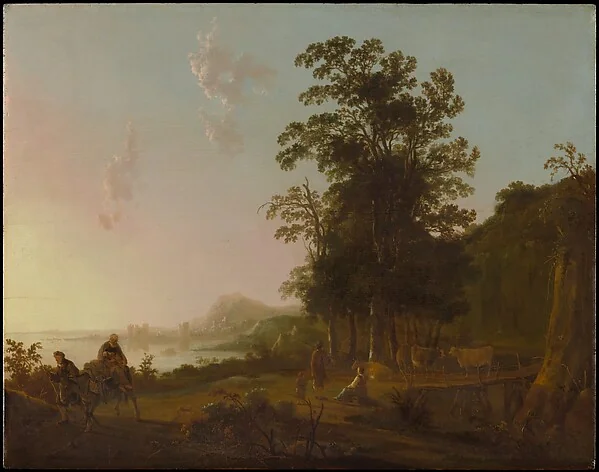
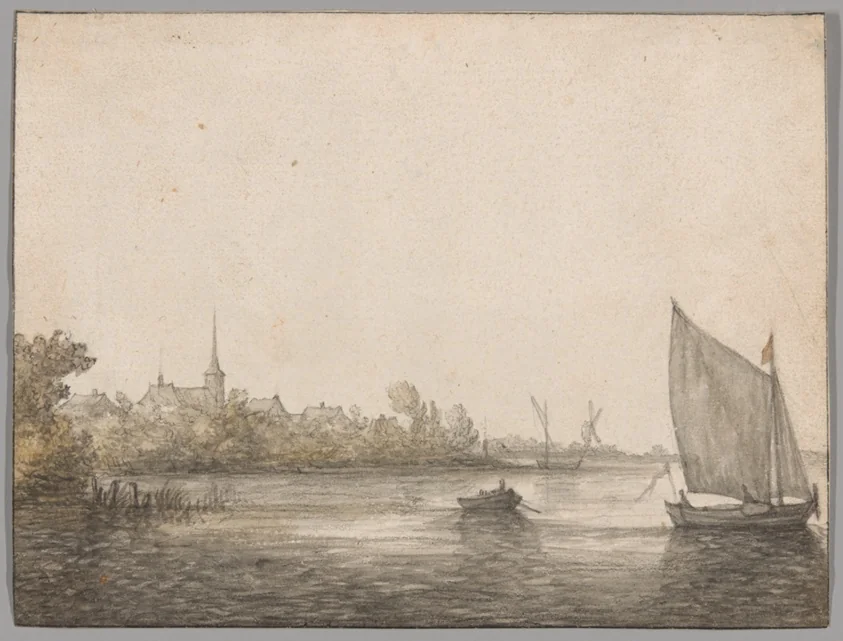
Even though he never ventured to Italy, Aelbert Cuyp distinguished himself as an artist who could evoke the golden light so often associated with southern Europe. Two of his works (View of IJsselmonde Seen across the New Maas (1967.383) and A View of Vianen with a Herdsman and Cattle by a River (2003.169), created around the same time, indicate how he achieved this effect in two different media. In both cases, Cuyp employed a restrained but highly evocative palette in which he selectively contrasted the dark brown elements of the foreground and the expansive gold-cast skies seen beyond the water in the middle ground. Although in the painting he achieved this effect by covering his entire canvas with pigment, it is remarkable to consider the atmospheric effects he created in the drawing with the strategic and minimal use of color on paper.

Provenance

William Mitchell (died 1908), Australia, London, and Eastbourne [blind stamp (Lugt 2638), verso, lower left].  William Pitcairn Knowles (1820–1894), Rotterdam and Wiesbaden [stamp (Lugt 2643), verso, lower center in purple]; sold, Frederik Muller and Company, Amsterdam, June 25, 1895.  Rudolf Philip Goldschmidt (c. 1840–1914), Berlin [stamp (Lugt 2926), verso, lower left, in black]; sold, Prestel, Frankfurt-am-Main, Oct. 4–11, 1917, lot 153. Curt Otto (c. 1880–1929), Leipzig; sold, C. G. Boerner, Leipzig, Nov. 7, 1929, lot 46.  Sold, C. G. Boerner, Leipzig, Apr. 28, 1939, lot 371 to Mertens [correspondence with Dr. F. Carlo Schmid of C. G. Boerner, Mar. 2004 in curatorial file]. Sold by Paul Drey Gallery, New York, to the Art Institute of Chicago, 1967.

View of IJsselmonde Seen Across the New Maas

Aelbert Cuyp

c. 1640

Accession Number

27606

Medium

Brush and black and yellow ochre watercolors, over black chalk, on ivory laid paper

Dimensions

14.5 × 19 cm (5 3/4 × 7 1/2 in.)

Classification

watercolor

Museum

The Art Institute of Chicago

Chicago, United States

Credit Line

Worcester Sketch Fund

Background & Context

Background Story

"View of IJsselmonde Seen Across the New Maas" is a c. 1640 watercolor by Aelbert Cuyp that captures the Dutch Golden Age master in his most topographically specific and coloristically luminous mode, the image showing the view across the New Maas with the same golden light and atmospheric clarity that characterized his most refined watercolors. The composition is a small watercolor—14.5 × 19 centimeters—showing IJsselmonde with the brush and black and yellow ochre watercolors over black chalk on ivory laid paper creating a surface of extraordinary luminosity and topographical precision. The combination of black and yellow ochre watercolors creates a warm, golden harmony that suggests both the physical reality of the Dutch landscape and the timeless quality of the afternoon light. The ivory laid paper provides a warm, luminous ground that enhances the sense of atmospheric depth and golden serenity. The c. 1640 date places this work in the period of Cuyp's most intensive production of watercolors and his exploration of the Dutch landscape through the transparent medium. Art historians have connected this watercolor to the broader tradition of the topographical view in Dutch art, from the drawings of the period to the paintings of the Italianate Dutchmen, noting that Cuyp's treatment is more focused on the coloristic harmony and the atmospheric suggestion, the transformation of observed reality into golden vision, than the architectural precision or the cartographic accuracy of these other traditions.

Cultural Impact

This c. 1640 watercolor made IJsselmonde topographically golden through small 14cm black-yellow-ochre watercolor harmony and ivory-paper atmospheric luminosity, using intensive watercolor production to transform Dutch river view into golden timeless vision beyond cartographic architectural precision.

Why It Matters

It matters because Cuyp painted a view across a river and made the paper feel like it was holding a piece of eternal Dutch afternoon—proving that even a sketch could be a homeland if the ochre was warm enough.