Description
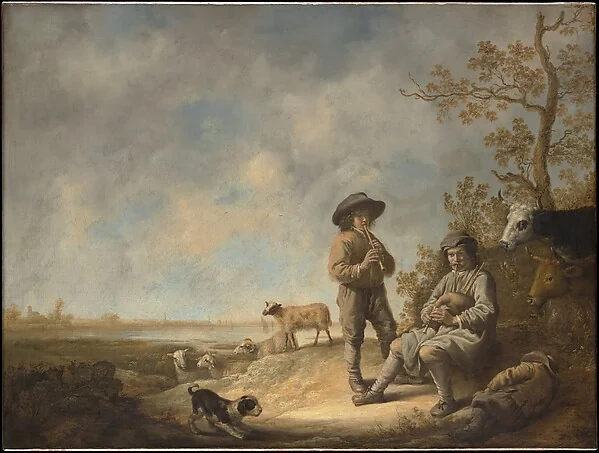
Aelbert Cuyp never traveled to Italy, yet he employed the golden light typical of southern Europe to dramatize his distinctly Dutch pastoral subjects. He enhanced views of the meandering rivers and flat terrain with cows and sheep, animals that abounded in the local countryside. In this relatively early painting, his use of a warm, monochrome color palette reflects the influence of his older contemporary, Jan van Goyen.
Provenance
Dowdeswell Gallery, London. Mrs. Fleischmann, by 1911 (lent by her to London, 1911). Noel Ashcroft, Birmingham, by 1915 (lent by him to Birmingham, 1915); by descent to his widow (lent by her to Birmingham 1950); on loan to Birmingham City Art Gallery, 1968 to 1992; sold, Sotheby's, London, December 9, 1992, no. 16, to Galerie Edel, Cologne and London; Galerie Edel, Cologne and London. Private Collection, Germany; sold through agency of Edel to Haboldt & Co., Paris and New York, by 2003; sold to the Art Institute, 2003.
Accession Number
181702
Medium
Oil on panel
Dimensions
40 × 55 cm (15 3/4 × 21 5/8 in.); Framed: 57.2 × 72.1 × 5.7 cm (22 1/2 × 28 3/8 × 2 1/4 in.)
Classification
Painting
Credit Line
Charles H. and Mary F. S. Worcester Fund
Background & Context
Background Story
"A View of Vianen with a Herdsman and Cattle by a River" is a c. 1643–c. 1645 oil on panel by Aelbert Cuyp that captures the Dutch Golden Age master in his most luminously atmospheric and pastoral mode, the image showing the Dutch countryside with the same golden light and peaceful serenity that made Cuyp the leading painter of the Dutch pastoral landscape. The composition is a medium-sized panel—40 × 55 centimeters—showing Vianen with the herdsman and cattle by the river rendered with the oil on panel creating a surface of extraordinary warmth and atmospheric depth. The panel support provides a smooth, stable ground that enhances the luminosity and richness of the colors. The c. 1643–c. 1645 date places this work in the period of Cuyp's most intensive production of pastoral landscapes and his establishment as the leading painter of the Dutch light. Art historians have connected this painting to the broader tradition of the pastoral landscape in Dutch art, from the works of van Goyen to the paintings of the Italianate Dutchmen, noting that Cuyp's treatment is more focused on the golden light and the peaceful atmosphere, the transformation of observed reality into pastoral idyll, than the topographical accuracy or the moral symbolism of these other traditions.
Cultural Impact
This c. 1643-45 oil panel made Vianen pastorally luminous through medium 40cm golden-light peaceful serenity and smooth panel-support atmospheric warmth, using intensive Dutch pastoral production to transform river-cattle observation into golden pastoral idyll beyond van Goyen topographical moral symbolism.
Why It Matters
It matters because Cuyp painted a herdsman with his cattle and made the panel feel like it was glowing with eternal afternoon light—proving that even a cow could be holy if the light was golden enough.