Accession Number
85675
Medium
Graphite with brush and gray wash, on tan laid paper
Dimensions
7.2 × 14.9 cm (2 7/8 × 5 7/8 in.)
Classification
graphite
Credit Line
The Leonora Hall Gurley Memorial Collection
Background & Context
Background Story
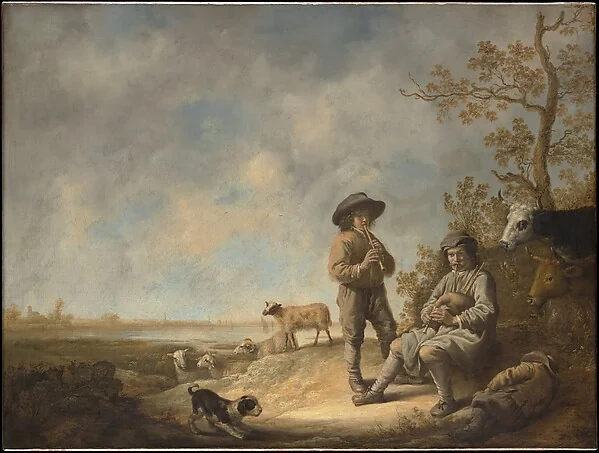
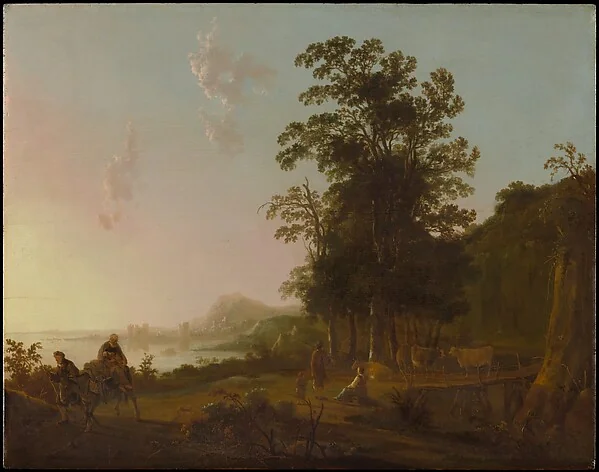
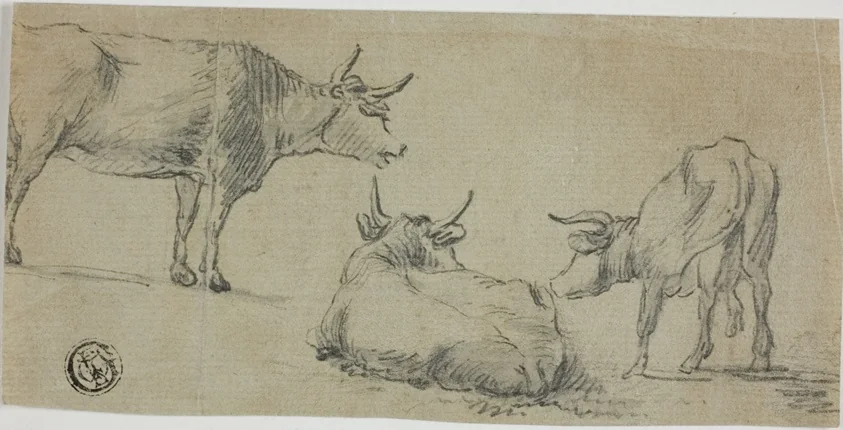
Aelbert Cuyp's Three Sketches of Cows demonstrates the Dutch Golden Age artist's methodical approach to building his iconic pastoral landscapes from closely observed animal studies. Each of the three cows is rendered from a different angle—one standing in profile, one resting, one turned toward the viewer—capturing the weight and mass of the animals with swift yet precise strokes of graphite reinforced by gray wash. Cuyp's cattle paintings were among the most sought-after works of the 17th century, prized by English collectors in particular for their golden light and idyllic atmosphere. This sheet reveals the foundation of that achievement: patient, direct observation of animal anatomy and posture. The sketch likely served as a reference for larger compositions, where these same cows might appear grazing beside a river or resting in a sunlit meadow under Cuyp's signature atmospheric haze. The combination of graphite line and gray wash creates both definition and atmosphere, the wash softening edges and suggesting the warm, diffuse light that would become Cuyp's hallmark.
Cultural Impact
Cuyp's animal studies are among the most influential preparatory drawings in Dutch art, directly inspiring the English landscape tradition of the 18th century. Collectors like Sir Joshua Reynolds prized Cuyp's works, and his golden pastoral vision shaped the English Picturesque aesthetic that defined landscape painting and garden design for generations.
Why It Matters
An animal study by Cuyp that reveals the observational foundation of his celebrated pastoral landscapes, where closely studied cattle become vehicles for luminous atmospheric effects that would profoundly influence English landscape painting.