Accession Number
97761
Medium
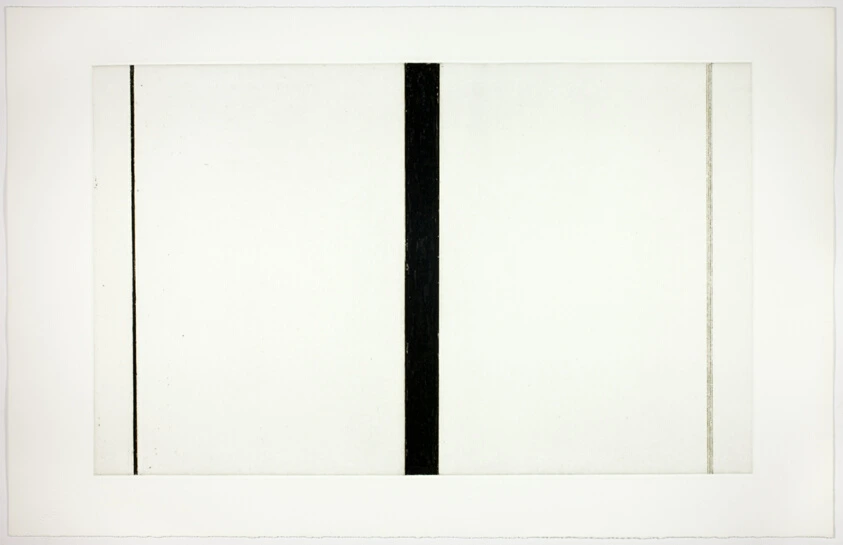
Etching with plate tone on white wove paper
Dimensions
Image/plate: 37.9 × 60.6 cm (14 15/16 × 23 7/8 in.); Sheet: 48.5 × 75.4 cm (19 1/8 × 29 11/16 in.)
Classification
etching
Credit Line
U.L.A.E. Collection acquired through a challenge grant of Mr. and Mrs. Thomas Dittmer; purchased with funds provided by supporters of the Department of Prints and Drawings; Centennial Endowment; Margaret Fisher Endowment Fund
Background & Context
Background Story
Barnett Newmans Untitled Etching 1 from 1969, printed with plate tone on white wove paper, is a companion to the variant with heavy bluish plate tone from the same series, demonstrating how subtly different inking can transform the fundamental act of drawing a line on a surface. In this version, the lighter plate tone allows more of the white paper to show through, creating a more open and luminous field that contrasts with the denser atmosphere of the bluish variant. The zip itself, a single vertical line etched into the plate, remains the same in both versions: it is the inking and printing process that creates the difference, a reminder that in Newmans art the relationship between line and field is always dynamic and contingent. Newman once described the zip as an event rather than a thing, and these two etchings literalize that insight by showing how the same event reads differently depending on its atmospheric context. The etching medium, with its capacity for plate tone, auroral ink washes, and variable wiping, gave Newman a range of atmospheric possibilities that oil paint alone could not provide, making these prints not reproductions of his paintings but independent investigations of the same existential questions.
Cultural Impact
Newmans decision to produce multiple variants of the same etching with different plate tones demonstrated the importance of printmaking to his artistic investigation, showing that the zip was not a fixed motif but a variable event responsive to its visual context. This insight influenced the way subsequent artists thought about the relationship between medium and meaning.
Why It Matters
A companion etching variant by Newman with lighter plate tone that reveals how the same zip reads differently in different atmospheric contexts, demonstrating that line and field constitute an event rather than a fixed structure.