The Beginning

Description

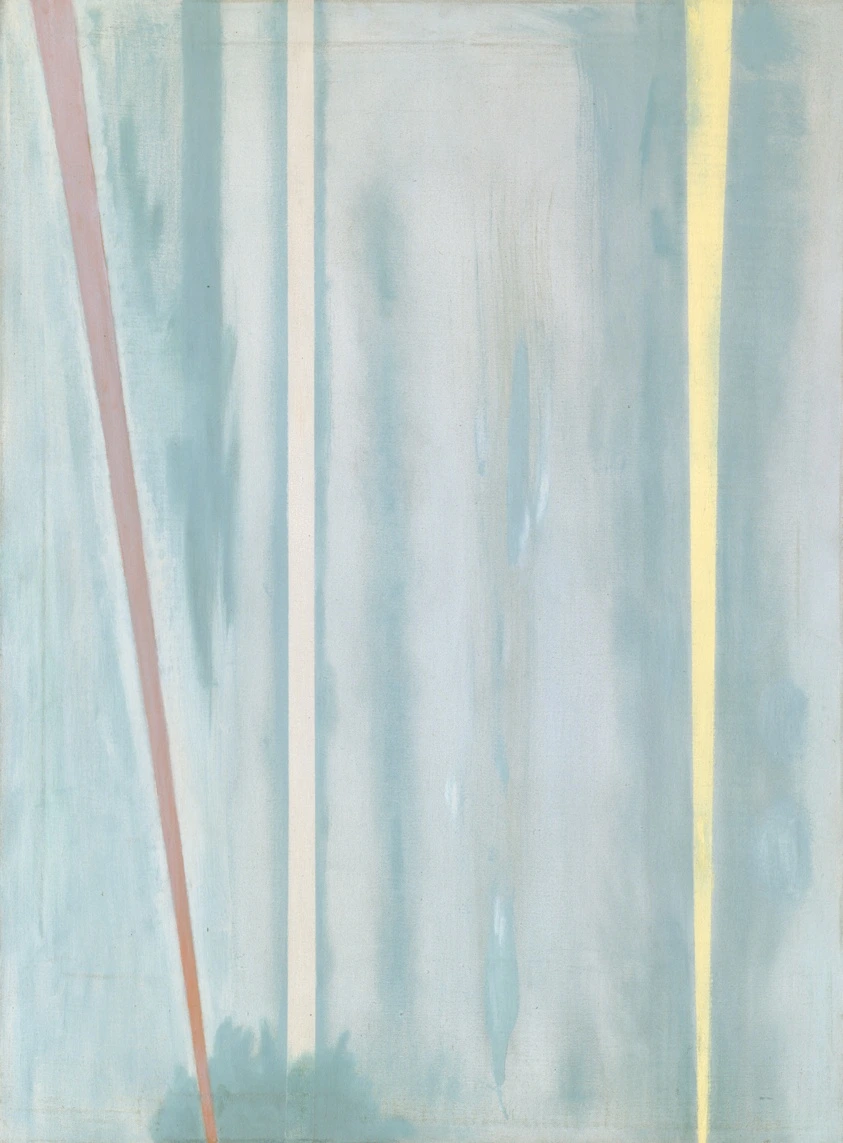
A key figure in the Abstract Expressionist movement, Barnett Newman is widely considered one of the most innovative and influential painters of the twentieth century. A brilliant colorist and a master of expansive spatial effects, he pioneered a new pictorial language that was at once emphatically abstract and powerfully emotive. For Newman, the spiritual content of abstract art was of paramount importance. Although his works seem largely focused on the formal qualities of painting, he insisted that they possessed symbolic meaning. This meaning was never explicit, but he often alluded to it in the titles of his works, as with The Beginning. In the mid-1940s Newman became preoccupied with the Old Testament story of Creation and began selecting titles in reference to the book of Genesis. In this painting, the bands of paint that emerge from the base of the canvas interrupt a richly variegated field of color, a sort of primordial fog. The artist created these three stripes with the aid of masking tape, which he applied to the canvas as a guideline before adding the surrounding color. This work is an important precursor to Newman’s mature paintings, which are characterized by a single vertical band, or “zip,” that divides the composition.

Provenance

Estate of the artist; by descent to Annalee Newman, New York, 1973; given to the Museum of Modern Art, New York, 1977; by exchange to Annalee Newman, New York, by 1988; sold to the Art Institute of Chicago, 1988.

The Beginning

Barnett Newman

1946

Accession Number

73417

Medium

Oil on canvas

Dimensions

101.6 × 75.6 cm (40 × 29 3/4 in.)

Classification

Painting

Museum

The Art Institute of Chicago

Chicago, United States

Credit Line

Through prior gift of Mr. and Mrs. Carter H. Harrison

Background & Context

Background Story

"The Beginning" is a 1946 oil on canvas by Barnett Newman that represents the American Abstract Expressionist at a crucial early moment in his development, the painting showing the emergence of the zip from the color field that would make him one of the most influential painters of the postwar period. The composition is a large canvas—101.6 × 75.6 centimeters—showing an abstract field of color with the first tentative zips or divisions that suggest both the creation of the world and the birth of the artist's mature style. The oil on canvas creates a surface of extraordinary richness and depth, the colors applied with a brushwork that suggests both the physical struggle of creation and the spiritual calm of contemplation, the painting becoming a meditation on the nature of beginnings in art and in life. The 1946 date places this work in the period of Newman's transition from the biomorphic abstraction of his early career to the reductive geometry of his mature period, the painting demonstrating both the accumulated wisdom of decades of experimentation and the fresh discovery of a new visual language. Art historians have compared this painting to the creation myths of abstract art, from the cosmic paintings of Kandinsky to the elemental forms of Mark Rothko, noting that Newman's treatment is more focused on the single moment of division, the first separation that creates meaning from chaos, than the cosmic narrative or the emotional diffusion of these other traditions.

Cultural Impact

This 1946 oil canvas made creation-myth abstract through large-field tentative zip emergence and physical-spiritual brushwork depth, using transitional biomorphic-to-reductive geometry to capture artistic-birth division-moment beyond Kandinsky cosmic narrative.

Why It Matters

It matters because Newman painted a beginning and made the canvas feel like it was just learning to speak—proving that even the first word could be a world if the zip was honest enough.