Description
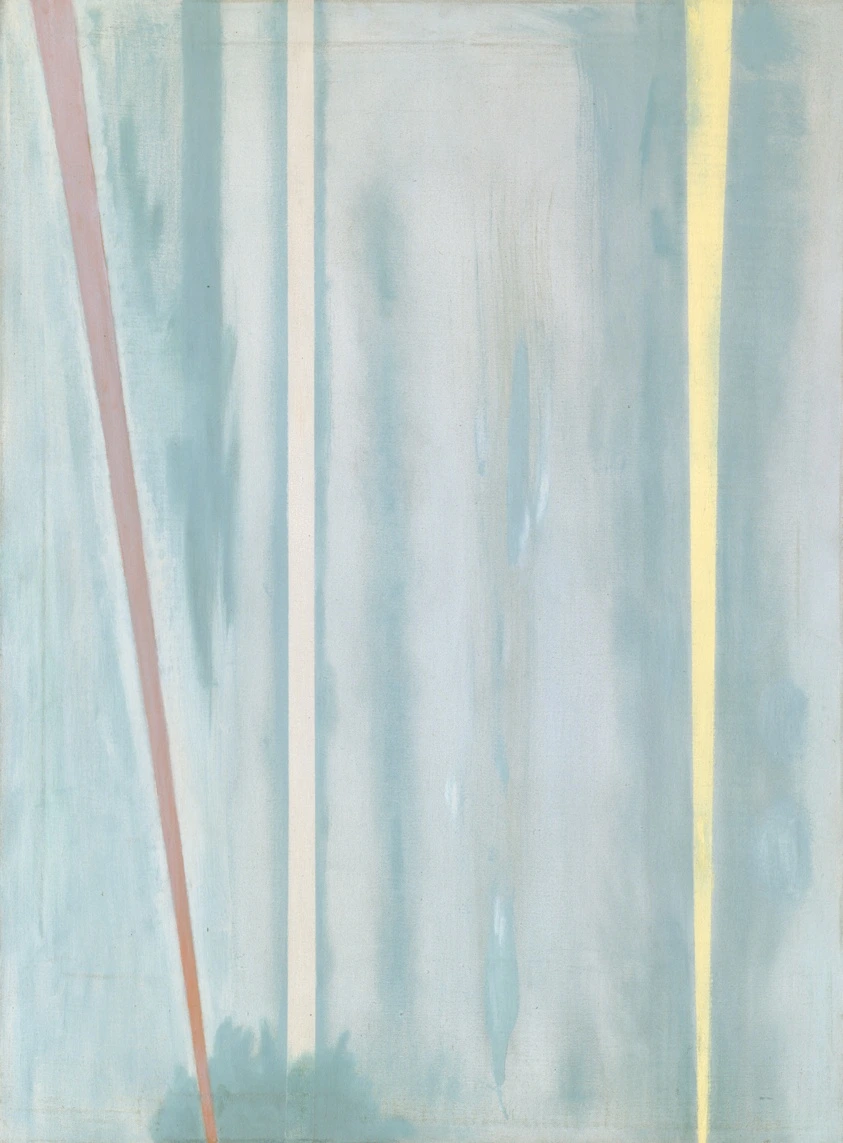
Untitled 3 is part of a series of six insistently vertical paintings exhibited by the artist at the Betty Parsons Gallery, New York, in 1951, in which Newman translated his signature compositions, “zip” paintings, into three-dimensional objects. Painted on canvas over an unusually thick frame, strips of cadmium red and silver gray thrust outward toward the viewer, dismantling the boundary between painting and sculpture. Concerned about the odd appearance of the deep sides of these works, the painter Jackson Pollock, a friend of Newman, constructed simple wood frames for the first three, this one included.
Provenance
Estate of the artist; by descent to Annalee Newman, New York, sold to the Art Institute of Chicago, 1988.
Accession Number
73420
Medium
Oil on canvas
Dimensions
142.2 × 7.6 cm (56 × 3 in.)
Classification
Painting
Credit Line
Through prior gift of Mr. and Mrs. Carter H. Harrison
Background & Context
Background Story
"Untitled 3" is a 1950 oil on canvas by Barnett Newman that captures the American Abstract Expressionist in his most radically reductive mode, the painting consisting of a single vertical line—a "zip"—painted on a field of color that challenges the viewer to confront the absolute and the sublime through the most minimal of means. The composition is extraordinarily narrow—142.2 × 7.6 centimeters—the vertical format emphasizing the upright human presence and the aspiration toward the infinite that Newman saw as the essential function of abstract art. The oil on canvas creates a surface of extraordinary depth and luminosity, the color field suggesting both the physical materiality of the paint and the metaphysical resonance of the void, the zip creating a moment of division and connection that suggests both the separation and the unity of existence. The 1950 date places this work in the period of Newman's most intensive exploration of the zip, when he was producing the series of paintings that established his reputation as the most philosophically ambitious of the Abstract Expressionists and the definitive artist of the sublime in postwar art. Art historians have connected this painting to the broader tradition of the monochrome in modern art, from the white squares of Malevich to the black paintings of Reinhardt, noting that Newman's treatment is more focused on the relationship between the part and the whole, the zip and the field, than the pure absence or the absolute negation of these other traditions.
Cultural Impact
This 1950 oil canvas made sublime reductively absolute through narrow vertical 7cm zip on luminous color field, using oil-on-canvas metaphysical depth to establish postwar Abstract Expressionist philosophical ambition beyond Malevich white-square negation.
Why It Matters
It matters because Newman painted a line and made the canvas feel like it was dividing the universe—proving that even the simplest mark could hold everything if the zip was vertical enough.