Accession Number
64684
Medium
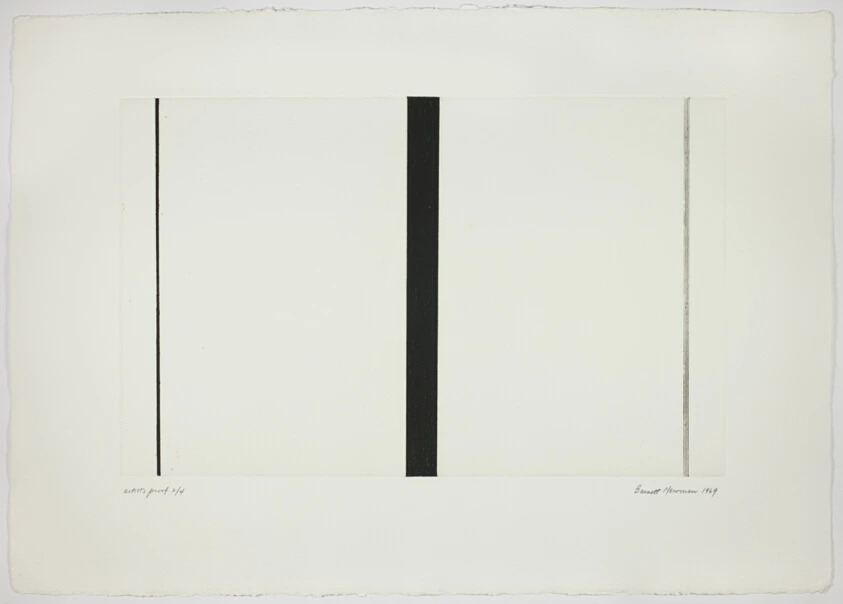
Etching on heavy ivory wove paper
Dimensions
Image/plate: 37.9 × 60.6 cm (14 15/16 × 23 7/8 in.); Sheet: 57.5 × 80.5 cm (22 11/16 × 31 3/4 in.)
Classification
etching
Credit Line
U.L.A.E. Collection acquired through a challenge grant of Mr. and Mrs. Thomas Dittmer; purchased with funds provided by supporters of the Department of Prints and Drawings; Centennial Endowment; Margaret Fisher Endowment Fund
Background & Context
Background Story
"Untitled Etching 1" is a 1969 etching by Barnett Newman that demonstrates the American Abstract Expressionist's engagement with the print medium in his final years, the image translating the zip and the color field into the linear and tonal vocabulary of etching with a precision and clarity that suggests both the logical culmination of his artistic project and the continued vitality of his creative imagination. The composition is a horizontal etching—image 37.9 × 60.6 centimeters—showing a zip or vertical division rendered in the fine, controlled lines of etching on heavy ivory wove paper, the technique creating a surface of extraordinary graphic clarity that makes the philosophical content of the zip feel immediate and accessible. The heavy paper provides a substantial, tactile ground that makes the etching feel like a physical object as well as an intellectual proposition, the weight of the paper matching the weight of the philosophical inquiry. The 1969 date places this work in the final years of Newman's life, when he was producing the prints and sculptures that disseminated his ideas to a wider audience and established his posthumous reputation as one of the most important artists of the twentieth century. Art historians have connected this print to the broader tradition of the artist's late work, from the final etchings of Rembrandt to the late prints of Picasso, noting that Newman's treatment is more focused on the translation of his central idea into new media, the zip adapted to the linear vocabulary of etching, than the introspection or the revision of these other traditions.
Cultural Impact
This 1969 etching made zip conceptually immediate through fine controlled horizontal graphic clarity and heavy ivory-paper tactile substance, using late-career medium translation to disseminate Abstract Expressionist central idea beyond Rembrandt introspective revision tradition.
Why It Matters
It matters because Newman etched a line and made the copper feel like it was thinking—proving that even a print could divide the world if the line was fine enough.