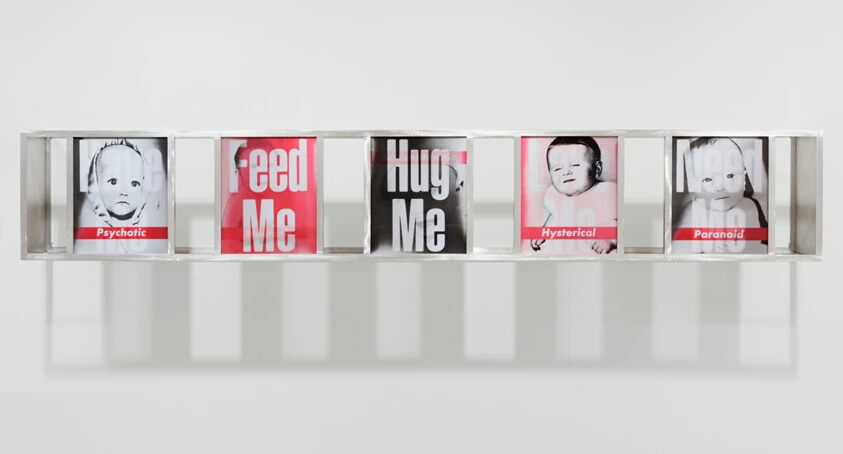
Have Me Feed Me Hug Me Love Me Need Me

Description

Building on her early career as a graphic designer, Barbara Kruger turns the style of advertising on its head to criticize consumer culture and the stereotyping of women. Each of these lenticular photographs shifts as it is viewed, alternating between the first-person demands of the title and pictures of newborn babies labeled with the names of psychological disorders. With these textual juxtapositions, Kruger calls out the societal pressures on women to bear children. The switching images, meanwhile, allude to the advertising practice of embedding subliminal messages that shape perceptions and desires. “[My] interest is in dealing with the way pictures and words have the power to tell us who we can and cannot be—how they construct us as social beings,” Kruger has said.

Have Me Feed Me Hug Me Love Me Need Me

Barbara Kruger

1988

Accession Number

121289

Medium

Lenticular photograph

Dimensions

Each panel: 44.2 × 36.1 cm (17 7/16 × 14 1/4 in.); Overall: 49.3 × 303.1 × 27.3 cm (19 7/16 × 119 3/8 × 10 3/4 in.)

Classification

lenticular photograph

Museum

The Art Institute of Chicago

Chicago, United States

Credit Line

Gift of Boardroom, Inc.
Background & Context

Background Story

Barbara Krugers Have Me Feed Me Hug Me Love Me Need Me from 1988 employs lenticular printing, a medium typically used in commercial advertising and novelty items, to animate hersignature text-image confrontations. As the viewer moves past the lenticular photograph, the image shifts, creating a flickering, aggressive presence that mirrors the relentless demands of consumer culture. The five commands, Have Me, Feed Me, Hug Me, Love Me, Need Me, constitute a sequence of escalating desire that Kruger presents without specifying subject or object, who is having, who is feeding, who needs, who is needed. This deliberate ambiguity forces the viewer to confront the ways that advertising language constructs desire as a series of demands directed at an audience trained to consume. The lenticular format is itself a commentary on the medium of manipulation: it requires physical movement from the viewer, who must literally change position to see the complete message, enacting the very passivity and compliance that the text critiques. Created during the height of the culture wars, the work targets the intersection of commodification, desire, and emotional need with the surgical precision that made Kruger one of the most widely discussed artists of her generation.

Cultural Impact

Krugers lenticular works from the late 1980s represent an important expansion of her practice beyond the static photo-text format, embracing the moving image as a metaphor for the manipulation and seduction of commercial media. Her influence on subsequent generations of artists working with text, image, and social critique is incalculable.

Why It Matters

A lenticular photograph by Kruger that uses commercial printing technology to animate five commands of escalating desire, forcing the viewer into physical movement that enacts the compliance and consumption the text critiques.