Provenance
The artist; sold through Spruth Magers, Los Angeles, to the Art Institute of Chicago, April 12, 2022.
Accession Number
252341
Medium
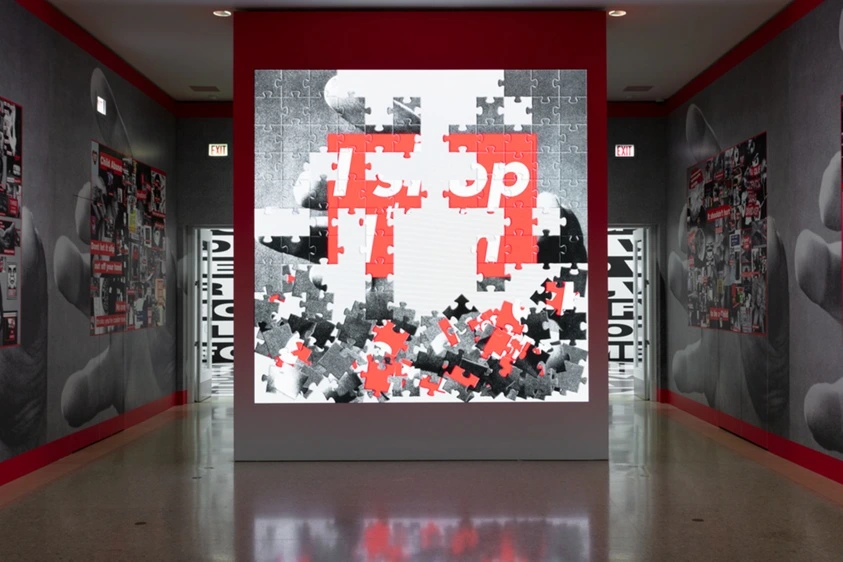
Single-channel video on LED panel, sound; 57 sec.;
Dimensions
350 × 350 cm (137 7/8 × 137 7/8 in.)
Classification
time based media
Credit Line
Kate S. Buckingham Endowment Fund
Background & Context
Background Story
"Untitled (I shop therefore I am)" is Barbara Kruger's most iconic work, a 1987 single-channel video on LED panel that translates her signature combination of found image and aggressive text into the time-based medium of moving image, creating a work that circulates through galleries, museums, and public spaces with the same ubiquity as the advertising that it critiques. The phrase itself is a brilliant parody of Descartes's famous philosophical maxim "I think therefore I am," replacing the Cartesian assertion of rational identity with the consumerist reduction of selfhood to purchasing power. The video format adds temporal dimension to Kruger's critique: the text flickers, changes, or repeats, creating a hypnotic rhythm that mimics the repetitive assault of commercial media while simultaneously exposing its mechanism. The 1987/2019 date reflects the work's ongoing life: originally created for video monitors in the 1980s, it has been updated for LED panels and digital display, demonstrating Kruger's commitment to making her work accessible through the same technologies that distribute the images she critiques. Art historians have connected this work to the broader tradition of institutional critique, from the conceptual investigations of Hans Haacke to the media interventions of the Guerrilla Girls, noting that Kruger's treatment is more immediately legible, more popular in its address than these contemporaries. The work also demonstrates Kruger's understanding of the temporality of media: advertising depends on repetition and duration, and by adopting these same formal qualities, Kruger makes her critique feel not like an external judgment but like an internal doubt, a suspicion that arises within the viewer's own experience of consumption. In the history of video art, the piece stands as evidence that the medium could sustain political content without sacrificing visual punch or popular appeal.
Cultural Impact
This 1987 LED video parodied Cartesian identity through consumerist repetition, using flickering temporal rhythm to make institutional critique feel like internal doubt arising from the viewer's own media experience.
Why It Matters
It matters because Kruger replaced thinking with shopping and made the screen blink like a warning—proving that even philosophy could become an advertisement if the words were rearranged.