Description
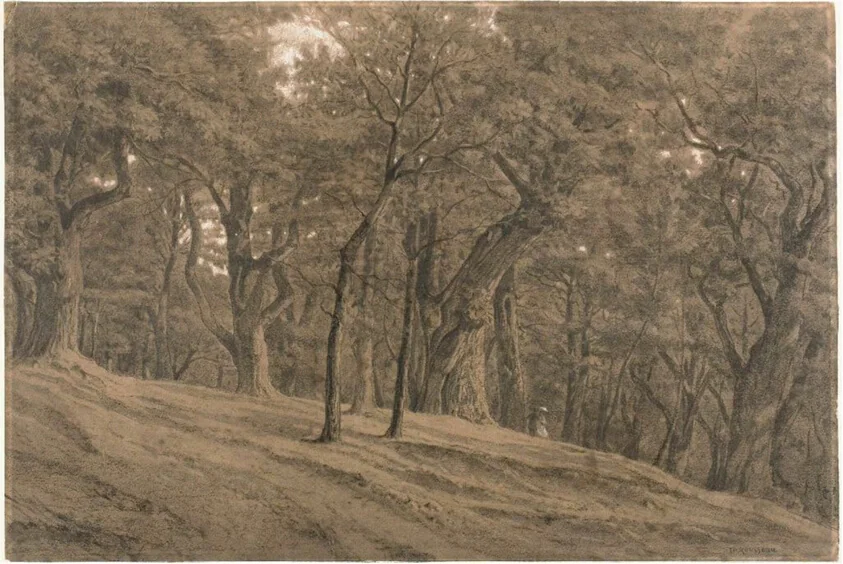
The forest at Fontainebleau was a favorite subject of Barbizon artists, who were by its beauty and its proximity to Paris. Rousseau, a premier Barbizon painter, was attacked by critics in the 1830s and 1840s for his humble farm and forest scenes, which they considered to be "vulgar." The two figures in this landscape may be Rousseau himself and the adopted daughter of George Sand; the two were engaged in 1845.
Provenance
Sold by B. C. Holland, Chicago, to the Art Institute, 1967.
Accession Number
27873
Medium
Charcoal, with stumping and black pastel, heightened with touches of white chalk, on dark tan wove paper, laid down on tan wood pulp board
Dimensions
28.5 × 42.4 cm (11 1/4 × 16 3/4 in.)
Classification
chalk
Credit Line
Harold Joachim Purchase Fund
Background & Context
Background Story
"In the Forest of Fontainbleau" is a c. 1850 charcoal drawing by Théodore Rousseau that captures the French Barbizon School painter in his most intimate and observational mode, the image showing a forest scene rendered with the same attention to the details of nature that Rousseau brought to his large-scale landscapes. The composition is a view into the forest, the trees and undergrowth rendered with the stumped charcoal and black pastel that create a surface of extraordinary tonal richness and atmospheric depth, the white chalk highlights suggesting the filtering sunlight and the mysterious shadows of the woodland interior. The dark tan wove paper provides a warm, sympathetic ground that makes the charcoal tones appear rich and substantial, the dark paper creating a sense of enclosure and mystery that matches the forest subject. The c. 1850 date places this work in the period of Rousseau's most intensive study of the Fontainebleau forest, the years when he was producing the drawings and paintings that established the Barbizon School as the leading force in French landscape art. Art historians have connected this drawing to the broader tradition of the forest interior in European art, from the dark woodland scenes of the Northern Renaissance to the sun-dappled clearings of the Impressionists, noting that Rousseau's treatment is more naturalistic, more focused on the observed reality of the forest ecosystem than the symbolic or the decorative approaches of these other traditions.
Cultural Impact
This c. 1850 charcoal drawing made Fontainebleau interior naturally mysterious through stumped tonal richness and white-chalk filtered sunlight, using dark tan paper enclosure to establish Barbizon forest observation beyond Northern Renaissance symbolism.
Why It Matters
It matters because Rousseau drew a forest and made the charcoal feel like it was growing leaves—proving that even a sketch could breathe if the shadows were deep enough.