Green and Blue: The Dancer

Description

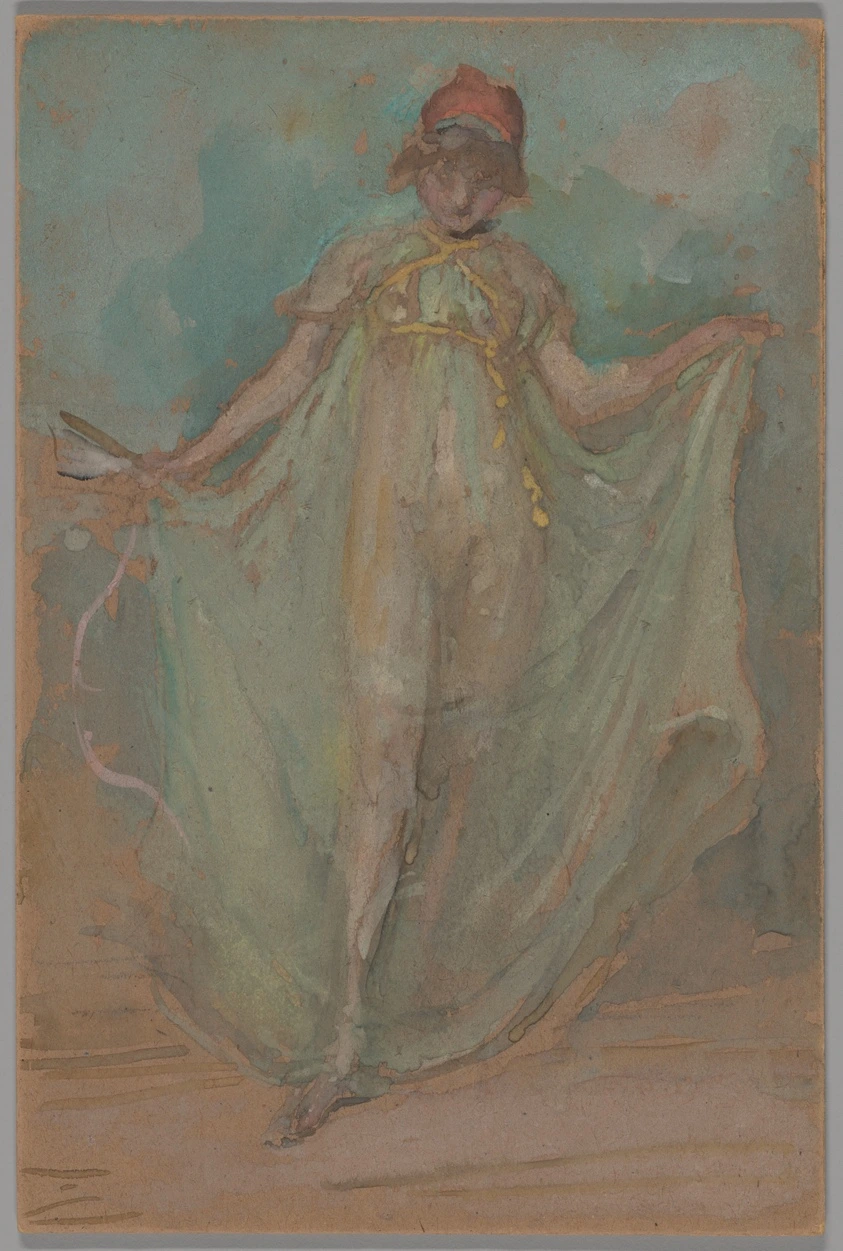
Inspired by Greek sculpture and Japanese prints, James McNeill Whistler became entranced with portraying the female form clad in diaphanous drapery in the 1890s. He developed this theme in all the media in which he worked, including transfer lithography, oil, pastel, and watercolor. The artist usually provided garments for his models to wear, often classical gossamer gowns with high waists and crossed bodices paired with brightly colored kerchiefs. His models needed a certain degree of strength and agility, as he sometimes asked them to dance about his studio until he found a suitable pose. In Green and Blue: The Dancer, Whistler employed thin watercolor washes to distill the graceful movements of his lissome young model. The brown paper on which he painted lends opacity to the washes, thereby adding subtle weight to the thin veils of fabric draping the figure.

Provenance

R. A. Canfield, Providence, R.I., acquired directly from the artist, May 1903 [MacDonald 1995]; sold to Knoedler and Company, New York, March 1914 [MacDonald 1995]; sold to Harris Whittemore (1864-1927), April 1914 [MacDonald 1995]; sold, Christie's, New York, December 6, 1985, lot 178, to Peter Terian, New York [MacDonald 1995]. Sold by David Nisinson, New York to the Art Institute, 1988.

Green and Blue: The Dancer

James McNeill Whistler

c. 1893

Accession Number

111164

Medium

Watercolor and opaque watercolor over traces of black chalk on brown wove paper laid down on card

Dimensions

27.5 × 18.3 cm (10 7/8 × 7 1/4 in.)

Classification

watercolor

Museum

The Art Institute of Chicago

Chicago, United States

Credit Line

Purchased with funds provided by Dr. William D. Shorey; through prior acquisitions of the Charles Deering Collection and through prior bequest of Mrs. Gordon Palmer
Background & Context

Background Story

"Green and Blue: The Dancer" is a c. 1893 watercolor by James McNeill Whistler that demonstrates the American-born artist's mastery of the dance subject and his exploration of the figure in motion through the medium of watercolor, the image showing a dancer rendered with the same attention to tonal harmony and elegant suggestion that characterized his most powerful figure compositions. The composition is a medium-sized watercolor—27.5 × 18.3 centimeters—showing a dancer with the watercolor and opaque watercolor over traces of black chalk on brown wove paper laid down on card, the technique creating a surface of extraordinary warmth and atmospheric depth. The brown wove paper provides a warm, sympathetic ground that makes the green and blue watercolor appear luminous and inviting, enhancing the sense of movement and musical rhythm. The c. 1893 date places this work in the period of Whistler's most intensive production of watercolors and his exploration of the dance subject as a vehicle for tonal arrangement. Art historians have connected this watercolor to the broader tradition of the dancer in modern art, from the paintings of Degas to the sculptures of Rodin, noting that Whistler's treatment is more focused on the tonal harmony and the elegant suggestion, the transformation of movement into chromatic poetry, than the anatomical analysis or the narrative content of these other traditions.

Cultural Impact

This c. 1893 watercolor made dancer tonally rhythmic through medium 27cm green-blue watercolor-opaque chalk traces and brown-paper warm musical luminosity, using dance-subject tonal exploration to transform movement into chromatic elegant poetry beyond Degas anatomical narrative analysis.

Why It Matters

It matters because Whistler painted a dancer and made the paper feel like it was swaying to music in green and blue—proving that even motion could be still if the tones were harmonious enough.