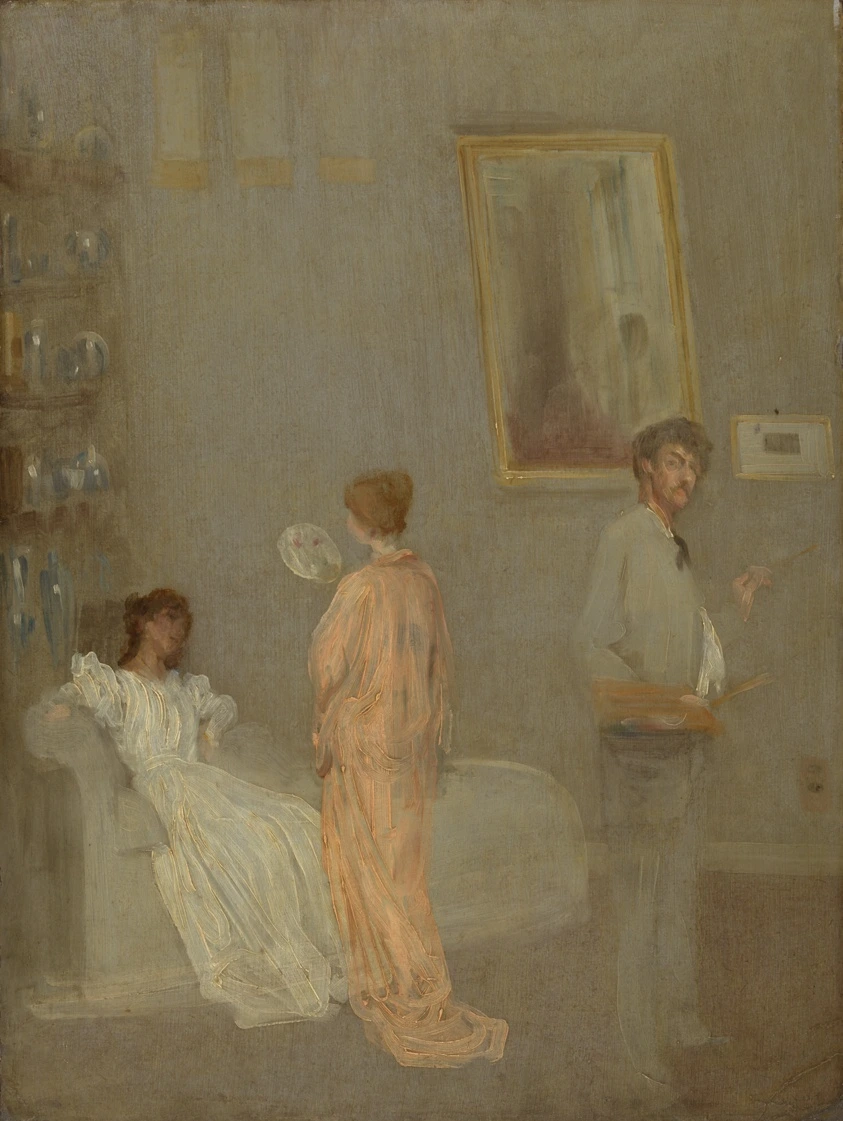
The Artist in His Studio

Description

By the mid-1860s, the London-based, American artist James McNeill Whistler was increasingly fascinated with the aesthetics of Asian art. In The Artist in His Studio, Whistler stares out at the viewer with palette and paintbrush in hand, surrounded by works from his collection: three Japanese scrolls hang on the wall and Chinese porcelain adorns shelves on the left. He applied thin layers of paint in muted tones to evoke the flattened appearance of Japanese woodblock prints. The composition also recalls the work of the Spanish Baroque painter Diego Velázquez, who likewise included a self-portrait at his easel in Las Meninas (1656, Museo Nacional del Prado, Madrid). Whistler harmonized Western and Eastern artistic elements, placing himself at the center of such an enterprise.

Provenance

James McNeill Whistler (1834–1903), 1865/66; Dr. William McNeill Whistler (1836–1900), London, by 1886 [list by James McNeill Whistler, 1886, GUL BP II 8/7, copy in curatorial object file]; consigned to Goupil Gallery, London, December 1896 [letter from James McNeill Whistler to Mrs. William Whistler, undated (December 1896), GUW 07023; letter from James McNeill Whistler to Dr. William Whistler, dated January 2, 1897, GUW 07025]; sold to Douglas William Freshfield (1845–1934), London, by October 1897 [letter from James McNeill Whistler to David Croal Thomson, October 1897, GUW 08443]; with Brown & Phillips, London, 1911; sold to P. & D. Colnaghi and Obach, London, by August 1911 [according to Young, MacDonald, Spencer, and Miles 1980]; partial share sold to M. Knoedler & Co., New York, August 24, 1911 [M. Knoedler & Co. Painting Stock Book 5: 8800-12652, April 1899–December 1911, inv. no. 12505, copy in curatorial object file]; probably consigned to Henry Reinhardt Galleries, New York and Chicago, September 1911 [according to American Art News November 25, 1911, and Young, MacDonald, Spencer, and Miles 1980; exhibited New York 1911]; sold to the Friends of American Art, Chicago, by December 1911 [according to American Art News December 23, 1911]; given to the Art Institute of Chicago, 1912.

The Artist in His Studio

James McNeill Whistler

1865–66

Accession Number

65709

Medium

Oil on paper mounted on panel

Dimensions

Board: 62 × 46.5 cm (24 7/16 × 18 5/16 in.); Overall: 63 × 47.3 cm (24 13/16 × 18 5/8 in.)

Classification

Painting

Museum

The Art Institute of Chicago

Chicago, United States

Credit Line

Friends of American Art Collection
Background & Context

Background Story

"The Artist in His Studio" is one of the most important self-portraits in Whistler's early career, showing the artist in his London studio with the tools of his trade—palette, brushes, and the unfinished canvas that would become known as "The White Girl." The image is rendered in oil on paper mounted on panel, a medium that Whistler favored for its portability and its capacity for fine detail. The composition is informal and reflective: the artist is shown in three-quarter view, his dark clothing merging with the shadowed interior while his face catches the studio light with a pallor that suggests both concentration and physical fragility. This self-portrait belongs to the tradition of the artist in his atelier that stretches from Vermeer's "Art of Painting" to Courbet's "The Artist's Studio," but Whistler's treatment is distinguished by its psychological modesty. He does not claim the role of cultural prophet or political commentator; he is simply a man working, his identity subordinate to his vocation. The unfinished "White Girl" visible in the background is historically significant as the painting that would launch Whistler's international reputation when it was exhibited at the Paris Salon des Refusés in 1863. By including it in the self-portrait, Whistler established a narrative of creative continuity, linking his present labor to future recognition. The muted palette of blacks, grays, and warm flesh tones anticipates the tonal harmonies of his later "Arrangements," suggesting that even at this early stage Whistler was developing the aesthetic theories that would make him one of the most influential writers and painters of the fin de siècle.

Cultural Impact

This self-portrait embedded Whistler's emerging aesthetic theory in a modest studio scene, making the unfinished canvas speak louder than the artist's own presence.

Why It Matters

It matters as a mirror that looks past itself—Whistler painting who he was becoming rather than who he had already been.