Description
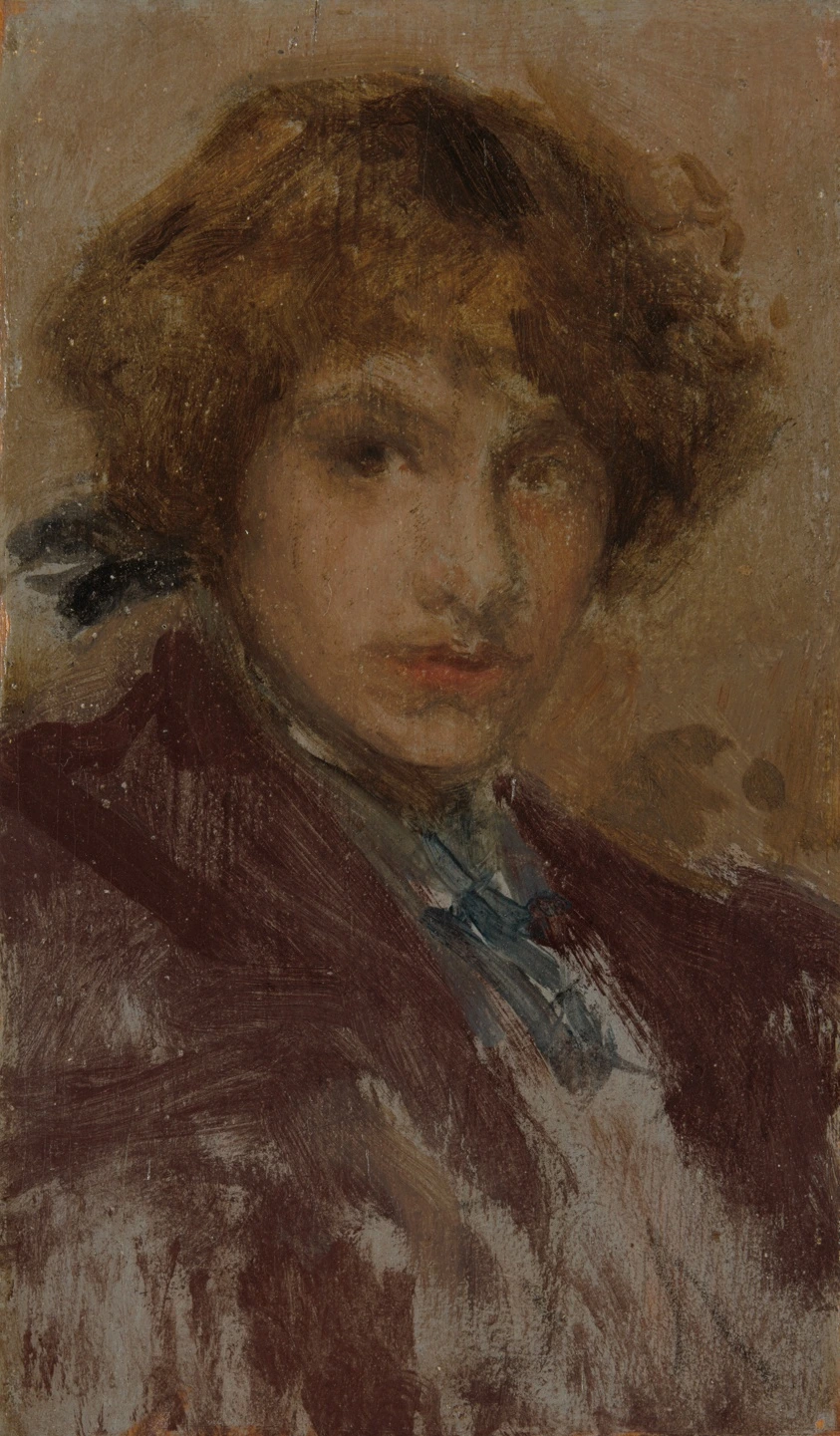
In addition to large-scale portraits, James McNeill Whistler created small-scale likenesses, often on wood panel, as in this painting of a young sitter. A well-known beauty, Olga Caracciolo lived in Dieppe, France, likely where this work was executed, and later married the photographer Adolf de Meyer. Rather than a swift, abbreviated study for a larger composition, Whistler considered a work such as this to be a satisfying aesthetic whole. Indeed, small paintings serve as invitations for an intimate viewing experience and contemplation of the artist’s harmonies of color and form.
Provenance
Baroness Olga de Meyer, by 1905 [lent to London 1905]. Annie Swan Coburn (Mrs. Lewis Larned, 1856–1932), Chicago, by 1932; bequeathed to her friend Walter Stanton Brewster (1872–1954), Chicago, 1932 [Last Will and Testament and Letters Testamentary of Annie S. Coburn, Dated August 9, 1932, Article 3 (p), as Girl’s Head]; given to the Art Institute of Chicago, 1933.
Accession Number
14317
Medium
Oil on panel
Dimensions
15.5 × 9.5 cm (6 1/8 × 3 3/4 in.)
Classification
Painting
Credit Line
Walter S. Brewster Collection
Background & Context
Background Story
"Study of a Girl's Head and Shoulders" is an 1896–97 oil on panel by James McNeill Whistler that captures the American-born artist in his most delicately intimate and tonally refined mode, the image showing a young girl rendered with the same attention to subtle tonal variation and elegant simplification that made Whistler's portraits among the most sophisticated works of late nineteenth-century art. The composition is a tiny panel—15.5 × 9.5 centimeters—showing a girl's head and shoulders with the oil on panel creating a surface of extraordinary luminosity and intimate warmth, the small scale enhancing the sense of direct encounter and quiet observation. The panel support provides a smooth, hard ground that allows for the delicate brushwork and the subtle tonal gradations that Whistler required for his most refined effects. The 1896–97 date places this work in the final years of Whistler's life, when he was producing the small panels and watercolors that summarized his lifelong commitment to the art of tonal arrangement. Art historians have connected this painting to the broader tradition of the portrait sketch in European art, from the drawings of Ingres to the pastels of Degas, noting that Whistler's treatment is more focused on the tonal harmony and the elegant simplification, the transformation of observed reality into aesthetic arrangement, than the anatomical precision or the psychological penetration of these other traditions.
Cultural Impact
This 1896–97 oil panel made girl's portrait tonally intimate through tiny 15cm delicate subtle gradation and smooth hard-ground luminosity, using final-life summary to transform observed reality into elegant aesthetic tonal arrangement beyond Ingres anatomical precision.
Why It Matters
It matters because Whistler painted a girl and made the panel feel like it was holding a breath—proving that even a study could be a symphony if the tones were quiet enough.