Provenance
Sir George Donaldson [1845-1925], London; purchased 1906 by William A. Clark [1839-1925], New York; bequest April 1926 to the Corcoran Gallery of Art, Washington; acquired 2015 by the National Gallery of Art.
Accession Number
2015.143.13
Medium
oil on panel
Dimensions
overall: 53.34 × 67.31 cm (21 × 26 1/2 in.) | framed: 78.11 × 93.35 × 8.89 cm (30 3/4 × 36 3/4 × 3 1/2 in.)
Classification
Painting
Credit Line
Corcoran Collection (William A. Clark Collection)
Tags
Painting Baroque (1600–1750) Oil Painting Panel Painting Dutch
Background & Context
Background Story
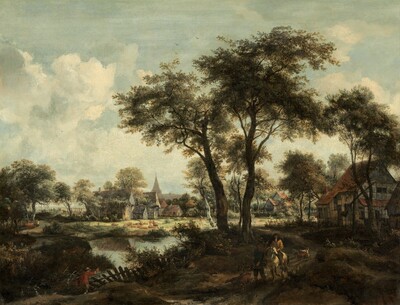
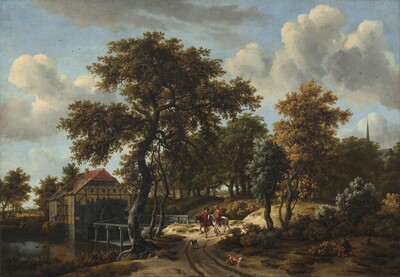
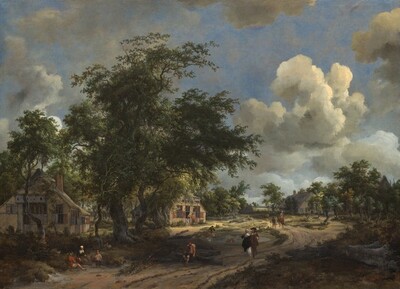
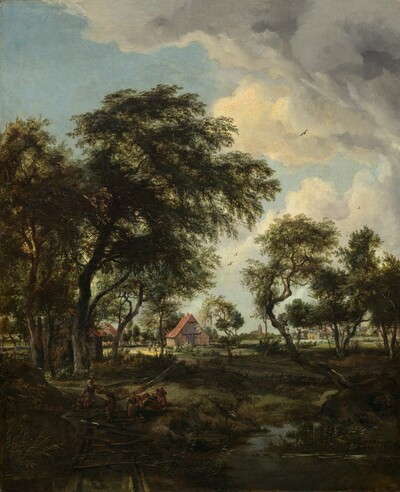
Wooded Landscape with Figures (c. 1658) is an early work that shows Hobbema developing the distinctive approach to woodland painting that would define his mature style. The presence of figures in the composition connects this work to the broader Dutch tradition of landscape with figures—paintings where human presence provides narrative interest, scale, and a point of identification for the viewer. The figures likely include travelers, riders, or peasants engaged in activities appropriate to a woodland setting: walking, resting, or gathering firewood. The year 1658 places this work during Hobbema's formative period, when he was still working closely with his teacher Jacob van Ruisdael. The influence of Ruisdael's darker, more dramatic forest scenes can be felt in this early work, but Hobbema's own emerging preference for lighter effects and more genial atmosphere is already visible. The painting thus represents a key document in the development of Hobbema's personal style—the moment when his characteristic sun-dappled woodland was beginning to emerge from Ruisdael's shadow. The 1650s context is also significant: the Dutch Republic was at the height of its Golden Age, and landscape painting was one of the Republic's most distinctive cultural achievements.
Cultural Impact
Hobbema's early woodland paintings influenced how the transition from teacher to student was understood in Dutch art, providing a case study in artistic development that art historians have analyzed for centuries. The paintings also influenced the broader tradition of woodland landscape that developed from Dutch models, particularly in England where Hobbema's work was especially admired and collected. The figures-in-landscape convention influenced later European genre-landscape painting that similarly combined landscape settings with human narrative.
Why It Matters
This painting matters because it documents a pivotal moment in an artist's development—the transition from influenced student to independent master. For artists and art students today, Hobbema's early works provide a model for how personal style gradually emerges from training and influence rather than appearing fully formed. The painting also demonstrates that even the greatest artists go through periods of uncertainty and imitation before finding their own voice.