Provenance
(Cabruja sale, Galerie Georges Petit, Paris, 20 May 1921, no. 5); purchased by Durand-Ruel.[1] (sale, Christie's, London, 23 April 1937, no. 102, as Property of a Lady); (Arthur Tooth & Sons, London);[2] sold January 1943 to Mrs. Peter Pleydell-Bouverie, London, until at least 1954.[3] N. Beecham.[4] (Marlborough-Gerson Gallery, New York); sold December 1963 to Mr. Paul Mellon, Upperville, VA; gift 1983 to NGA.
[1] Annotated sales catalogue in Knoelder library fiche (copy in NGA curatorial files).
[2] Annotated sales catalogue in Knoedler library fiche (copy in NGA curatorial files). Arthur Tooth records, accession no. 860679, Getty Research Institute, Los Angeles: volume XXI, London branch stock inventory, p. 105.
[3] _The Pleydell-Bouverie Collection of Impressionist and Other Paintings_, exh. cat., Tate Gallery, London, 1954, no. 6.
[4] Beecham given as prior owner in _A Selection of Important 19th Century French Masters_, exh. cat., Marlborough Fine Art Ltd, London, October 1960, no. 3.
Accession Number
1983.1.8
Medium
oil on wood
Dimensions
overall: 34.7 x 57.5 cm (13 11/16 x 22 5/8 in.) | framed: 58.4 x 81.6 x 12.7 cm (23 x 32 1/8 x 5 in.)
Classification
Painting
Credit Line
Collection of Mr. and Mrs. Paul Mellon
Tags
Painting Impressionist & Modern (1851–1900) Oil Painting French
Background & Context
Background Story
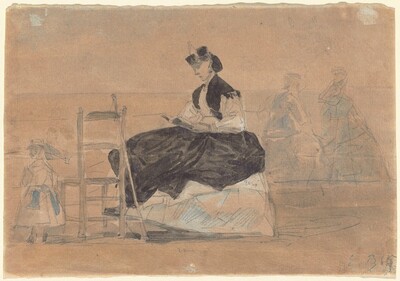
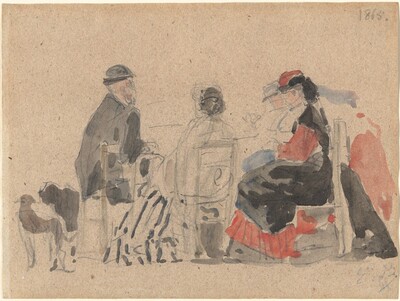
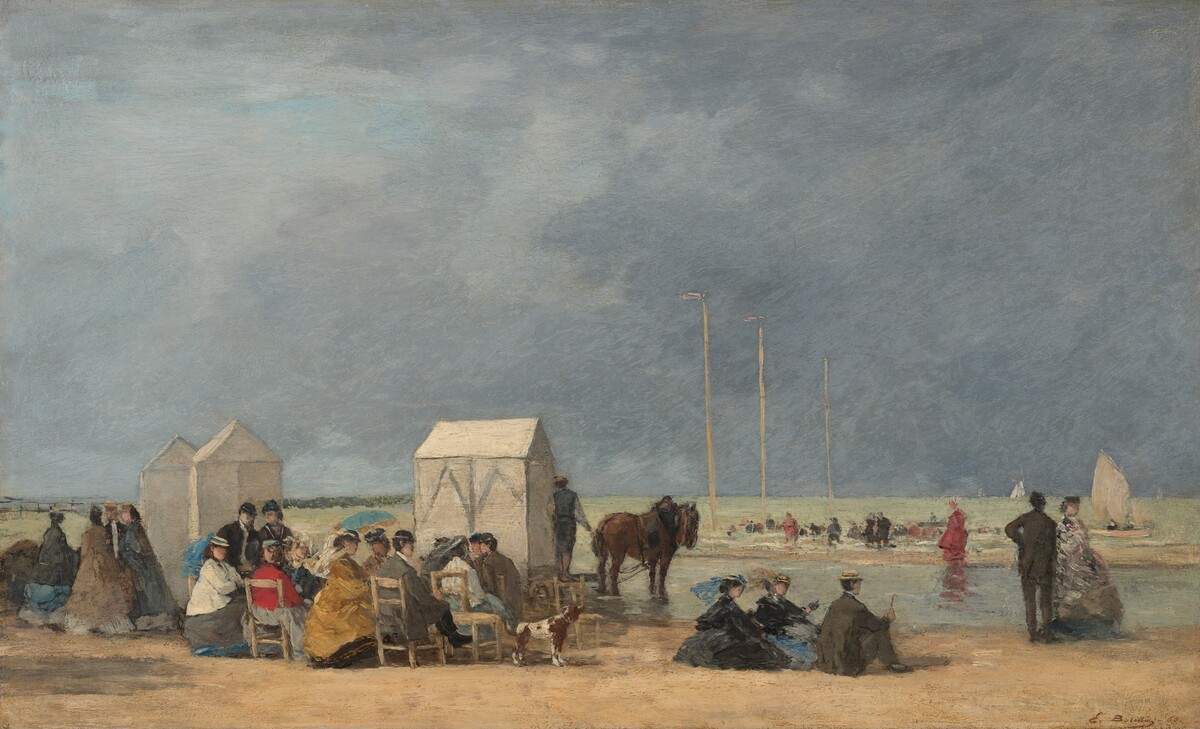
Bathing Time at Deauville (1865) captures the emerging seaside resort culture at one of Normandy's most fashionable destinations. Deauville, developed by the Duc de Morny in the 1860s as a rival to Trouville, was designed from its inception as a playground for the wealthy. The year 1865—just as Deauville was being established—makes this painting a document of the resort's earliest days. Bathing at the seaside was becoming fashionable among Paris's elite, driven by medical recommendations for sea air and cold-water immersion. Boudin's painting captures the elaborate social rituals of seaside bathing: the bathhouses where bathers changed, the horses that pulled bathing machines into the surf, and the crowds of spectators who watched the spectacle. The painting's social observation—Boudin distinguishes between the bathers, the spectators, and the working people who serviced the resort—reveals the class structure of seaside leisure. His treatment of the fashionable costumes—women in cumbersome bathing dresses, men in neck-to-knee suits—documents the peculiar modesty that 19th-century beach culture required. Boudin's atmospheric handling—Deauville's light reflecting from sand, water, and the painted bathhouses—demonstrates his mastery of the coastal light effects that were his signature subject.
Cultural Impact
Boudin's Deauville paintings influenced how French seaside resorts were represented in art and popular culture, establishing visual conventions that persisted through illustrated travel guides to contemporary tourism imagery. The paintings documented the birth of resort culture at Deauville, providing visual evidence of the development that would make the town one of Europe's most exclusive destinations. The bathing subject influenced how seaside leisure was visually represented in French art.
Why It Matters
This painting matters because it captures the birth of one of Europe's most famous seaside resorts at the moment of its creation. Deauville in 1865 was still becoming itself—Boudin's painting records the resort's earliest period with the informed attention that only a local artist could provide, making it both an artistic achievement and an invaluable cultural document.