Provenance
(Marlborough Fine Art, London); sold 1961 to Mr. Paul Mellon, Upperville, VA; gift 1985 to NGA.
Accession Number
1985.64.4
Medium
oil on wood
Dimensions
overall: 18.4 x 26.4 cm (7 1/4 x 10 3/8 in.) | framed: 29.2 x 37.2 x 4.1 cm (11 1/2 x 14 5/8 x 1 5/8 in.)
Classification
Painting
Credit Line
Collection of Mr. and Mrs. Paul Mellon
Tags
Painting Impressionist & Modern (1851–1900) Oil Painting French
Background & Context
Background Story
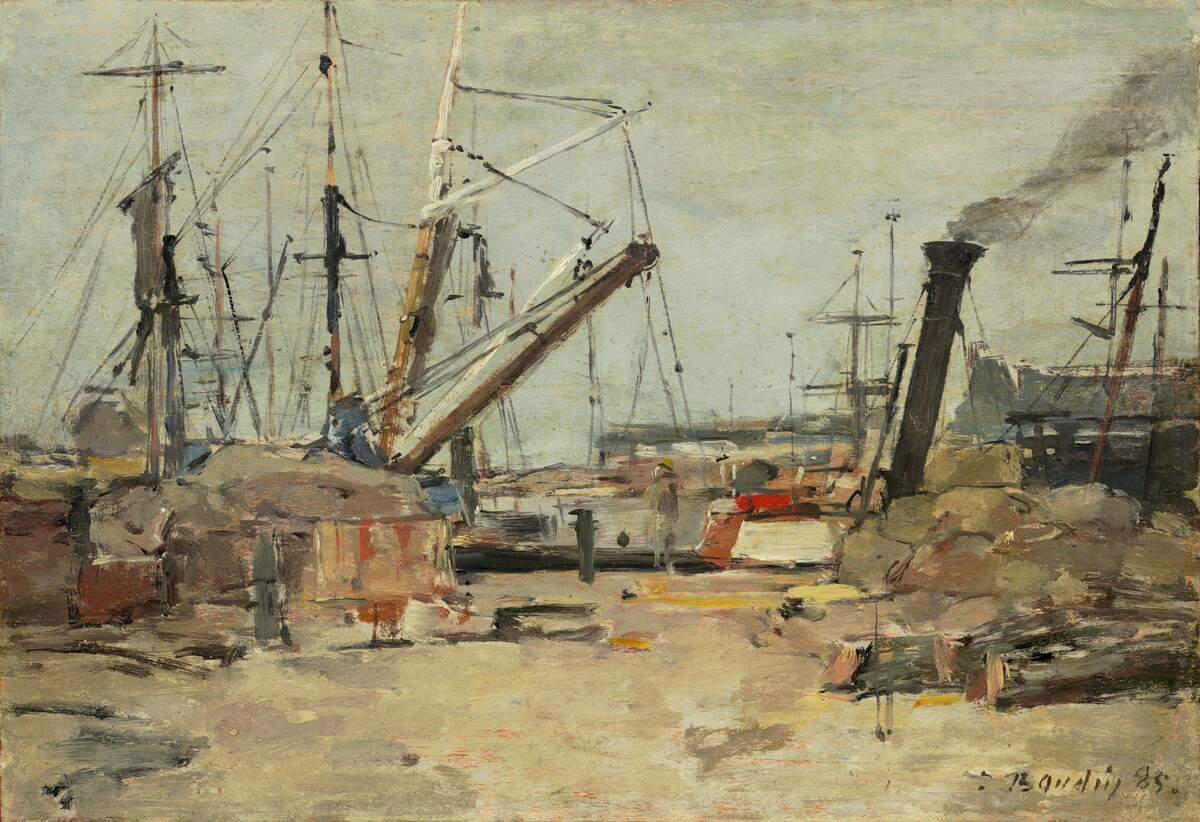
Eugène Boudin's The Trawlers (1885) depicts the fishing boats that were the economic backbone of Normandy's coastal communities. Trawlers—vessels that dragged nets along the seabed—represented the industrial dimension of fishing that sustained ports like Honfleur, Trouville, and Dieppe. Boudin, who grew up in Honfleur and knew the fishing community from the inside, painted trawlers with the informed specificity of someone who understood their rigging, their working procedures, and their relationship to the sea. The year 1885 places this during Boudin's mature period, when his reputation as the painter of Normandy's coast was secure and his influence on the younger Impressionists was widely acknowledged. The painting likely depicts the trawlers at rest or departing—moments that reveal their distinctive rigging and hull design—and the coastal conditions that determined their working schedule. Boudin's treatment of the sea and sky—his signature subjects—creates the atmospheric setting where the boats operate, demonstrating his conviction that marine painting's primary subject was not the vessel but the light and air that surrounded it. The trawlers themselves, rendered with Boudin's characteristic precision, are nevertheless subordinate to the atmospheric effects that were his deepest artistic concern.
Cultural Impact
Boudin's fishing boat paintings influenced how Normandy's maritime economy was represented in art, documenting working vessels that would be replaced by motorized craft within a generation. The paintings influenced later marine painters who similarly sought to combine vessel precision with atmospheric effect. Boudin's trawlers influenced how French fishing culture was visually understood, contributing to the cultural memory of sail-powered coastal fishing.
Why It Matters
This painting matters because it documents the fishing economy that sustained Normandy's coastal communities at a specific historical moment—the 1880s, when sail-powered trawlers were still the dominant fishing technology but were about to be displaced by steam and motor power. Boudin's painting preserves the visual character of this vanishing technology with the attention it deserved but rarely received.