Provenance
Probably (sale, Hôtel Drouot, Paris, 17 May 1873, no. 8).[1] (Arthur Tooth and Sons, London); sold December 1961 to Mr. Paul Mellon, Upperville, VA; gift 1983 to NGA.
[1] According to Robert Schmidt, _Eugene Boudin, 1824-1898_, Paris, 1973: no. 519.
Accession Number
1983.1.11
Medium
oil on canvas
Dimensions
overall: 47.3 x 66 cm (18 5/8 x 26 in.) | framed: 65.1 x 83.8 cm (25 5/8 x 33 in.)
Classification
Painting
Credit Line
Collection of Mr. and Mrs. Paul Mellon
Tags
Painting Impressionist & Modern (1851–1900) Oil Painting Canvas French
Background & Context
Background Story
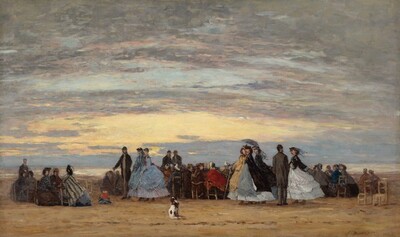
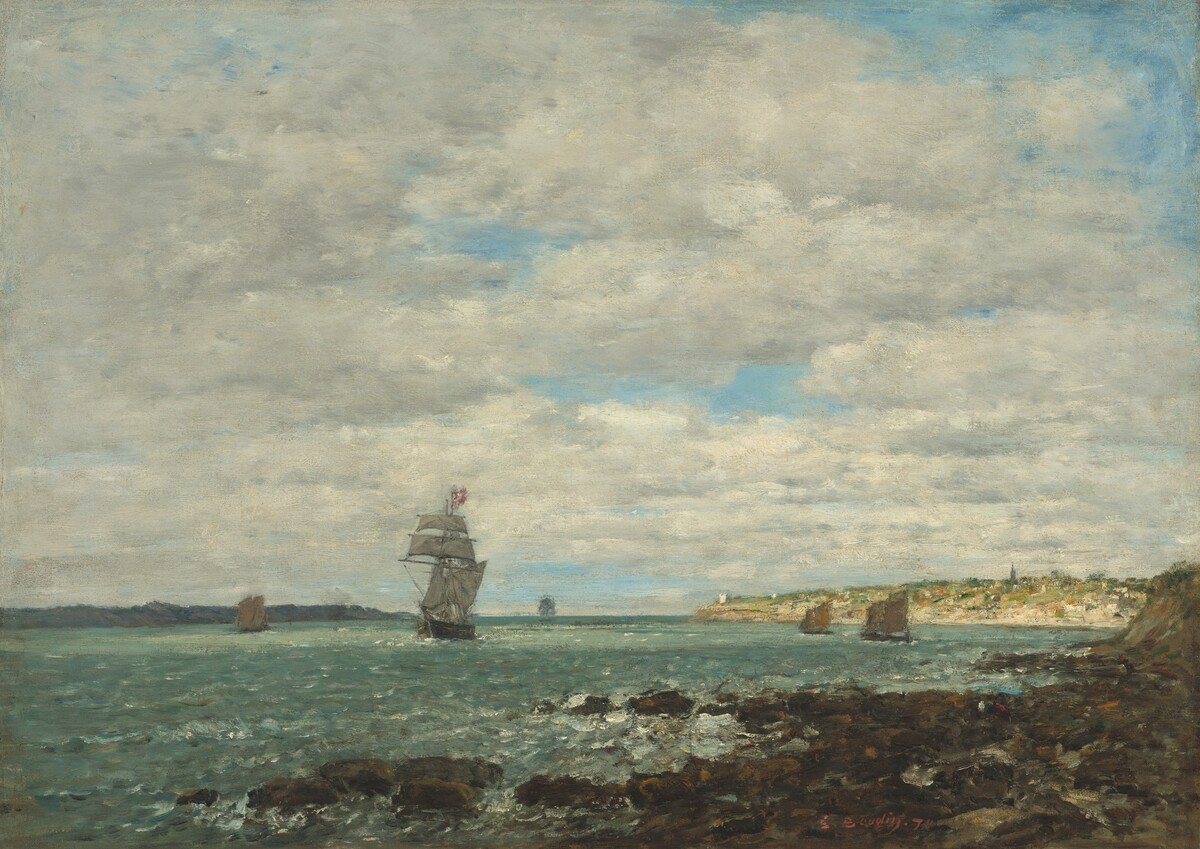
Coast of Brittany, painted around 1870, captures the rugged shoreline of the Brittany peninsula under the vast, changeable skies that were Eugene Boudin's lifelong subject. The painting depicts fishing boats drawn up on the beach, their dark hulls contrasting with the silvery light that plays across sand, water, and cloud. Brittany, with its Celtic culture and fishing villages, provided Boudin with a subject distinct from the fashionable beaches of Deauville and Trouville: a working coast where human activity was shaped by the demands of the sea rather than the pleasures of leisure.
Boudin painted in Brittany throughout his career, drawn by the dramatic quality of the Atlantic light and the authenticity of the fishing communities. His Breton coast paintings are among his most atmospheric works, demonstrating his ability to render the specific character of a sky over a particular stretch of water at a specific moment in the weather cycle.
Cultural Impact
Boudin's Breton coast paintings documented a working maritime culture that was already disappearing in his lifetime, as industrial fishing replaced traditional methods and tourism transformed the coastal villages. His works preserve both the visual character of the Breton coast and the atmospheric conditions that gave it its distinctive beauty.
Why It Matters
This painting captures Boudin's conviction that the most humble subjects - a beach, some boats, a sky - contain all the beauty that art requires. The Breton coast, under its ever-changing sky, is both a specific place and a demonstration of Boudin's central belief: that the artist's job is to look, and that looking is enough.