Provenance
One of the sitters, Victurnienne Delphine Nathalie, marquise de Rougé [1759-1828, née Rochechouart Mortemart], Paris, Château de la Bellière, Château de Beaune-la-Rolande, and Château de Moreuil; by inheritance to her son, comte Adrien Gabriel Victurnien de Rougé [1782-1838], Château de Guyencourt, Cuyencourt-sur-Noye (Somme); by inheritance to his son, comte Armel-Jean-Victurnien de Rougé [1813-1898]; by inheritance to his son, Armel-Marie-Fernand de Rougé [b. 1847], Paris and Château de Saint-Symphorien-des-Monts (Manche), until at least 1914; by inheritance to his son, comte Jean de Rougé [1880-1960], Château de Saint-Symphorien; presumably to his nephew, Charles-Edouard de Cassagnes de Beaufort de Miramon-Pesteils [b. 1930]; purchased 1960 by (Wildenstein & Co., Inc., New York); purchased 24 June 1964 by the Bay Foundation, New York; gift 1964 to NGA.
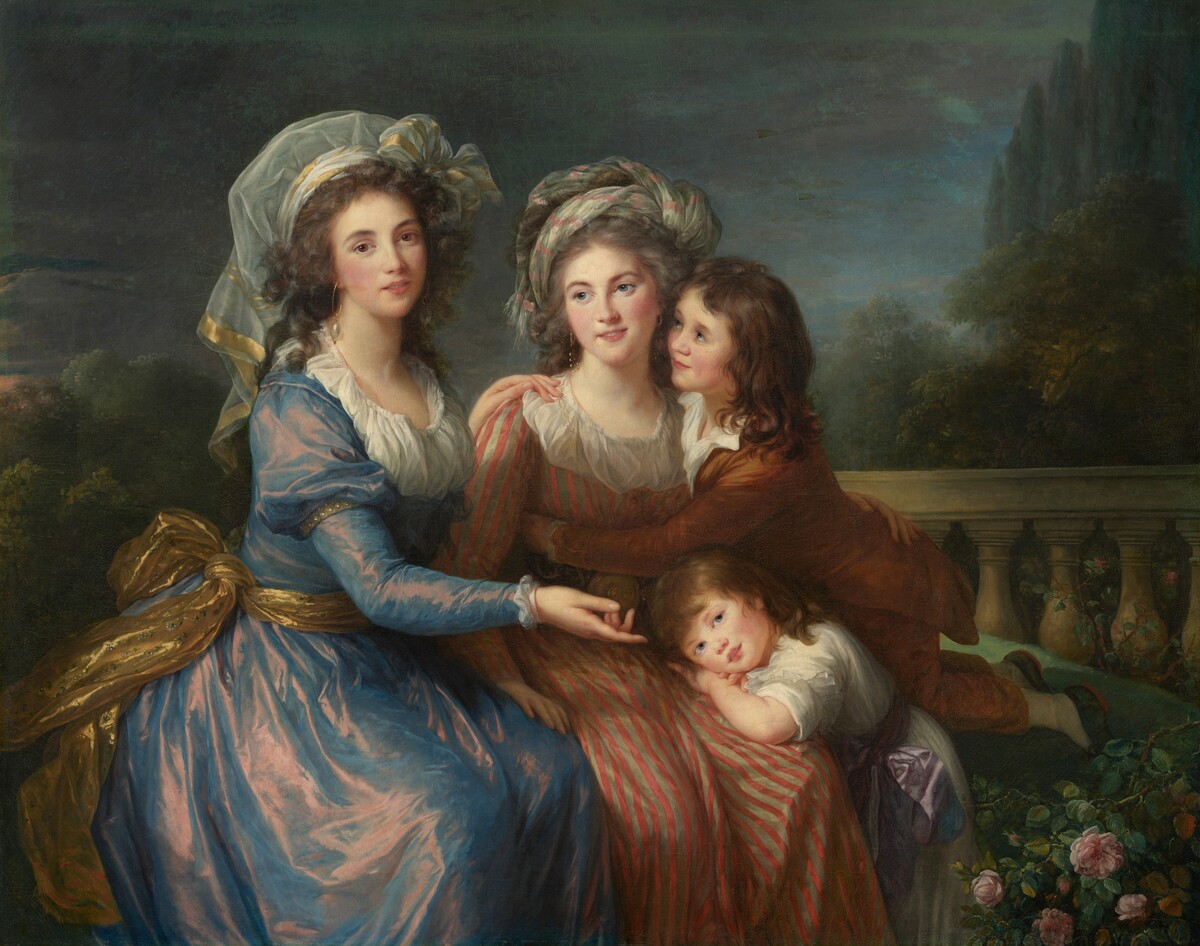
The Marquise de Pezay, and the Marquise de Rougé with Her Sons Alexis and Adrien
1787
Accession Number
1964.11.1
Medium
oil on canvas
Dimensions
overall: 123.4 x 155.9 cm (48 9/16 x 61 3/8 in.) | framed: 177.8 x 203.2 x 19.1 cm (70 x 80 x 7 1/2 in.)
Classification
Painting
Credit Line
Purchased as the Gift of the Bay Foundation in memory of Josephine Bay Paul and Ambassador Charles Ulrick Bay
Tags
Painting Neoclassical & Romantic (1751–1850) Oil Painting Canvas French
Background & Context
Background Story
This double portrait from 1787 is one of Vigée Le Brun's most celebrated works, depicting two aristocratic women—one with her two sons—arranged in a composition that combines the formality of aristocratic portraiture with the intimacy of a domestic group. The arrangement of the figures demonstrates Vigée Le Brun's ability to compose a multi-figure portrait with the same elegance and compositional sophistication that she brought to her single portraits.
Cultural Impact
This double portrait is one of Vigée Le Brun's most important works because it demonstrates her ability to compose a multi-figure portrait with the same elegance she brought to single portraits. The arrangement of two women and two children in a landscape setting creates a composition simultaneously formal and domestic, combining aristocratic formality with maternal intimacy.
Why It Matters
The Marquise de Pezay and the Marquise de Rougé is Vigée Le Brun's multi-figure portraiture at its most elegant: two aristocratic women and their children arranged in a landscape setting that combines formal portraiture with domestic intimacy. The 1787 portrait demonstrates her compositional skill extended beyond single sitters to multi-figure groups.