Provenance
Presumably the collection of the sitter and her family; possibly (Ferol, Paris), c. 1850.[1] Mrs. Stephen Lyne-Stephens [1813-1894, née Yolande-Marie-Louise Duvernay],[2] Lynford Hall, Norfolk, Upper Grove House, Roehampton, and Paris; (her estate sale, Christie, Manson & Woods, London, 9-11 and 13-17 May 1895, 3rd day [May 11], no. 360, sold for 2,250 guineas); (Thos. Agnew and Sons, Ltd., London); sold 13 May 1895 to J. Pierpont Morgan I [1837-1913], London;[3] consigned July 1943 by the Morgan estate to (M. Knoedler & Co., New York); sold October 1943 to (Wildenstein & Co., Inc., New York); purchased 3 January 1944 by the Samuel H. Kress Foundation, New York;[4] gift 1946 to NGA.
[1] According to T. Humphry Ward and William Roberts, _Pictures in the Collection of J. Pierpont Morgan at Prince's Gate & Dover House, London: Dutch & Flemish, French, Italian, Spanish_, 2 vols., London, 1907: unpaginated. Frits Lugt, _Répertoir des catalogues de ventes publiques intéressant l'art ou la curiosité_, 4 vols., The Hague, 1939-1964: 2:nos. 22745 and 25136, records two sales in the 1850s for the dealer Férol, one of 22 January 1856, in which there were paintings, and the second on 7-8 December 1859, composed of prints and books. The NGA portrait was featured in neither.
[2] On the life and career of Mrs. Stephens Lyne-Stephens (earlier in her life, the French ballerina Pauline Duvernay), who was an art collector of considerable stature, see Louis Véron, _Les mémoires d'un bourgeois de Paris_, 6 vols., Paris, 1854; Charles Boigne, _Ces demoiselles de l'opéra_, Paris, 1887: 110-118; Lillian Moore, "Pauline Duvernay," _The Dancing Times_ (January 1934): 449-452; Cyril W. Beaumont, _Three French Dancers of the Nineteenth Century: Duvernay, Livry, and Beaugrand_, London, 1935; Ivor Forbes Guest, _The Romantic Ballet in Paris_, Middletown, Connecticut, 1966.
[3] On p. 34 of the _Saterlee Album_ (New York, Pierpont Morgan Library Archives), there is a photograph of the upstairs drawing room of J.P. Morgan's London home at Princes Gate (see _J. Pierpont Morgan, Collector: European Decorative Arts from the Wadsworth Atheneum_, exh. cat., Wadsworth Atheneum, Hartford, 1987: 32, fig. 7, 35, fig. 10). The painting is included in J.P. Morgan Jr.'s list of Morgan possessions lent to the Metropolitan Museum of Art in 1912 (document in the Morgan Library, box 168, folder 3, p. 143, no. 1347, as the "Portrait of the Marquise de Laborde by Vigée Le Brun...," with the Morgan inventory number 1341); Eliot W. Rowlands, personal communication with Joseph Baillio.
[4] See The Kress Collection Digital Archive, https://kress.nga.gov/Detail/objects/1674.
Accession Number
1946.7.16
Medium
oil on wood
Dimensions
overall: 107 x 83.2 cm (42 1/8 x 32 3/4 in.) | framed: 133.7 x 111.8 cm (52 5/8 x 44 in.)
Classification
Painting
Credit Line
Samuel H. Kress Collection
Tags
Painting Neoclassical & Romantic (1751–1850) Oil Painting French
Background & Context
Background Story
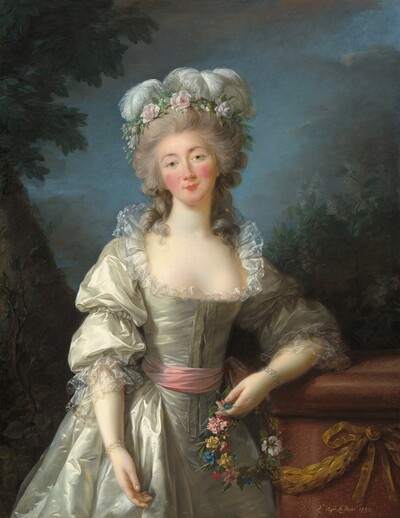
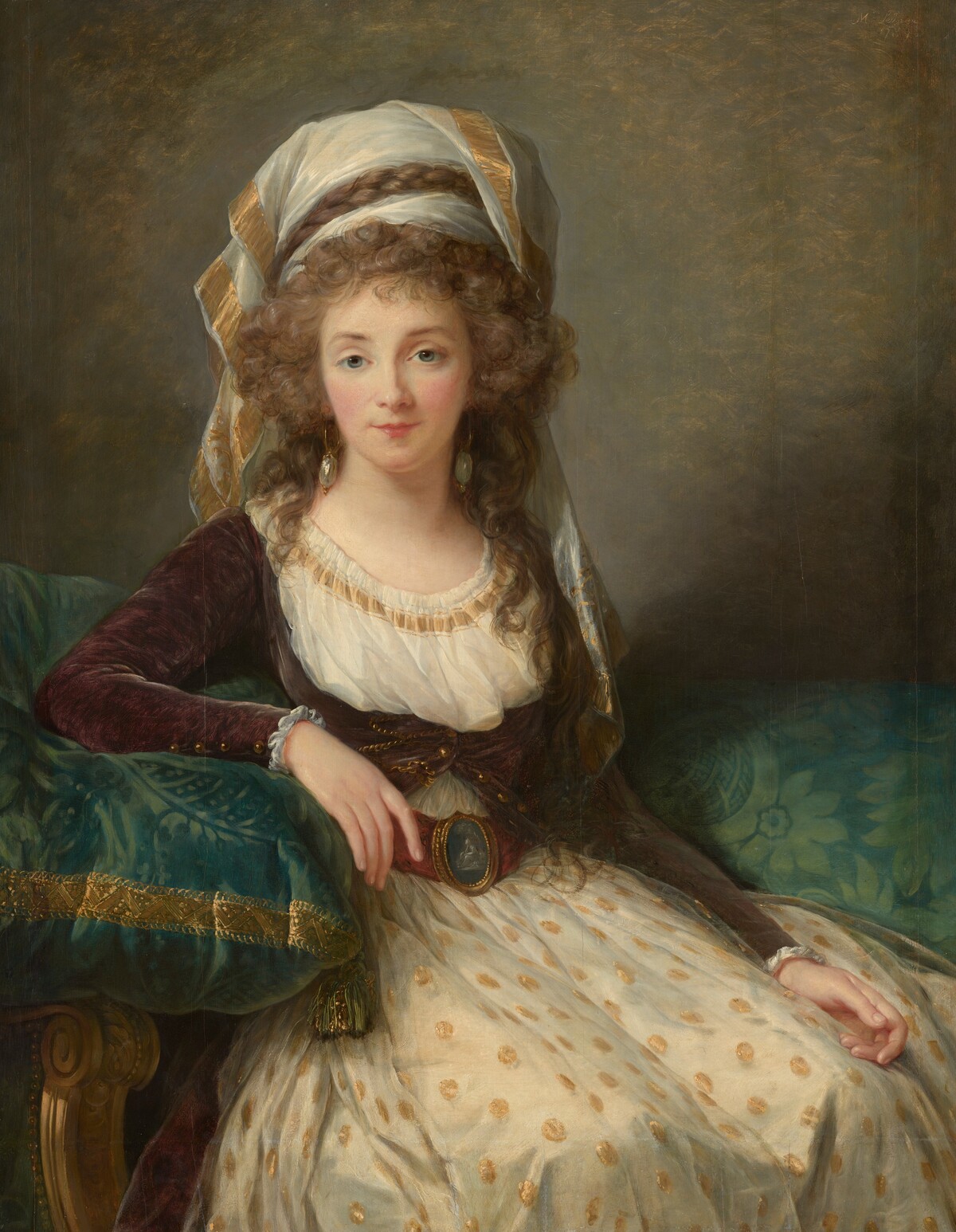
Madame d'Aguesseau de Fresnes from 1789 is one of Vigée Le Brun's most accomplished portraits, painted in the year of the French Revolution. The portrait depicts a member of the French aristocracy with the compositional elegance and tonal subtlety that distinguish Vigée Le Brun's best work, but the 1789 date gives it particular poignancy: the sitter's aristocratic repose would soon be threatened by the Revolution that was gathering force as the portrait was being painted.
Cultural Impact
The 1789 date gives this portrait a particular historical poignancy because it was painted in the year of the French Revolution—the political upheaval that would destroy the world of aristocratic portraiture that Vigée Le Brun had served so successfully. The sitter's aristocratic repose is a last glimpse of the Ancien Régime before the Revolution swept it away.
Why It Matters
Madame d'Aguesseau de Fresnes is Vigée Le Brun's Ancien Régime at its most elegant: an aristocratic portrait painted in 1789, the year of the Revolution that would destroy the world it depicts. The sitter's aristocratic repose is a last glimpse of a social order about to disappear.