Provenance
Possibly the Manfrin collection, Palazzo Venier, Venice.[1] (Count Alessandro Contini Bonacossi, Florence), by 1937; purchased 1939 by the Samuel H. Kress Foundation, New York;[2] gift 1943 to NGA.
[1] Fern Rusk Shapley, _Catalogue of Italian Paintings_, 2 vols., Washington, D.C., 1979: 1:400, listed only "Palazzo Venier," while Jeffery Daniels, _Sebastiano Ricci_, Hove, 1976: 153, gives "Venice, Palazzo Venier, Manfrin." Neither offers any documentation. The Palazzo Priuli-Venier was purchased in 1787 by Count Girolamo Manfrin [d. 1801], a wealthy tobacco producer, who installed his art collection there. The painting does not appear in the _Catalogo dei quadri esistenti nella Galleria Manfrin in Venezia_, Venice, 1856, or in the subsequent sales of Manfrin's daughter Giovanna Plattis (Sambon, Venice, 24-25 May 1870) or granddaughter Lina Plattis-Sardegna (Hôtel Drouot, Paris, 13-14 May 1897). On the collection's history, see the prefaces to the sale catalogues and Giuseppe Tassini, _Alcuni palazzi di venezia storicamente illustrata con annotazioni_, Venice, 1879, 191-192. Neither Tassini nor other nineteenth-century guidebooks mention significant art collections in the other Venier palaces.
[2] According to notations in the Kress records, NGA curatorial files. Expert opinions by Roberto Longhi, William Suida, and Giuseppe Fiocco on the back of photographs from the Kress files, evidently prepared for Contini, are dated Florence, 1937. See also The Kress Collection Digital Archive, https://kress.nga.gov/Detail/objects/2222.
Accession Number
1943.4.32
Medium
oil on canvas
Dimensions
overall: 67 x 104 cm (26 3/8 x 40 15/16 in.) | framed: 85.7 x 122.6 x 8.6 cm (33 3/4 x 48 1/4 x 3 3/8 in.)
Classification
Painting
Credit Line
Samuel H. Kress Collection
Tags
Painting Baroque (1600–1750) Oil Painting Canvas Italian
Background & Context
Background Story
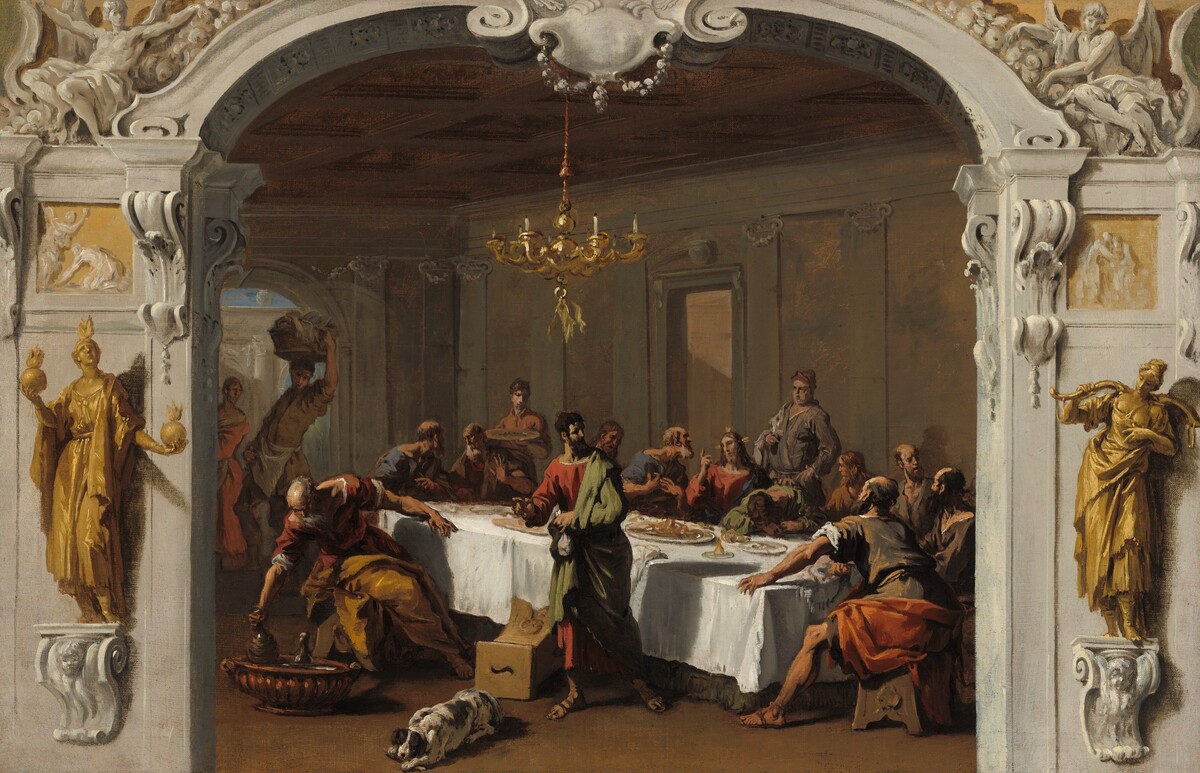
The Last Supper from 1713-1714 is one of Ricci's most important religious paintings, depicting the moment when Christ announces that one of his disciples will betray him. Ricci's treatment combines the dramatic narrative of the Baroque with the luminous color of the Venetian tradition: the disciples react to Christ's announcement with a range of gestures and expressions that create the kind of dynamic composition that Baroque painting demanded, while the lighting and color recall the luminous palette of Veronese's feast paintings. The 1713-14 date places this in Ricci's mature period, when he had fully assimilated the lessons of both Roman Baroque composition and Venetian color.
Cultural Impact
Ricci's Last Supper participates in the tradition of Venetian feast paintings that stretches from Veronese through the 18th century, and its luminous palette and dynamic composition demonstrate Ricci's ability to combine the Venetian color tradition with the Roman Baroque tradition of dramatic narrative. The painting is simultaneously a Venetian feast and a Baroque drama—a combination that defines Ricci's best work.
Why It Matters
The Last Supper is Ricci's Venetian Baroque at its most balanced: the dramatic narrative of Christ's announcement and the disciples' reactions combined with the luminous color and decorative composition of the Venetian tradition. The painting is simultaneously a sacred event and a Venetian feast—a combination that defines Ricci's contribution to 18th-century Italian painting.
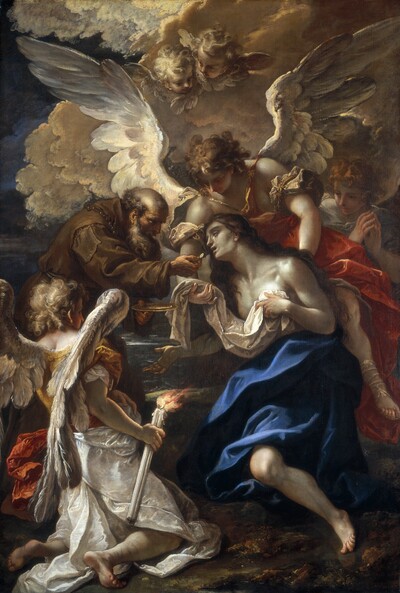
![The Ecstasy of Saint Francis [recto]](https://api.nga.gov/iiif/3df95859-f883-419d-8f1e-2910adce7aac/full/400,/0/default.jpg)
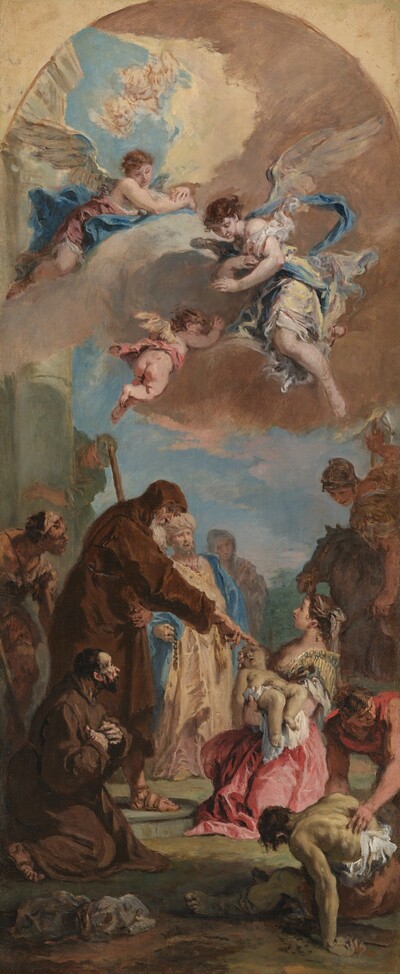
![Biblical Scene [verso]](https://api.nga.gov/iiif/36722160-44a6-48ea-8068-45c3484f550b/full/400,/0/default.jpg)